Posts

Showing posts with the label drama

Phlyax play

Image
A Phlyax play, also known as a hilarotragedy, was a burlesque dramatic form that developed in the Greek colonies of Magna Graecia (southern Italy) in the 4th century BCE. Its name derives from the Phlyakes, “Gossip Players,” in Doric Greek. From the surviving titles of the plays they appear to have been a form of mythological burlesque, which mixed figures from the Greek pantheon with the stock characters and situations of Attic New Comedy. The absence of any surviving script has led to conjecture that they were largely improvised.  Although only a few script fragments have been found, fortunately, such plays were a popular subject of vase paintings from the region. The vases first appeared at the end of the 5th century BCE, but most are 4th century BCE. They depict grotesque characters, the masks of comedy, and the props of comic performance such as ladders, baskets, and open windows. These vase paintings indicate that they were performed on a raised wooden stage with an upper gal...

The Muses

Image
 According to Pausanias, who wrote in the later second century CE, there were originally three Muses, worshipped on Mount Helicon in Boeotia: Aoide ("song" or "tune"), Melete ("practice" or "occasion"), and Mneme ("memory").  The earliest known records of the Muses come from Boeotia and some ancient authorities point to Thrace as the origin of this myth.   Writing in the first century BCE, Diodorus Siculus claims Homer and Hesiod state there are actually nine Muses, though.  According to Hesiod's account (c. 600 BCE), generally followed by most writers of antiquity, the Nine Muses were the nine daughters of Zeus and Mnemosyne (i.e., "Memory" personified), which represented personifications of knowledge and the arts, especially poetry, literature, dance and music.  Ironically, Hesiod says the Muses brought to people forgetfulness, that is, the forgetfulness of pain and the cessation of obligations, though. For poet and ...

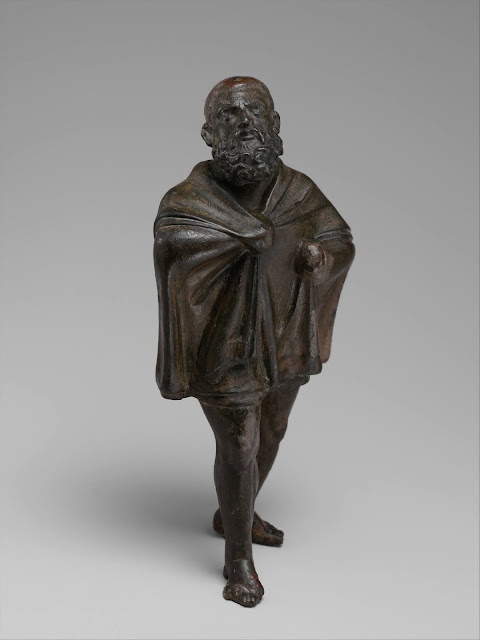
Bronze statuette of a draped man thought to be an actor 1st century BCE - 1st century CE

Image
This impressive statuette shows a mature, bearded man who stands purposefully and looks upward. The cloak that covers his torso also conceals his arms, bent forward over his chest. Proposed identifications have linked him with the theater, specifically as an actor declaiming a text rather than playing a role. - Metropolitan Museum of Art Roman theater began to develop following the devastation of a widespread plague in 364 BCE. Roman citizens began including theatrical presentations as a supplement to the Lectisternium ceremonies, religious propitiatory meals, in a stronger effort to pacify the gods. In the years following the establishment of these practices, actors began adapting these dances and games into performances by acting out texts set to music and simultaneous movement. As the era of the Roman Republic progressed, citizens began including professionally performed drama in the eclectic offerings of the ludi (celebrations of public holidays) held throughout each year—the large...