Posts

Showing posts with the label demon

Deciphering Iconography of a late Classical Period Etruscan sarcophagus

Image
The sarcophagus of Etruscan priest Laris Partunus found in the Tarquinian necropolis was produced in the late Classical Period.  This exquisite sarcophagus crafted of Parian marble is painted with scenes of the Amazonomachy.  The Greeks are shown in hoplite armor while the Amazons are wearing chitons. Surprisingly, the Amazons are depicted winning most of the paired battles instead of an equal number of victories as depicted on the Amazon sarcophagus also from Tarquinia. The Partunus sarcophagus also depicts blue-skinned demons, but unlike the fearsome blue demons seen in the Tomb of the Blue Demons, also in Tarquinia, these figures appear to be gently guiding an aristocratic lady to her family like Greek psychopomps,  creatures, spirits, angels, or deities in many religions whose responsibility is to escort newly deceased souls from Earth to the afterlife.  The painting on the long side of the sarcophagus depicts the execution of Trojan prisoners. They too are accom...

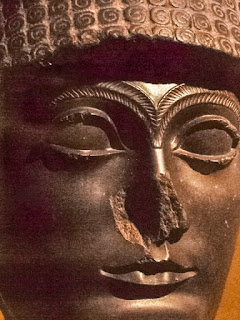
Demon God Protector of Egypt at the NY Carlsberg Glyptotek in Copenhagen, Denmark, May 20 - October 31, 2021

Image
Say the words ‘Egyptian gods’ and it is usually the sun god Ra, Anubis god of the dead or the goddess Isis that spring to mind. These gods were closely associated with the Pharaoh and the upper echelons of Egyptian society. But in ancient Egypt, it was the demon gods that were inextricably linked to the everyday life of Egyptians. The most important of these was Bes, who provided protection against all manner of ills and ailments in ancient Egypt. “The exhibition isn’t just a story about the popular, multifaceted deity Bes, whom very few people today know. Bes provides a unique insight into how the people in general lived, and into the thought and faith of ancient Egypt”, says the Egyptologist and exhibition curator Tine Bagh. “Throughout history, humankind has sought safety and security. In today’s Denmark we have a welfare system to look after us. In ancient Egypt they had Bes.” Bes is easily recognisable. He has short, stumpy legs, his tongue pokes out of his mouth, his beard resemb...

Mesopotamia: Civilization Begins exhibit now open at the Getty Villa in Pacific Palisades, California

Image
The Getty Villa has reopened and is now hosting the special exhibit "Mesopotamia: Civilization Begins."  Some of the objects are from the Metropolitan Museum of Art in New York.  Others are on loan from The Louvre and the Bibliothèque Nationale de France. Ancient Mesopotamia, centered in present-day Iraq, occupies a unique place in the history of human culture. It is there, around 3400–3000 BC, that all the key elements of urban civilization first appear in one place: cities with monumental infrastructure and official bureaucracies overseeing agricultural, economic, and religious activities; the earliest known system of writing; and sophisticated architecture, arts, and technologies. For some three thousand years, Mesopotamia remained the preeminent force in the Near East. In 539 BC, however, Cyrus the Great captured Babylon and incorporated Mesopotamia into the Persian Empire. Periods of Greek and Parthian rule followed, and by about AD 100 Mesopotamian culture had effective...

Miniature from the tomb of Alexander IV

Image
Ivory and gold miniature of the Thracian deity Sabazios from the Tomb of Alexander IV, 311 BCE in Aigai, Macedonia. According to the Archaeological Museum of Aigai, the garments worn by this half-man, half-plant demon-like figure point to Sabazios, a Thracian deity identified with Dionysos.  This hybrid creature, with both Greek and Oriental features, is typical of art of the Hellenistic Period (323-31 BCE).  Celebrating the coexistence and synthesis of different cultures, it reflects the unity Alexander imposed on his empire. This miniature was part of the rich decoration on a couch found in Alexander IV's tomb.  Alexander IV, the son of Alexander the Great, with a Macedonian father and Bactrian mother, was a good example of this unity.  Sadly, he was assassinated at the age of only 12 (others say 14), before he could take his father's throne by an officer of his father's Companion cavalry on the orders of Cassander.  His tomb is thought to be among the royal t...

Cauldron with Siren and Demon Attachments, Bronze, found in the "Midas Mound" at Gordion Turkey, 740 BCE.

Image
Cauldron with Siren and Demon Attachments, Bronze, found in the "Midas Mound" at Gordion Turkey, 740 BCE. This large cauldron, found inside the tomb known as the Midas Mound was likely built by King Midas for his father and was used to store liquids for the funerary feast.  The siren and demon figurines are not only decorative but also symbolic, probably intended to inspire awe and to offer protection to the deceased.  Part of the collections of the Museum of Anatolian Civilizations photographed at the Penn Museum in Philadellphia.  Cauldron with Siren and Demon Attachments, Bronze, found in the "Midas Mound" at Gordion Turkey, 740 BC photographed at the Penn Museum by Mary Harrsch.