Posts

Showing posts with the label death

Golden Mummies of Egypt through July 11, 2021 at the North Carolina Museum of Art in Raleigh, North Carolina

Image
This exhibition uses mummies from the collections of the Manchester Museum (England) to allow visitors to examine life for the wealthy in multicultural Roman Egypt, where diverse Egyptian, Roman, and Greek communities and cultural influences were blended. The exhibition journey traces expectations for the afterlife and introduces cultural constructions of identity, strikingly demonstrated by haunting painted panel portraits. The practices of preservation and decoration of the body, and the transformation of the deceased into a god, are explored by the mummies on display. Eight gilded mummies  and more than 100 related objects are presented in the display, including papyri, jewelry, ceramics, and artworks depicting deities that connect the daily lives of these Greco-Roman Egyptians to the religious world of the gods in a series of lavishly illustrated thematic sections covering the period from 300 BCE to 200 CE. The youngest of the preserved individuals is a 2 or 3 year-old child wr...

Mourning Women, South Italian (Apulian, Canosan), 300-275 BCE Terracotta

Image
Statues of Mourning Women, South Italian (Apulian, Canosan), 300-275 BCE Terracotta, now in the collections of the J. Paul Getty Museum, Villa venue, Pacific Palisades, California This group of mourning women, often understood as female figures in prayer (orantes), was likely produced in the area of Canosa in south-eastern Italy. Although there are considerable differences in terms of clothing, poses and hairstyles, the four statues seem to depict a type of youthful female figure, probably envisioned as one of the mourners who expressed their grief during funerary ceremonies. The group was intended to be placed around a funerary couch (kline), and was probably produced for a fairly prestigious client who, in the context of Romanization in the area, aspired to underscore his economic prosperity, personal identity, and native traditions. The figures were made not with molds, as has been previously conjectured, but rather through a modeling process over a fairly thick conical structure. W...

Etruscan funerary banquet figurines

Image
"The banquet was one of the most popular and consistent funerary motifs in ancient Etruria. The earliest banquet scenes depict people sitting, whereas later representations show banqueters reclining on couches. The deceased is either depicted at a meal or ancestor figures are shown welcoming the newly deceased to the banquet. The characterization of the deceased at a meal is a funerary theme that also finds expression in the earlier tomb groups of the Villanovan period." - Anthony S. Tuck, The Etruscan Seated Banquet: Villanovan Ritual and Etruscan Iconography One of the earliest representations of a seated banquet was found in the Tomb of the Five Chairs at Cerveteri. A terracota figure was originally placed on each of five rock-carved thrones in a side chamber of the cruciform tomb.  Two stone tables were placed in front of the chairs  and classicist F. Prayon further describes the setting as including a large basket, libation table, and a rectangular base used for two addi...

Philoctetes and compassion for Hercules on the Pyre

Image
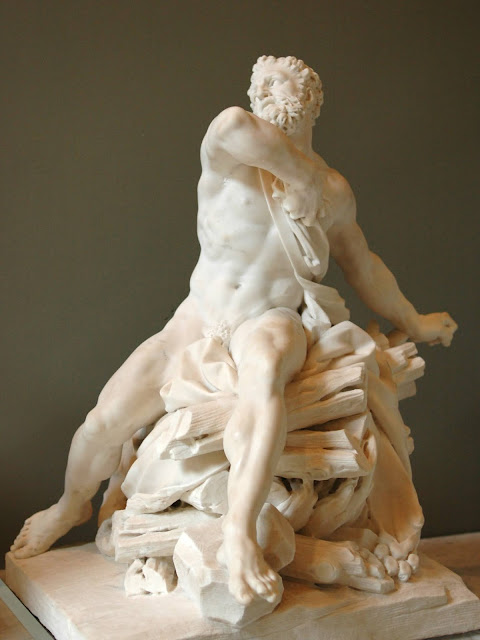
According to the most common legend of Hercules' death, no one but Hercules' friend Philoctetes,  son of King Poeas of the city of Meliboea in Thessaly, would light his funeral pyre. For his compassion, Philoctetes  received Hercules' bow and arrows. Later, Philoctetes as one of the many eligible Greeks who competed for the hand of Helen, the Spartan princess, was required to participate in the Trojan War to reclaim Helen for Menelaus when she was stolen away by Paris.  On his way to the Trojan War, Philoctetes was bitten by a snake that Hera sent to molest him as punishment for his service to Hercules. The wound festered and began to smell so his Greek companions stranded Philoctetes on the island of Lemnos. When the Greeks reached Troy, Helenus, the prophetic son of King Priam, revealed under torture that one of the conditions for the Greeks to win the war was that they needed the bow and arrows of Hercules as some of the arrows were those dipped in the poison bloo...

Insight provided by Roman funerary inscriptions

Image
Insight provided by Roman funerary inscriptions Roman tombstone (PD) Roman Funerary inscriptions on tombstones provide invaluable insight into the lives of ordinary Romans. Funerary inscriptions revealed that many women worked. Many of them were doctors. For example: ‘To the departed spirit of Julia Saturnina, 45 years of age, wonderful wife, excellent physician, most blameless woman. Erected by her husband Cassius Philippus out of gratitude. She lies here, and may the earth rest lightly upon her.’ Other professions attested to women’s tombstones included scribe: ‘To Hapate, short-hand writer of Greek. She lived for 25 years. Pittosus erected this monument to his most affectionate wife,’ or merchant: ‘Thymele, Marcella’s dealer in silk’ or actress: ‘Luria Privata, an actress in mime shows, lived 19 years. Bleptus made this monument.’ The epitaphs of men also illustrated a variety of jobs, from humble laborers like ‘Publius Marcius Philodamus, construction worker, freedman ...

Ptolemaic Greek funerary traditions in Alexandria, Egypt

Image
During the Ptolemaic period a distinctive type of subterranean tomb for multiple burials proliferated in the cemeteries around the city of Alexandria. Underground chambers cut into the living rock radiated from a central courtyard open to the sky. Most chambers contained a number of loculi, long narrow niches cut into the walls, which served as burial slots. Some loculi were sealed with painted limestone slabs in the form of small shrines. Here, a lively depiction of a man trying to bridle a horse, while a boy stands behind him, commemorates a man from Thessaly in Northern Greece, who must have been one of the many foreigners who congregated in the wealthy, cosmopolitan Ptolemaic capital. - Metropolitan Museum of Art Image: Painted limestone funerary slab with a man controlling a rearing horse 2nd half of 3rd century B.C.E. at the Metropolitan Museum of Art

Owls: Symbols of Wisdom or Harbinger of Death

Image
Those of us who study the ancient world are familiar with Athena's owl and its association with wisdom and vigilance but even in the ancient world owls were not always viewed in such a positive light.  Pliny the Elder tells us Rome had to undergo a lustration, a purification of the entire city normally performed at the conclusion of the taking of the census every five years, because an owl found its way into the Capitolia. Pliny describes the owl as a funereal bird, a monster of the night and the very abomination of human kind.  Virgil describes an owl's death-howl as a precursor to Dido's death and Ovid speaks of the bird's presence as an evil omen. Surprisingly, the same viewpoint was held by the Aztecs and Maya who considered the owl a symbol of death and destruction.  The Aztec god of death, Mictlantecuhtli, was often depicted with owls.  The Popol Vuh, a Mayan religious text, describes owls as messengers of Xibalba (the Mayan "Place of Fright").  Later...