Posts

Showing posts with the label cuirass

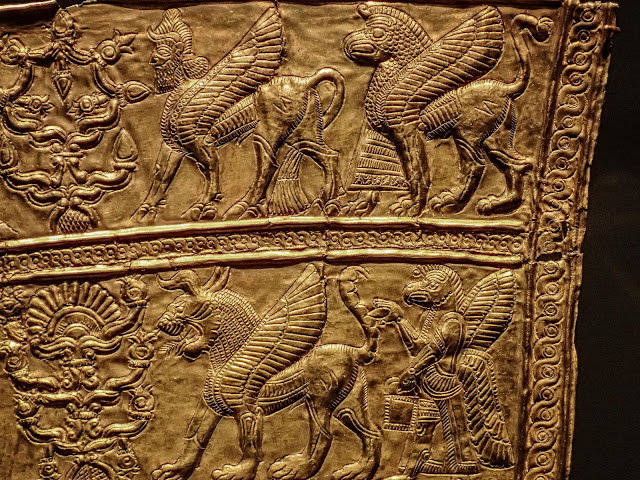
Iron Age III gold cuirass fragments from Northwestern Iran, 8th-7th centuries BCE
Image
In 2015, I had the opportunity to photograph artifacts in the Smithsonian's Sackler Gallery of Asian Art.  In it, I found this spectacular fragment of a gold breastplate dating to the Iron Age III period. Other fragments of this breastplate are today in the Cincinnati Art Museum and in the Royal Ontario Museum in Toronto. Fragments from a second gold breastplate found in the burial mound near the village of Ziwiye are in the Metropolitan Museum of Art and in the National Museum in Teheran. "This is a fragment from the lower part of a much larger pectoral, or breastplate, made of sheet metal and embellished with figures and ornament arranged in horizontal bands. A breastplate shielded the chest from arrows or other weapons. The decoration on this example consists of mythical guardian creatures, whose images were believed to provide magical protection for the wearer." "A pectoral made of thin sheet gold, like this one, would have been attached to a sturdier material, p...

Armor from the original Pyrhhic victory

Image
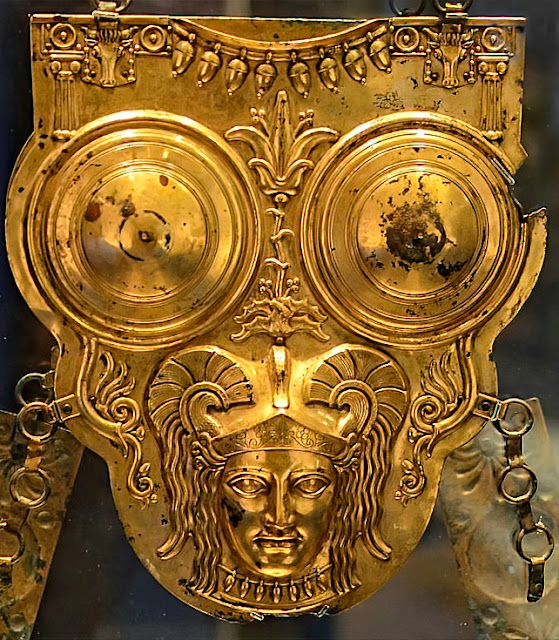
Pyrrhus  was born to prince Aeacides of Epirus, and Phthia, a Thessalian noblewoman, the daughter of the Thessalian general Menon. Aeacides was a cousin of Olympias, making Pyrrhus a second-cousin-once-removed to Alexander the Great. When Aecides father died, he left Epirus to the joint rule of Aeacides and his younger half-brother Neoptolemus. Aeacides supported Olympias in her fight against Cassander and marched on Macedon. When Cassander was ultimately victorious, Epirus became a puppet kingdom of Cassander. Pyrrhus' family fled north and took refuge with Glaukias of the Taulantians, one of the largest Illyrian tribes. Cassander marched against Glaukias, and with his army defeated, Glaukias promised not to act against Cassander, but refused to give up Pyrrhus and his family. By 313 BCE, Cassander was distracted by his war against Antigonus Monophthalmus so Aeacides returned to Epirus and raised a large army. However, Cassander, not that distracted,  sent an army under his b...

Autonomy differences between Carthaginian and Roman commanders

Image
Competition among the elites of Rome in both the political and military spheres is well known. It was also used by one of Rome's most fiercesome opponents as well.  In Carthage, command was sometimes shared between two or even three generals and sometimes commanders were expected to seek approval from the council of 104 and the two suffetes (roughly equivalent to Rome's consuls) for  important decisions such as declaring a truce, to sue for peace, or withdraw from a conflict altogether. Furthermore, punishment of command officers was draconian (in every sense of that word!). It ranged from large fines to crucifixion of the offending general.  Even the families of those committing suicide were not spared humiliation.  Ancient sources record that the council crucified the corpse of one commander named Mago (out of the many men named Mago in the history of Carthage) in 344 BCE.  Scholars think these severe punishments rather than simply a  loss of command may ...

Etruscan panoply of the late 5th to early 4th century BCE

Image
This panoply comprises a matching ensemble of helmet, cuirass, and greave (shin guard), which are rare Etruscan works exemplifying the finest qualities of the form and decoration that characterize the greatest armors made in Etruria during the Classical period. In addition to exhibiting originality of design and exceptional workmanship, this ensemble occupies an important place in the historical development of Etruscan armor. It includes one of the finest Etruscan cuirasses known to survive and a helmet that has no parallels in the Ancient World. Very few Etruscan panoplies appear to have ever included anatomical cuirasses, and among the few specimen known to remain, many are extensively damaged or restored, unlike this example. The helmet, with its delicate embossed, chased, and engraved ornament, and its striking bronze and silver appliqués, is one of the most luxurious examples of a type found only in Etruria, and by far the best preserved representative of this exclusive group. It ...