Posts

Showing posts with the label child

The tragic boy emperor Philip II

Image
Philip II (Latin: Marcus Julius Severus Philippus; 237 – 249CE), also known as Philip the Younger, was the son and heir of the Roman Emperor Philip the Arab by his wife Marcia Otacilia Severa. When his father became emperor in 244, young Philip was appointed caesar at the age of only seven-years-old. In 247, he became consul, and was later elevated by his father to the rank of augustus and co-ruler.  Although ancient historians claim both Philip the Arab and his son were killed in battle by Decius.   Decius was a distinguished senator who had served as suffect consul in 232, had been governor of Moesia and Germania Inferior soon afterwards, served as governor of Hispania Tarraconensis between 235 and 238, and was urban prefect of Rome during the early reign of Emperor Philip the Arab. In 248 or 249 Decius was sent to quell the revolt of Pacatianus and his troops in Moesia and Pannonia, a rebellion seen by some modern historians as emerging Balkan separatism.  After t...

Bronze statuette of a girl holding a puppy, Greek or Roman, 1st century BCE – 2nd century CE

Image
 The Romans favored bronze and marble above all else for their finest work and loved miniatures.  By the mid-1st century CE, Roman sculptors began to move away from emulating their Etruscan and Greek predecessors and sought to capture and create optical effects of light and shade for greater realism.  This trend may well have developed from the tradition of keeping realistic wax funeral masks of deceased family members in the ancestral home.  Although few bronze examples have survived due to a high demand for reuse of the alloy, those that did, like this poignant figurine, portrayed a people who were realistically scarred, wrinkled, or plump, like this healthy-appearing little girl. Sadly (from my viewpoint anyway), towards the end of the Empire, the influence of art from the eastern Mediterranean resulted in figural sculpture with enlarged heads, vacantly staring eyes, and out-of-proportion torsos and limbs such as those seen in works portraying the emperor Constant...

Bronze oil flask depicting a slave with a lantern waiting for his master

Image
A servant waiting to escort his master home was a well-known sculptural subject during the Hellenistic and Roman periods. A Hellenistic terracotta statuette from the Fayum, Egypt provides the earliest known evidence for this type. The subject was particularly popular in Roman times, when marble examples served as fountain sculptures in villa gardens in Pompeii and Syria, and bronze and silver variations were made into luxurious household objects such as inkwells, pepper-castors, and oil flasks. The example of a bronze oil flask included here is from the Roman town of Isurium Brigantum, now known as the Aldborough Roman Site in modern Yorkshire. It was founded in the late first century or early second century by Julius Agricola. This Roman civitas was the administrative center of the Brigantes tribe, the largest and most northerly tribe in Roman Britain. Tacitus recorded that Isuer was the seat of Venutius, king of the Brigantes who was usurped by his wife, Cartismandua (also spelled Ca...

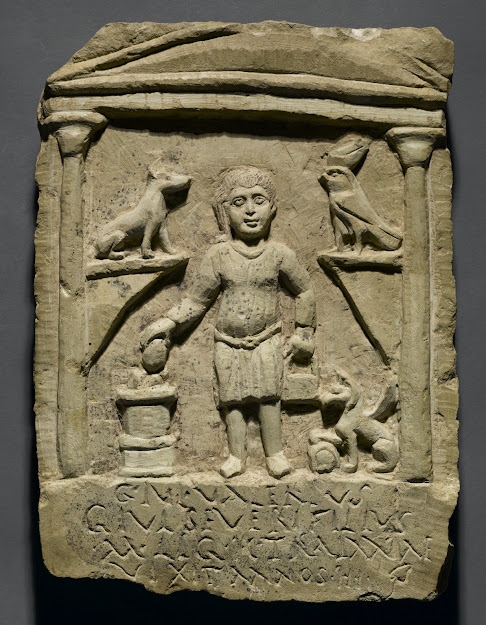
Cultural mingling in the Roman provinces of the 3rd century CE

Image
This funerary stela shows a boy who died when he was three. His father, a Roman soldier, was stationed near Alexandria. His Egyptian mother is not mentioned. The child’s costume and pose are Roman, but his long sidelock of hair is traditionally Egyptian, as are the jackal god Anubis and the falcon god Horus above his head. The griffin in the lower right corner represents the classical goddess Nemesis, who controlled life and death and appears to show Greek influence. In his left hand is a bucket perhaps a type of situla used as a libation vessel.  With his right hand he grasps a circular object, perhaps an offering he is about to place on the small altar. He is probably intended to represent Horus.  The Latin inscription provides the boy's name and age at death.  Extensive but faint traces of bright red paint remain on the hatched background. It is thought this monument was recovered at Terenouthis, Egypt, located in the western Nile Delta, about 70 km northwest of Cairo....

Terracotta group of two girls playing a game known as ephedrismos

Image
The subject of this group with one person carrying another has a long history in Greek art. It is thought to illustrate a game called ephedrismos. A stone was placed upright on the ground, and balls or pebbles were thrown at it from a distance. The loser's eyes were covered, and he had to carry the other player on his back until he found and touched the stone. There were probably a number of variations. Here the little girl carries her companion but does not have her eyes covered. Image: Terracotta group of two girls playing a game known as ephedrismos late 4th–early 3rd century B.C.E. Greek, Corinthian at the Metropolitan Museum of Art in New York courtesy of the museum.

Girl playing astragaloi (knucklebones), from Caelian Hill in Rome, 150 CE, at the Altes Museum in Berlin

Image
This Hellenistic sculpture is one of six Roman copies with a similar theme.  All versions depict a female sitting  on the floor with her legs drawn up, supporting herself with her left hand and just throwing two knuckles ( astragales ) with her right hand.   The subject is dressed in a thin chiton , which has slipped from the left shoulder to the elbow and exposes the left breast. This nudity is thought to have been incorporated by the sculptor to elevate the subject to an ideal, divine level. A version of the sculpture in The Louvre depicts the subject as an adult.  But 17th century restorers substituted a shell for the astragaloi and dubbed the sculpture "Venus with the Shell."  This piece was originally in the collections of the Duke Camillo Borghese and held in the Villa Borghese but when the Duke married Pauline Bonaparte, his new brother-in-law, Napoleon, forced the Duke to sell the work to him.  The more elegant and endearing sculpture of t...

Delicately sculptured head of a Roman child of the 2nd century CE at the Kelsey Museum of Archaeology in Ann Arbor, Michigan.

Image
Delicately sculptured head of a Roman child of the 2nd century CE at the Kelsey Museum of Archaeology in Ann Arbor, Michigan. Romans kept track of the passing of time by celebrating their birthday every year just as we do. These celebrations consisted of wine, garlands of flowers, ritual cakes, and fire on the domestic altar. A child who reached its first birthday (the stage known as anniculus) was able to have legal privileges  and the parents could apply for full Roman citizenship for their child. From the ages of 5 to 7, children were seen to have more rational minds and were expected to take on responsibility around the home such as taking care of the animals, gathering materials, and general chores around the house. Also during these years, children were considered to be aware of social and sexual roles and children’s groups were organized by gender at that time. The age of 5 was around the end of what was considered to be the infant stage (infantia). At this age Romans...