Posts

Showing posts with the label chariot

Usil: Etruscan God of the Sun
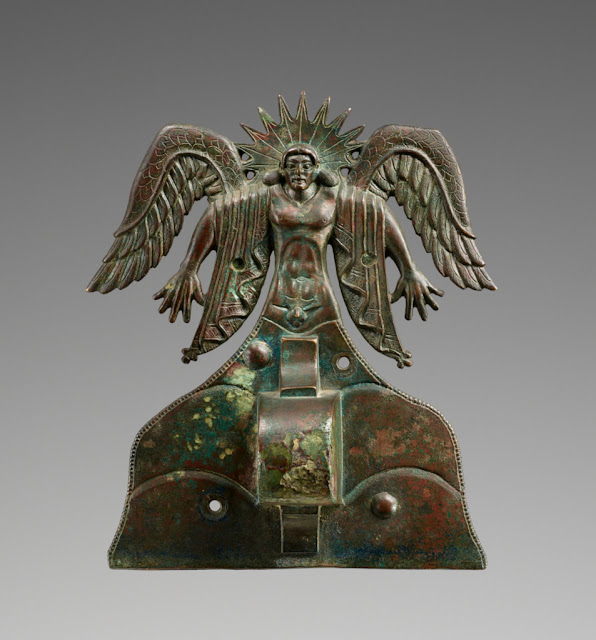
Image
Usil, the Etruscan god of the sun, is equated with the Greek and Roman Helios/Sol Invictus. Appliques depicting the god usually depict the deity with spread wings and a nimbus of rays surrounding his head which is also adorned with a diadem.  On such a plaque obtained by the J. Paul Getty Museum, the figure merges into a broad plate decorated with undulating lines, suggesting the sea from which the sun emerges at daybreak and sinks at dusk.  "Ornamental reliefs such as this functioned as fittings on funeral carts and chariots, which often accompanied the burials of Etruria’s equestrian elite. Probably affixed to the sides of the vehicle, the winged god reflects the imagery of a celestial divinity driving the chariot of the sun across the sky, which was common in Greek and later Etruscan art. The earliest Usil plaque, in the Vatican Museums, was reportedly found at Roma Vecchia between 1760 and 1775 and was illustrated by Francesco Piranesi in 1778. In 1845, four similar plaque...

The Roman nature of Neptune

Image
Some scholars argue that Indo-European people, having no direct knowledge of the sea as they originated from inland areas, reused the theology of a deity originally either chthonic or wielding power over inland freshwaters for the god of the sea as contact was made with seafaring peoples. They then paired him with Salacia, the goddess of saltwater who subsequently came to represent the virile force of Neptune.  This conclusion was arrived at by the numerous findings of inscriptions mentioning Neptune in the proximity of such locations. Servius the grammarian also explicitly identified Neptune as the deity in charge of all the rivers, springs, and waters. Before the 1st century BCE, the Romans thanked the god Portunus or Fortunus for naval victories, but Neptune supplanted him in this role by at least the first century BCE when Sextus Pompeius, younger son of Pompey Magnus, called himself "son of Neptune."  Like Poseidon, Neptune was also worshipped by the Romans as a god of h...

Etruscan bronze chariot depicting scenes from the life of Achilles, 4th century BCE, in an exhibit in the Palazzo dei Conservatori at the Musei Capitolini

Image
I ran across these images of this fascinating chariot while researching the Roman cavalry relief in the Capitoline Museum.  I've photographed the beautiful Monteleone Etruscan chariot at the Metropolitan Museum of Art in New York dated to 530 BCE but have never seen this one before. Over 300 ancient chariots are known to still exist but only six are reasonably complete. Surprisingly, the chariot was actually invented to provide a moving platform from which soldiers could shoot at enemies with arrows or javelins before mounted cavalry was introduced into ancient warfare.  Scholars think the horses were initially weaker and unable to support a man.  They were eventually bred to be stronger until they could be mounted and rode about a millennium and a half after the chariot was invented. The first reference to chariots was found in Syria and dated to about 1800 BCE.  Scholars claim on suitable terrain the chariot was an effective weapon and the number of chariots compar...

Etruscan chariots

Image
Silver panel, perhaps from a parade chariot or piece of furniture, overlaid with electrum and decorated in repoussé relief with two riders, perhaps taking part in a horse-race, with a fallen comrade below, Etruscan, 540-520 BCE, found in the Castel San Mariano near the city of Perugia. Perguia, first called Perusia in the ancient sources, was one of the 12 confederate cities of Etruria.  The league was mostly an economic and religious league, or a loose confederation, similar to the Greek states.  The historical Etruscans had achieved a state system of society, with only remnants of the chiefdom and tribal forms used by surrounding Italics. The government was viewed as being a central authority, ruling over all tribal and clan organizations and wielding the power of life and death. The gorgon was revered as an ancient symbol of that power, and frequently appeared as a motif in Etruscan decoration. The individual referred to as a "fallen comrade" in this Archaic period relief ...

Triumphal regalia

Image
 In Republican Rome, truly exceptional military achievement merited the highest possible honors, which connected the vir triumphalis ("man of triumph", later known as a triumphator) to Rome's mythical and semi-mythical past. Triumphs were tied to no particular day, season, or religious festival of the Roman calendar. Most seem to have been celebrated at the earliest practical opportunity, probably on days that were deemed auspicious for the occasion. Tradition required that, for the duration of a triumph, every temple was open. The ceremony was thus, in some sense, shared by the whole community of Roman gods, but overlaps were inevitable with specific festivals and anniversaries.  The dates selected for some triumphs may have been coincidental with other official festivals while others were maneuvered to coincide. For example, March 1, the festival and dies natalis of the war god Mars, was the traditional anniversary of the first triumph by Publius Valerius Publicola (504...

Chariots in ancient warfare

Image
 The origin of the chariot is not definitively documented but it is thought to have been a technology developed in the Eurasian steppe by cultures such as the Sintashta, a Middle Bronze Age civilization dating to the period 2200-1800 BCE.  The earliest remains of chariots have been found in Sintashta burials. Russian archaeological analysis indicates the preceding Abashevo culture was already marked by endemic intertribal warfare. Intensified by ecological stress and competition for resources in the Sintashta period, this drove the construction of fortifications on an unprecedented scale and innovations in military technique such as the invention of the war chariot.   Many Sintashta graves are furnished with weapons, although the composite bow associated later with chariotry does not appear. The Sintashta economy included the production of copper from ore in nearby mines  and arsenical bronze, that uses arsenic rather than tin, which was smelted on an industrial...

The Oxus Treasure and the challenges of provenance

Image
The Oxus Treasure is a collection of about 180 surviving pieces of metalwork in gold and silver from the Achaemenid Persian period which were found by the Oxus river about 1877-1880.  The metalwork is believed to date from the sixth to fourth centuries BCE and is thought to belong to a temple where votive offerings were deposited over a long period. Sculptural objects include two model chariots in gold, one incomplete, plus figures of a horse and a rider that may belong to this or other model groups, as may two other horses cut out from sheet gold. The wheels of the complete chariot would originally have turned freely, and it had received at least one repair in antiquity. It is pulled by four horses (rather small, and with only nine legs surviving between them) and carries two figures, a driver and a seated passenger, both wearing torcs. The chariot has handrails at the open rear to assist getting in and out, while the solid front carries the face of the protective Egyptian dwarf-...

Before the Gracchi - Lycurgus of Sparta: Early Land Reformer and Father of the Great Rhetra

Image
Lycurgus was the quasi-legendary lawgiver of Sparta who established the military-oriented reformation of Spartan society in accordance with the Oracle of Apollo at Delphi. All his reforms promoted the three Spartan virtues: equality (among citizens), military fitness, and austerity and were contained in an oral constitution known as the Great Rhetra. According to Herodotus, at some time before the reigns of Leon of Sparta and Agasicles about 590 BCE, the Spartans "had been the very worst governed people in Greece" until Lycurgus consulted the Delphic oracle and was provided with an entire constitution which Lycurgus took back and implemented. Lycurgus was the younger son of the Eurypontid king, Eunomus. He was thus passed over for the throne in favor of his brother, Polydectes, but the latter died. Although Lycurgus was offered the throne, his dead brother's wife was pregnant so Lycurgus became regent for the child when it was born. But Polydectes' wife and her rel...

Gold earring with Nike driving a two-horse chariot, Greek, at the Museum of Fine Arts Boston

Image
Gold earring with Nike driving a two-horse chariot at the Museum of Fine Arts Boston. This beautifully detailed earring dates from 350 - 325 BCE. Wearing a belted chiton (tunic), a full-length skirt, and several items of jewelry, Nike, the granddaughter of Poseidon, leans forward, her left hand pulling on the reins of the horses, whose front legs rear sharply. In Greek mythology, Nike flew around battlefields rewarding the vi ctors with glory and fame, symbolized by a wreath of laurel leaves. When Zeus was assembling allies for the Titanomachy against the older deities, Nike assumed the role of the divine charioteer, in which she is often portrayed in Classical Greek art like this exquisite piece of jewelry. The features on the goddess's face are crisp and her expression resolute, while the animals appear startled and tense. Raised as if in flight, Nike's elaborate, feathery, and finely chased wings provide an elegant counterbalance to the dynamic composition. The ornament ...

Bronze Etruscan chariot inlaid with ivory, 2nd quarter of the 6th century BCE at the Metropolitan Museum of Art in New York

Image
Bronze Etruscan chariot inlaid with ivory, 2nd quarter of the 6th century BCE at the Metropolitan Museum of Art in New York. On the Italian peninsula, the largest number of chariots come from Etruria and the surrounding regions. They are datable between the second half of the eighth and the fifth centuries B.C. and represent several varieties. None seems to h ave been used for fighting in battle. Most came to light in tombs; after serving in life, they were buried with their owners, male and also female. The Monteleone chariot belongs to a group of parade chariots, so called because they were used by significant individuals on special occasions. They have two wheels and were drawn by two horses standing about forty-nine inches (122 centimeters) apart at the point where the yoke rests on their necks. The car would have accommodated the driver and the distinguished passenger. The shape of the car, with a tall panel in front and a lower one at each side, provided expansive surfaces fo...

Dangerous Beauty: Medusa in Classical Art: Through January 2019 at the Metropolitan Museum of Art, New York City

Image
Dangerous Beauty: Medusa in Classical Art: Through January 2019 at the Metropolitan Museum of Art, New York City - This heavy metal ornament, decorated with the head of Medusa and inlays of silver and copper, probably comes from a currus triumphalis (ceremonial chariot) used in processions rather than a lightweight racing chariot.  Roman.  1st - 2nd century CE.  Image courtesy of the Metropolitan Museum of Art in New York City, New York. Beginning in the fifth century B.C., Medusa, the snaky-haired Gorgon whose gaze turned men to stone, became increasingly anthropomorphic and feminine, undergoing a visual transformation from grotesque to beautiful. A similar shift in representations of other mythical female half-human beings, such as sphinxes, sirens, and the sea monster Scylla, took place at the same time. Featuring 60 artworks, primarily from The Met collection, this exhibition explores how the beautification of these terrifying figures manifested the idealizing...