Posts

Showing posts with the label ceramic

Red-figured fish plates of the 5th century BCE

Image
Throughout my travels to various museums around the world I have often encountered red-figured fish plates. First developed in Athens, these beautifully detailed serving pieces became especially popular in South Italy and Sicily in the 400s BCE. I stumbled across this excellent video about them and learned that fish plates produced in Magna Graecia were usually more colorful with white accents and the fish are portrayed with their bellies facing inwards towards the small central depression that is thought to have contained dipping sauce like garum. Fish on plates produced in Athens are painted with their bellies facing outwards. I thought this is quite a peculiar style difference.  There also seems to be disagreement among scholars as to whether these plates were actually used in everyday life or produced for funerary purposes only, as almost all of the 1,000 examples that have been recovered came from ancient burials. Art historian Lucas Livingston points out that many of the reco...

Spartan black-figured kylix with horseman, birds, and a winged figure, possibly Nike (Victory), attributed to the Rider Painter, 550-530 BCE

Image
 As I was looking through the images I took at the British Museum in 2016, I saw this drinking cup and wondered about the symbolism depicted on it.  Although the horseman could be just any mounted warrior and not a mythical hero, that would be unusual during the 6th century.  Although the Spartan kings during this time period were accompanied by 300 royal guards called hippeis (cavalrymen),  they were actually infantry hoplites like all Spartiatai. The Spartans did not utilize a cavalry of their own until late into the Peloponnesian War (431-404 BCE), when small units of 60 cavalrymen were attached to each mora (unit of 576 men composed of four lochoi of 144 men each).  This cup was produced, though, about the time of earliest contact between the Greeks and the Celts which occurred around the Greek colony of Massalia in 600 BCE. Celtic elites traded for wine, drinking vessels, and other status symbols with merchants from Greece and Etruscan Italy. Perhaps Celtic...

Figure Vase of Woman Holding Dog, New Kingdom, Dynasty 18, 1479-1353 BCE at the Brooklyn Museum

Image
Throughout the mid-Eighteenth Dynasty, a small group of potters, perhaps members of a single workshop, fashioned charming vessels in human and animal forms. They shaped the two halves of each container in open molds and joined the pieces along the sides. Complex details such as arms were created by hand and applied to the molded pieces. The potters then covered the vessel with a red slip (a mixture of clay and water) and polished the surface. This example depicts a servant woman carrying a small dog, perhaps the honored pet of her master or mistress. - Brooklyn Museum Note: I wonder what aspect of the figure points to the woman being a servant? (I'm not as familiar with Egyptian art as Roman art!) Image: Figure Vase of Woman Holding A Dog, New Kingdom, Dynasty 18, 1479-1353 BCE that I photographed at the Brooklyn Museum.

Ancient Art of Mesoamerica

Image
Mesoamerica gave rise to a group of stratified, culturally related agrarian civilizations spanning an approximately 3,000-year period before European arrival.  This assortment of ancient cultures that shared religious beliefs, art, architecture, and technology included the Olmec, Teotihuacan, Maya, Zapotec, Mixtec, Huastec, Purepecha (also known as the Tarascans), Toltec, and Mexica/Aztecs.  These indigenous civilizations built pyramid-temples, and developed mathematics,  astronomy, medicine, a unique writing system, highly accurate calendars, fine arts, intensive agriculture, engineering, an abacus calculator, and complex theology.  Their number system was base 20 and included zero.  While many city-states, kingdoms, and empires competed with one another for power and prestige, they consolidated power and distributed influence in matters of trade, art, politics, technology, and theology.  Evidence of trade routes starting as far north as the Mexico Central...

Creative art at the birth of democracy

Image
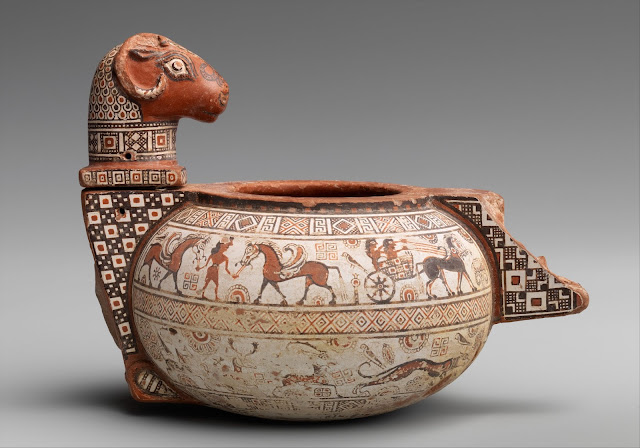
Terracotta cosmetic vase 4th quarter of the 6th century B.C.E. Archaic Period East Greek at the Metropolitan Museum of Art in New York On one side of the upper frieze of this exquisite vase, a youth holds two winged horses and two youths drive a chariot. Real and imaginary animals circulate on the other frieze areas between carefully drawn geometric patterns. The ram's-head cover may have served as a handle for a cosmetic applicator. In this period, there was huge economic development in Greece, and also in its overseas colonies which experienced a growth in commerce and manufacturing. There was a great improvement in the living standards of the population. Some studies estimate that the average size of the Greek household, in the period from 800 BC to 300 BCE, increased five times, which indicates a large increase in the average income of the population. In the second half of the 6th century BCE, Athens fell under the tyranny of Peisistratos and then of his sons Hip...

Heron-Shaped Aryballos (oil vessel), 580 BCE Miletus, Greece at the Cleveland Art Museum in Cleveland, Ohio

Image
Heron-Shaped Aryballos (oil vessel), 580 BCE Miletus, Greece at the Cleveland Art Museum in Cleveland, Ohio.  In the 6th century BC, a particular type of vessel for scented oil was produced in Corinth, Rhodes, and along the western coast of Asia Minor. Primarily animal forms, they are made of unglazed fired clay with painted decoration. This example in the form of a heron was crafted by a Milesian potter. The bird rests with its delicately curving and counter-curving neck nearly touching the ground; the feathers are defined by incision and painted black slip.  Miletus was settled around 1000 BCE.  By 600 BCE, Miletus had become a wealthy center of trade exchanging goods and ideas with the cities of Egypt, Persia and Western Greece.  Greece was not yet a political entity at the time, but shared a Homeric culture with other Greek city states. Greek philosophers Thales, Anaximander and Anaximenes were all from Miletus. Image: Ceramic Heron-Shaped Aryballos 580 B...

Sacrificial objects from the Purification Pit of Mykonos. Ongoing. At the Archaeological Museum of Mykonos, Greece.

Image
Sacrificial objects from the Purification Pit of Mykonos.  Ongoing. At the Archaeological Museum of Mykonos, Greece.  Pithos from the Purification Pit of Mykonos depicting the fall of Troy.  7th century BCE.  Image courtesy of  travel-to-mykonos.com These 5th - 7th century BCE artifacts were unearthed in an archaeological excvation known as  the Purification Pit in 1898 .  They include pithoi, large storage jars used for liquids and grain, depicting scenes from the Capture of Troy.  The body of one pithos is enclosed with panels depicting soldiers going on an offensive against innocent women and children. Scholars believe the pithos is dated back to the 7th century BCE.   The collection also includes pictoral grave steles, a nude Heracles in lion skin with club, and the Archaic Hydria which is embellished with intricately designed floral pattern and images of horses.

Archaeological discoveries in Tehran, Iran. Ongoing. At the National Museum of Iran in Tehran, Iran.

Image
Archaeological discoveries in Tehran, Iran. Ongoing. At the National Museum of Iran in Tehran, Iran.  An exhibition, featuring archaeological discoveries of ancient relics in Tehran, has opened its doors to the public at the National Museum of Iran. The exhibition includes artifacts from the urban area of Tehran that date back to 8,000 years B.P. Objects on display include distinctive spouted ceramic vessels excavated beneath the grand bazaar. If you can't make it to Iran, I highly recommend visiting the collection of artifacts from the ancient Near East at the Los Angeles County Museum of Art in Los Angeles, California. Above is a colorful spouted jar from western Iran on display there. It is dated 1000 to 800 BCE.