Posts

Showing posts with the label bull

The Storm God of the Hatti then Hittite
Image
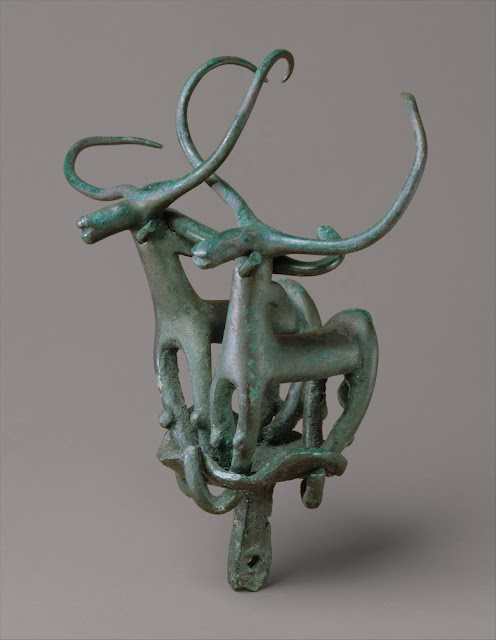
During the early Bronze Age the Hatti, who were neither Semitic nor Indo-European, inhabited central Anatolia. They were actually distinct from the Hittite but as the Hittite expanded beginning about 2000 BCE, the Hatti were gradually absorbed into the Hittite political and social order.  The Hatti were organized in monarchical city-states. These states were ruled as theocratic kingdoms or principalities. Hatti regions of Anatolia came to be influenced by mighty Mesopotamian polities, in the form the Akkadian Empire (24th-22nd century BCE) and the succeeding Old Assyrian Empire (21st-18th century BCE), both of which set up trading colonies called karum, located throughout eastern and central Anatolia. During the first centuries of the 2nd millennium BCE, an Assyrian trade colony existed in the city of Hattush, and several Assyrian inscriptions mention the existence of local rulers (kings) of Hattush, also referring to their relations with other city-states in the region. Fortunatel...
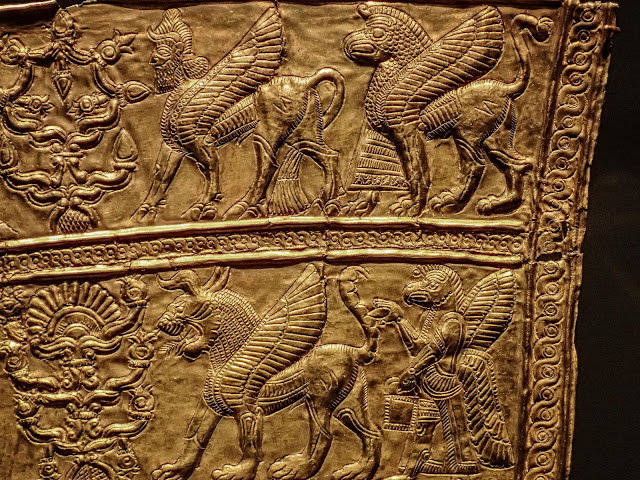
Iron Age III gold cuirass fragments from Northwestern Iran, 8th-7th centuries BCE

Image
In 2015, I had the opportunity to photograph artifacts in the Smithsonian's Sackler Gallery of Asian Art.  In it, I found this spectacular fragment of a gold breastplate dating to the Iron Age III period. Other fragments of this breastplate are today in the Cincinnati Art Museum and in the Royal Ontario Museum in Toronto. Fragments from a second gold breastplate found in the burial mound near the village of Ziwiye are in the Metropolitan Museum of Art and in the National Museum in Teheran. "This is a fragment from the lower part of a much larger pectoral, or breastplate, made of sheet metal and embellished with figures and ornament arranged in horizontal bands. A breastplate shielded the chest from arrows or other weapons. The decoration on this example consists of mythical guardian creatures, whose images were believed to provide magical protection for the wearer." "A pectoral made of thin sheet gold, like this one, would have been attached to a sturdier material, p...

Heracles and the Cretan Bull

Image
According to Jeremy McInerney, the iconography of the bull permeates Minoan culture. The cult of the bull was also prominent in southwestern Anatolia. Bernard Clive Dietrich notes that the most important animal in the Neolithic shrines at Çatalhöyük was the bull. The bull was a chthonic animal associated with fertility and vegetation. It figured in cave cults connected with rites for the dead.   According to Greek myth, to confirm his right to rule, King Minos of Crete prayed to Poseidon to send him a snow-white bull as a sign. Poseidon sent Minos the bull, with the understanding that bull would be sacrificed to the god. Deciding that Poseidon's bull was too fine of a specimen to kill, Minos sent the bull to his herds and substituted another, inferior bull for sacrifice. Enraged, Poseidon had Aphrodite cause Pasiphaë, wife of Minos, to fall in love with the bull. She subsequently gave birth to the half-man, half-bull, Minotaur. Poseidon passed on his rage to the bull, causing ...

Pre-Achaemenid art: Neo-Assyrian or Median?

Image
The Medes were an ancient Iranian people who spoke the Median language and who inhabited an area known as Media between western and northern Iran. Around the 11th century BCE, they occupied the mountainous region of northwestern Iran and the eastern region of Mesopotamia located around Hamadan (Ecbatana). Herodotus reports the Medes played a determining role in the fall of the Assyrian Empire and "could" have  formed an empire at the beginning of the 7th century BCE that lasted until the 550s BCE. It was originally thought they competed with the kingsoms of Lydia and Babylonia for hegemony.  However, the Medes left no written account of their history.  Archaeologists have had to rely upon foreign sources such as the Assyrians, Babylonians and Greeks for Median history, instead, as well as a few Iranian archaeological sites, which are believed to have been occupied by Medes. Some scholars have gone so far as to suggest a Median kingdom as a political entity never existed a...

Part of a throne with deity on a bull, ca. late 8th–7th century B.C.E., Urartian

Image
Assyrian inscriptions of Shalmaneser I (c. 1274 BCE) first mention Uruartri as one of the states of Nairi, a loose confederation of small kingdoms and tribal states in the Armenian Highlands in the thirteenth to eleventh centuries BCE which he conquered. It extended from northeastern Turkey into northwestern Iran with its cultural center around Lake Van. Its settlements were palace-fortresses that protected agricultural production and supported many crafts, especially an extensive metalworking industry.  The Nairi states were repeatedly subjected to further attacks and invasions by the Middle and Neo-Assyrian Empires.  But Urartu, united under King Arame (860-843 BCE),  reemerged in Assyrian language inscriptions in the ninth century BCE as a powerful northern rival to the Neo-Assyrian Empire. Urartologist Paul Zimansky speculated the Urartian ruling class were few in number and governed over an ethnically, culturally, and linguistically diverse population. This diversity...

Achelous and the origins of the Horn of Plenty

Image
 In ancient Greek religion and mythology, the god Achelous (also Acheloos or Acheloios) was associated with the Achelous River, the largest river in Greece. According to Hesiod, he was the son of the Titans Oceanus and Tethys. He was also said to be the father of the Sirens, several nymphs, and other offspring. Achelous was able to change his shape, and in the form of a bull, he wrestled Heracles for the right to marry Deianeira, daughter of the king of Calydon, but lost.  This myth is retold in a 7th century BCE poem by Archilochus.  In the 5th century BCE, Pindar claimed Heracles broke off one of Achelous's horns, and the river-god was able to get his horn back by trading it for a horn from Amalthea, foster mother of Zeus. In his play, Women of Trachis, Sophocles relates Deianeira's account of the courtship: "For my suitor was a river-god, Achelous, who in three shapes was always asking me from my father—coming now as a bull in visible form, now as a serpent, sheeny and...

Pre-Achaemenid, Greek, Roman, Egyptian and ancient Asian art at the Miho Museum in Sigaraki, Japan.

Image
Pre-Achaemenid, Greek, Roman, Egyptian and ancient Asian art at the Miho Museum in Sigaraki, Japan. The Miho Museum is located southeast of Kyoto, Japan, near the town of Shigaraki. Among the objects in its 2,000-piece permanent collection are more than 1,200 objects that appear to have been produced in Achaemenid Central Asia. Some scholars have claimed these objects are part of the famous Oxus Treasure, lost shortly after its  discovery in 1877 and rediscovered in Afghanistan in 1993, although both the Miho and British Museum's material from this period point to unique findspots. In addition to the Persian objects, the museum houses Roman, Greek, and Egyptian antiquties as well as art from ancient China, Japan, and southeast Asia. Image: 1 ) Vessel with Bull Attacked by a Lion Pre-Achaemenid Period 8th-6th centuries BCE. The wounded bull is extremely serene, looking more as though the lion was embracing him. This vessel symbolizes the order of the cosmos, as the t...

Remains of ancient Octodurus at the Pierre Gianadda Foundation Museum in Martigny, Switzerland

Image
Remains of ancient Octodurus at the Pierre Gianadda Foundation Museum in Martigny, Switzerland. Octodurus was originally an oppidum of the Gallic Veragri tribe and was located on the route to the strategic pass of Poeninus (now known as Great St. Bernard's Pass) in the Swiss Alps. It was conquered by the Roman Republic in 57 BCE then occupied by Servius Galba and the 12th legion. While wintering there, Galba's legion was atta cked by a Gallic force of more than 30,000 warriors. Although the Battle of Octodurus is considered a Roman victory, one third of the village was destroyed during the battle and Galba burned the remainder when he retreated. Octodurus was rebuilt and during the reign of Claudius was designated a new Roman colony named Forum Claudii Augusti then renamed Forum Claudii Vallensium Octodurensium and became the capital of Vallis Poenina Province. Roman remains include an amphitheater that was restored in 1978 and the forum. The museum itself was constructed o...