Posts

Showing posts with the label Yemen

Art of Ancient Yemen

Image
Ancient Yemen was composed of a number of regional kingdoms including the Minaeans in the north in Wādī al-Jawf, the Sabeans on the southwestern tip, stretching from the highlands to the sea, the Qatabānians to the east of them, and the Ḥaḑramites east of them.  They were all engaged in the spice trade, especially frankincense and myrrh. They left behind many inscriptions in the monumental ancient South Arabian script or Musnad, as well as numerous documents in the related cursive Zabūr script.  Scholars disagree about their origins with some claiming these kingdoms arose about 1200 BCE.  Others say they did not begin to flourish until the 8th century BCE and lasted until they were conquered by the Himyarites.  The Himyarite Kingdom conquered neighbouring Saba' for the first time in c. 25 BCE, Qataban in c. 200 CE, and Haḍramaut c. 300 CE. The Middle Saba' kingdom rose in the early 2nd century CE with its capital established at Ma'rib. Himyar's fortunes relative to S...

Ancient Art of the Mediterranean. Ongoing at the Seattle Art Museum in Seattle,

Image
Ancient Art of the Mediterranean. Ongoing at the Seattle Art Museum in Seattle, Washington. The permanent collection of ancient art at the Seattle Art Museum includes a wide variety of sculpture, ceramics, glass, reliefs, portraiture, utilitarian objects, and funerary art from Egypt, Mesopotamia, Greece, and Rome. Alabaster head of a Qatabanian (Roman Arabia Felix - ancient Yemen) 3rd - 1st century BCE. The large eye cavities once held typical Near Eastern inlays. Photographed at the Seattle Art Museum, Seattle, Washington.

A Glimpse of Ancient Yemen’ – Through Aug. 18, 2019 at the Smithsonian's Sackler Gallery in Washington D.C.

Image
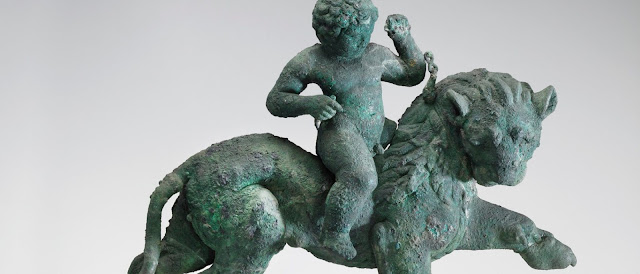
A Glimpse of Ancient Yemen’ – Through Aug. 18, 2019 at the Smithsonian's Sackler Gallery in Washington D.C. Erote mounted on a striding lion, Bronze, 1st century BCE - 1st century CE Kingdom of Qatabān (ancient Yemen) courtesy of the Sackler Gallery in Washington, D.C. This exhibit highlights south Arabia (now known as Yemen) and its prosperous trading during ancient times. Aromatics such as frankincense and myrrh came from the region to Greece, Rome and Persia, which in turn spread artistic and cultural traditions in Arabia. The exhibit features objects that were retrieved from the region in the early 1950s, by the so-called "American Lawrence of Arabia", Wendell Phillips, painting a detailed picture of an ancient metropolis. I had the opportunity to view this small but fascinating collection when I visited Washington D.C. in 2015. Phillips' excavation party was attacked by warring tribesmen and barely managed to save just a few of the items his team rec...