Posts

Showing posts with the label Vulci

Usil: Etruscan God of the Sun
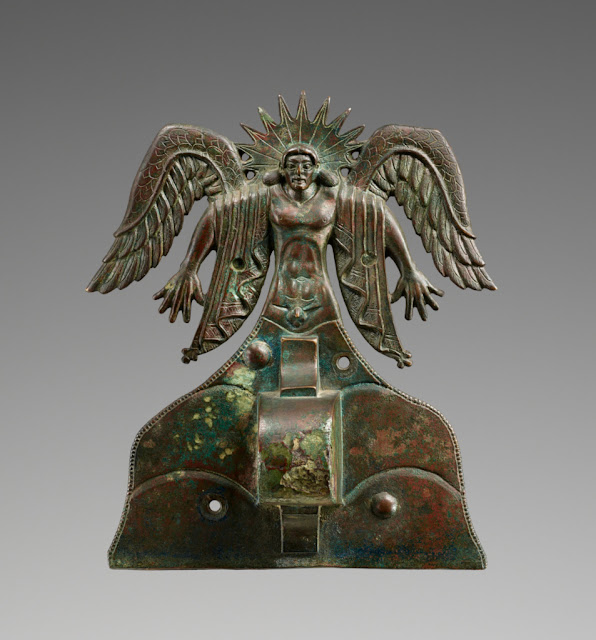
Image
Usil, the Etruscan god of the sun, is equated with the Greek and Roman Helios/Sol Invictus. Appliques depicting the god usually depict the deity with spread wings and a nimbus of rays surrounding his head which is also adorned with a diadem.  On such a plaque obtained by the J. Paul Getty Museum, the figure merges into a broad plate decorated with undulating lines, suggesting the sea from which the sun emerges at daybreak and sinks at dusk.  "Ornamental reliefs such as this functioned as fittings on funeral carts and chariots, which often accompanied the burials of Etruria’s equestrian elite. Probably affixed to the sides of the vehicle, the winged god reflects the imagery of a celestial divinity driving the chariot of the sun across the sky, which was common in Greek and later Etruscan art. The earliest Usil plaque, in the Vatican Museums, was reportedly found at Roma Vecchia between 1760 and 1775 and was illustrated by Francesco Piranesi in 1778. In 1845, four similar plaque...

Etruscan Bucchero Ware

Image
Bucchero ware, distinguished by its glossy black surface, was produced by the Etruscans in central Italy between the 7th and 5th centuries BCE. The first appearance of a ceramic type that can clearly be classified as bucchero occurred around 675 BCE at the coastal community of Caere (the modern-day Cerveteri), with somewhat later centers of production to be found at Veii and Tarquinia, both cities, like Caere, located in the southern part of the Etruscan heartland. Although the shapes of Villanovan pots provided the basics for the Etruscan potters, they added new types and forms largely inspired through intensified trade with the more advanced cultures at the eastern end of the Mediterranean, in particular the areas of Cyprus, Syria, and Phoenicia, as well as Egypt. Many of the new, exotic shapes were in imitation of the metalwares imported from these cultures. The potters of Etruria were able to offer their customers a locally produced and less-expensive ceramic equivalent to the desi...