Posts

Showing posts with the label Villa dei Papiri

A goat and satyr "Buried by Vesuvius" at the Getty Villa until October 28, 2019
Image
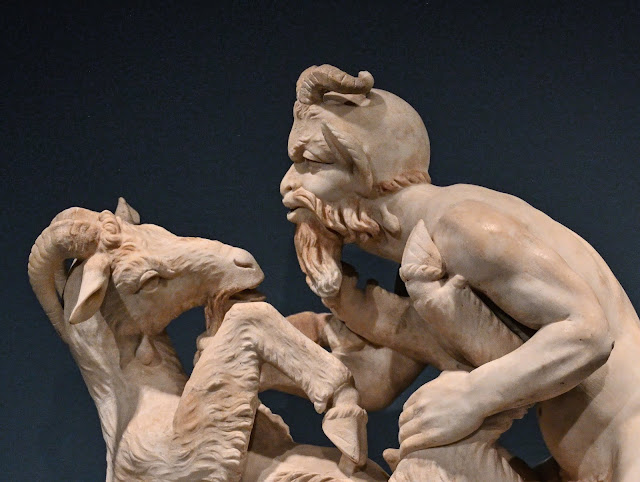
A goat and satyr "Buried by Vesuvius" at the Getty Villa until October 28, 2019. The marble sculpture of the woodland god Pan having intercourse with a she-goat was discovered in the Villa dei Papiri in 1752. It immediately became notorious and was long off-limits, viewable only in the vaults of the royal palace at Portici by special permission of the king. Explicit imagery was common in antiquity. S ome modern commentators have interpreted this sculpture as evidence of the Romans’ reverence for the generative power of sex. Others have seen it as a satire on the bestial nature of all men. As many of the sculptures in the villa seem to have been grouped thematically, it is tempting to link this work with busts found nearby such as the Macedonian king Demetrios Poliorketes, often depicted with horns, like Pan, and famously dissolute. The satyr and goat were found on the south side of the rectangular peristyle on March 1, 1752. Image: Closeup of Satyr and goat found...

Philetairos of Pergamon "Buried by Vesuvius" at the Getty Villa until October 28, 2019

Image
Philetairos of Pergamon "Buried by Vesuvius" at the Getty Villa until October 28, 2019. Philetairos, 343 –263 BCE, was the founder of the Attalid dynasty of Pergamon in Anatolia. After the death of Alexander the Great in 323 BCE, Philetairos became embroiled in the struggle for supremacy, called the Wars of the Diadochi, between Alexander's generals. Philetairos served first under Antigonus then shifted his allegiance to Lysim achus who, after Antigonus was killed at the Battle of Ipsus in 301 BCE, made Philetairos commander of Pergamon, where Lysimachus kept a treasury of nine thousand talents of silver. Philetairos served Lysimachus until 282 BCE when court intrigues prompted him to desert Lysimachus and offer himself and the important fortress of Pergamon, along with its treasury to Seleucus. Seleucus subsequently defeated and killed Lysimachus at the Battle of Corupedium in 281 BCE. But, Seleucus himself was subsequently killed by Ptolemy Ceraunus, the brother-in-...

Woman Wearing a Peplos, possibly Demeter or Hera, "Buried by Vesuvius" at the Getty Villa until October 28, 2019.

Image
Woman Wearing a Peplos, possibly Demeter or Hera, "Buried by Vesuvius" at the Getty Villa until October 28, 2019. Exploration of the Villa dei Papiri was abandoned in 1764. Its tunnels were backfilled and its precise location underground was forgotten despite the ever-growing fame of its contents. Renewed interest in the site in the 1980s led to limited excavations in the 1990s and 2000s, which brought to light a portion of the bu ilding’s atrium as well as lower levels that were unknown in the eighteenth century. Among the new discoveries were rooms with colorful mosaic floors and spectacular frescoed walls and stuccoed ceilings. Finds also included a seaside pavilion and swimming pool, where archaeologists recovered two marble sculptures and luxurious wood and ivory furniture components. These recent excavations helped clarify the chronology of the villa, which is now thought to have been built around 40 BCE, with the seaside pavilion added around 20 CE. Reconstructe...

Bronze female piglet "Buried by Vesuvius" at the Getty Villa through October 28, 2019.

Image
Bronze female piglet "Buried by Vesuvius" at the Getty Villa through October 28, 2019. This sculpture of a female piglet from the Villa dei Papiri likely celebrated the Epicurean ideals of its owner. It was found at the east corner of the rectangular peristyle on May 17, 1756. In antiquity, as today, calling someone a “pig” was generally an insult, but the followers of Epicurus enthusiastically appropriated  the term. The Roman poet Horace referred to himself as “a pig from the sty of Epicurus” - sleek, fat, and well cared for. The statesman Cicero, meanwhile, explained that in Epicurus’s philosophical doctrine, “every animal, as soon as it is born, seeks pleasure and delights in it as the greatest good, while avoiding pain as the greatest evil.” - J. Paul Getty Museum Images of a female piglet recovered from the Villa dei Papiri in Herculaneum courtesy of Allan Gluck.

The Runners "Buried by Vesuvius" at the Getty Villa through October 28, 2019

Image
The Runners "Buried by Vesuvius" at the Getty Villa through October 28, 2019. A pair of bronze runners were found at the west end of the rectangular peristyle of the Villa dei Papiri in Herculaneum on October 1, 1754. Each was assembled from seven separately cast pieces: head, torso, arms, legs, and genitals. Although they were likely produced in the same workshop, analysis of their alloys shows that they were cast from diffe rent batches of metal, and subtle variances in their measurements indicate that they were not made from identical molds. One figure, with its head slightly turned, is somewhat larger than the other, suggesting that the other was modeled after it - clay molds made from this statue would have shrunk when drying. The details of the hair of the larger sculpture are also more precise. Images: "The Runners" recovered from the Villa dei Papiri in Herculaneum and photographed at the Getty Villa, Roman, 1st century BCE - 1st century C...

Female philosopher "Buried by Vesuvius" through October 28, 2019 at the Getty Villa

Image
Female philosopher "Buried by Vesuvius" through October 28, 2019 at the Getty Villa. "This woman wearing a double fillet (headband) is often identified as the poet Sappho, but her unlayered himation (mantle) was commonly worn by male philosophers. Given the Epicurean aspect of the Villa dei Papiri’s contents, it is tempting to identify her as a follower of the philosopher Epicurus, who admitted women into his school . Epicurus praised one of his female pupils in particular, a former courtesan named Leontion. If this identification is correct, the ancient display of this bust near that of Seleukos (left) juxtaposed a king and military commander with a philosopher, perhaps contrasting the active life of a ruler with the contemplative life of an Epicurean. " - J. Paul Getty Museum The sculpture was found at the north corner of the rectangular peristyle on August 23, 1758. The sculpture is Roman and dated between the 1st century BCE and the first century CE. ...

Two versions of Silenus "Buried by Vesuvius" at the Getty Villa through October 28, 2019

Image
Two versions of Silenus "Buried by Vesuvius" at the Getty Villa through October 28, 2019. These two silens, aged companions of the wine god Bacchus, were part of a group of four displayed around the central pool of the Villa dei Papiri’s atrium. Water issued from the wineskin and the mouth of the panther. For the erudite owners of the villa and their cultured  visitors, these statuettes may have brought to mind Greek poems describing fountain figures in the form of satyrs. One poem, attributed to Plato, reads: “A cunning master wrought me, the satyr, son of Bacchus, divinely inspiring the monolith with breath . . . Instead of purple wine I now pour forth pleasant water.” - J. Paul Getty Museum Images: Silenus with a Wineskin found near the impluvium in the atrium of the Villa dei Papiri on December 18, 1754. Silenus with a Panther also found near the impluvium in the atrium on the same date. Both figurines are Roman bronze 1st century BCE - 1st century CE. Photo...

Archytas or just a man in a turban "Buried by Vesuvius" at the Getty Villa until October 28, 2019

Image
Archytas or just a man in a turban "Buried by Vesuvius" at the Getty Villa until October 28, 2019. This figure with a mature face, bulging brow, and turban was at first identified as Archytas, an ancient Greek philosopher from Tarentum, in southern Italy. Archytas was famous for his knowledge of astronomy and his skill in mechanics, and was said to have built a wooden bird that could fly. Today the portrait’s identification is  considered uncertain, but the man probably represents a philosopher or poet, perhaps from the East. The figure was originally depicted with a bare chest. His clothing was added in the eighteenth century and bears the three-rosette mark of the Neapolitan royal foundry that was responsible for restoring finds from Herculaneum. This bust was found at the east corner of the square peristyle of the Villa dei Papiri on November 6, 1753. Image: Man wearing a turban possibly Archytas or some other poet or philosopher from the east recovered from t...

Apollo's twin sister Artemis "Buried by Vesuvius" at the Getty Villa until October 28, 2019

Image
Apollo's twin sister Artemis "Buried by Vesuvius" at the Getty Villa until October 28, 2019. The goddess Artemis was the daughter of Zeus, king of the gods, and the Titaness, Leto. Artemis was one of the most widely venerated of the Ancient Greek deities and her temple at Ephesus was one of the Seven Wonders of the Ancient World. In this incarnation of her, traces of copper inlay remain on the lips and she once had inset eyes.  Parts of the nose, chest, and drapery are eighteenth-century restorations. The figure has been variously identified as the Ptolemaic queen Berenike, the poet Sappho, and an Amazon. Her identification as the goddess Artemis is based on comparisons to other works, as well as the bust’s findspot near an image of Artemis’ twin brother, Apollo . This sculpture is larger and more naturalistic than the archaic style of Apollo's sculpture, however. She was found at the east end of the rectangular peristyle of the Villa dei Papiri on April 29, 1756....

Apollo, also known as the Kouros Pisoni, "Buried by Vesuvius" at the Getty Villa until October 28, 2019

Image
Apollo, also known as the Kouros Pisoni, "Buried by Vesuvius" at the Getty Villa until October 28, 2019. One of approximately 90 sculptures in bronze and marble that once adorned the Villa dei Papiri, Apollo, also known as the Kouros Pisoni, is depicted in the archaic style rather than the Hellenistic style that dominates most of the art from the villa. Upon its discovery, scholars identified this bust as an Archaic Greek origi nal from the sixth century BCE on account of its stiff, stylized appearance. More recent analysis, however, suggests that it may be an ancient forgery of an Archaic work: its bronze and copper alloy parallels that of later bronzes, its ragged edges were deliberately cast to appear broken, and drip marks on the back betray attempts to make it look antique. The once hollow eyes were filled and painted in the eighteenth century. It was found at the east end of the rectangular peristyle of the Villa dei Papiri in 1756. Image: Apollo, also know...

Archidamus III, King of Sparta, "Buried by Vesuvius" at the Getty Villa until October 28, 2019

Image
Archidamus III, King of Sparta, "Buried by Vesuvius" at the Getty Villa until October 28, 2019. Archidamus III, the son of Agesilaus II, was king of Sparta from 360 BCE to 338 BCE. Archidamus headed the force sent to aid the Spartan army after its defeat by the Thebans at the Battle of Leuctra in 371 BCE. Four years later he captured Caryae, ravaged the territory of the Parrhasii and defeated the Arcadians, Argives and Messeni ans in the "tearless battle", so called because the victory did not cost the Spartans a single life. In 362 BCE, he showed great courage in the defense of Sparta against the Theban commander Epaminondas. In 343 BCE, the Spartan colony Tarentum asked for Sparta's help in the war against the Italic populations, notably the Lucanians and the Messapians. In 342 BCE Archidamus arrived in Italy with a fleet and mercenary army and fought against the barbarians. But in 338 BCE he was defeated and killed under the walls of Manduria. Im...

Two of five Appiades from the Villa dei Papiri in Herculaneum on view in the exhibit "Buried by Vesuvius" at the Getty Villa through October 28, 2019

Image
Two of five Appiades from the Villa dei Papiri in Herculaneum on view in the exhibit "Buried by Vesuvius" at the Getty Villa through October 28, 2019.  Two of five life-size statues of women were found  in the southwest colonnade of the Villa dei Papiri’s rectangular peristyle between April 1754 and October 1756.  Although they have been called priestesses, nymphs, actresses, carriers of baskets (kistophoroi), jars (kanephoroi), and water (hydrophoroi), and, more recently, Danaids, the mythical daughters of King Danaios who were condemned eternally to fill broken water jars in the Underworld, recent research suggests they are based on a famous sculptural group of the “Appiades,” mythical nymphs of the Aqua Appia, Rome’s first aqueduct. The original Appiades group, sculpted by the Greek artist Stephanos, once decorated a fountain in the forum of Julius Caesar in Rome. Given the strong association of the Villa dei Papiri with the father-in-law of Caesar, it seems plausib...

Dynamic bust of Seleukos I Nikator at the "Buried by Vesuvius" exhibit at the Getty Villa through October 28, 2019.

Image
Dynamic bust of Seleukos I Nikator at the "Buried by Vesuvius" exhibit at the Getty Villa through October 28, 2019.  Seleukos I Nikator (the Victor) was one of the Diadochi (the rival generals, relatives, and friends of Alexander the Great who fought for control over his empire after his death). Having previously served as an infantry general under Alexander the Great, he established the Seleucid Empire over much of the territory in the Near East which Alexander had conquered. Seleukos was involved in a number of wars and conspiracies among his fellow Diadochi but eventually brought the whole eastern part of Alexander's empire as far as the Jaxartes and Indus Rivers under his authority.   In the year 305 BCE, Seleukos went to India and occupied territory as far as the Indus, waging war with the Maurya Emperor Chandragupta. But the campaign was a failure. Seleukos eventually reached an agreement with Chandragupta exchanging territory for 500 war elephants.  It is a...

A contemplative Priapus, son of Dionysus and Aphrodite at the Getty Villa exhibit "Buried by Vesuvius" through October 28, 2019

Image
A contemplative Priapus, son of Dionysus and Aphrodite at the Getty Villa exhibit "Buried by Vesuvius" through October 28, 2019. In Greek mythology, Priapus was a minor rustic fertility god, protector of livestock, fruit plants, gardens and male genitalia as well as the patron of merchant sailing. Although Priapus is usually depicted in erotic imagery, the bust of the god found in the Villa dei Papiri portrays a much different  aspect of the deity and was displayed alongside busts of poets and philosophers. Originally worshiped by Greek colonists in Lampsacus in Asia Minor, the cult of Priapus spread to mainland Greece and eventually to Italy during the 3rd century BCE. Lucian tells us that in Bithynia, Priapus was accounted as a warlike god, a rustic tutor to the infant Ares. Pausanius says this god is worshiped where goats and sheep pasture or there are swarms of bees - but by the people of Lampsacus he is more revered than any other god, being called by them a son of D...

Selected Sculptures from the exhibit Buried by Vesuvius, Treasures from the Villa dei Papiri through October 28, 2019 at the Getty Villa In Pacific Palisades, California

Image
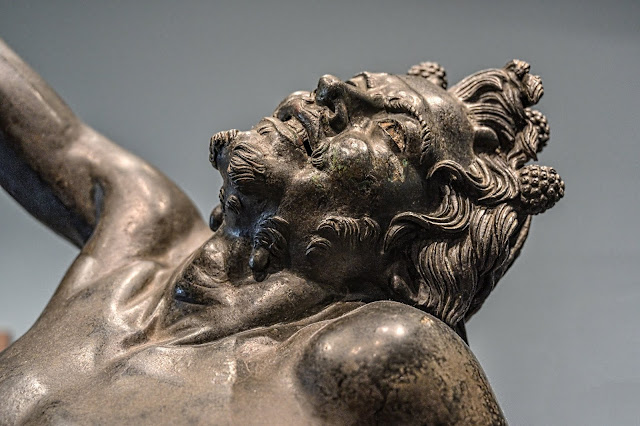
Selected Sculptures from the exhibit Buried by Vesuvius, Treasures from the Villa dei Papiri through October 28, 2019 at the Getty Villa In Pacific Palisades, California. A large collection of bronze and marble statuary as well as a thousand papyrus scrolls were rediscovered in the 1750s and 1760s when the ancient villa on the cliffs adjacent to the town of Herculaneum was excavated from the volcanic debris of the eruption of Mount Vesuvius in 79 CE.  For the next few days, we will examine some of these art objects that are featured in the current exhibit.  First of the objects is the famous drunken satyr, a replica of which basks in the sun in the Getty's large reflection pool in the outer peristyle.  Of the 65 statues and busts found at the archaeological site, the Drunken Satyr is considered the most impressive.  The statue did not emerge from the 80 feet of volcanic rock and debris  intact, however.  The right arm and left hand had become detached, a...