Posts

Showing posts with the label Trajan

The Phrygian cap in Greek and Roman art

Image
The Phrygian cap later known as a liberty cap is a soft conical cap with the apex bent over, associated in antiquity with several peoples in Eastern Europe and Anatolia, including Phrygia, Dacia, and the Balkans.  By the 4th century BCE (early Hellenistic period) the Phrygian cap was associated with Phrygian Attis, the consort of Cybele, the cult of which had by then become graecified. At around the same time, the cap appears in depictions of the legendary king Midas and other Phrygians in Greek vase-paintings and sculpture. The Phrygian cap also came to be applied to several other non-Greek-speaking peoples ("barbarians" in the classical sense). Most notable of these extended senses of "Phrygian" were the Trojans and other western Anatolian peoples, who in Greek perception were synonymous with the Phrygians, and whose heroes Paris, Aeneas, and Ganymede were all regularly depicted with a Phrygian cap.  While the Phrygian cap was of wool or soft leather, in pre-Helle...

Relief depicting a deified Trajan's posthumous Parthian triumph in 118 CE, from Praeneste at the Museo Archeologico Nazionale Palestrina

Image
There have been multiple theories proprosed for Trajan's war with Parthia that began in 113 Ce with the pretext that Rome disapproved of a puppet king placed on the throne of Armenia by the Parthians.  Some scholars point to the propaganda value of an Eastern conquest that would emulate, in Roman fashion, those of Alexander the Great.  An expansionist policy was supported by a powerful circle of conservative senators from Hispania, first among them being the all-powerful Licinius Sura as well.  I've previously discussed theories about attempts to balance trade relations with India.  Some scholars, though, think Trajan's original aims were purely military and quite modest: to assure a more defensible Eastern frontier for the Roman Empire, crossing Northern Mesopotamia along the course of the Khabur River in order to offer cover to a Roman Armenia.  Whatever the motivation, Trajan succeeded in placing a client king on the Parthian throne and if he had lived to re...

More than 5,000 years of history through art at the Museum Het Valkhof in Nijmegen, Netherlands

Image
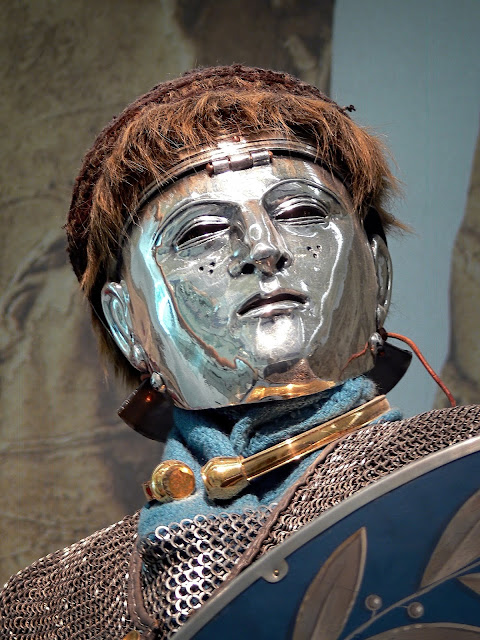
More than 5,000 years of history through art at the Museum Het Valkhof in Nijmegen, Netherlands. For four centuries, Nijmegen was the largest and most important location of the Romans in the region now known as The Netherlands. Highlights include the limestone pillar of the gods from the beginning of the era, the face helmets from the first century, many masterpieces of crafts from Roman tombs from the first to the fourth cent uries, a bronze portrait head of Emperor Trajan from Xanten, a silver drinking cup (kantharos) from Stevensweert and a bronze shield button from Blerick. Artifacts from prehistory and the Middle Ages are also on display. Images: 1) Modern reconstruction of a Roman cavalry helmet found on the Kops Plateau circa 150 CE courtesy of Wikimedia Commons contributor Wolfgang Sauber. 2) Nijmegen cavalry helmet, an iron mask sheathed in bronze and silver discovered in 1915 on the left bank of the Waal river near Nijmegen, second half of the first century CE...