Posts

Showing posts with the label Sparta

The aspis and rise of the Argives

Image
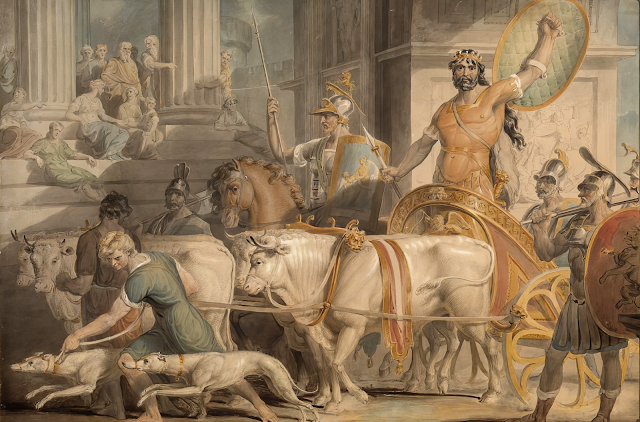
The ancient city of Argos was inhabited as far back as 7,000 years ago.   Argos experienced its greatest period of expansion and power, though, under the energetic 7th century BCE ruler, King Pheidon.  Pheidon was said to have been a descendant of Heracles through Temenus. Pheidon seized the throne from the reigning aristocracy with the support of the lower classes.  He was a vigorous and energetic ruler and greatly increased the power of Argos. Under Pheidon, Argos regained sway over the cities of the Argolid and challenged Sparta’s dominance of the Peloponnese. Spartan dominance is thought to have been interrupted following the Battle of Hyssiae in 669-668 BCE, in which Argive troops defeated the Spartans in a hoplite battle. The Argive army was already equipped at the time with a deeply dished wooden shield called the aspis which is thought to have given the Argives an advantage over the Spartans.  The revolutionary part of the shield was, in fact, the grip. ...

The Anthropological Implications of Laconian Art

Image
When scholars seek to show the role of Spartan austerity in the evolution of artistic production, they often limit themselves to objects of luxury and high prestige, supposedly condemned by the egalitarian civic ideology of the homoioi.  This raises the question, then,  of who among Spartan citizens actually produced the art.  Did Spartan citizens participate or was the art produced by the "perioikoi," a group of residents, sometimes referred to as mercenaries, living within the body of Lacedaemonians but not equal to Spartiates and yet distinct from the oppressed helots. Classicist Conrad M. Stibbe thinks we should also consider a third possibility, that Laconian art production was not a privilege of one social class or another but rather a branch of artistic industry open to all inhabitants of Laconia, whether free, less free, or unfree. Stibbe poses that archaic Sparta of the seventh and sixth centuries BCE was an open society in which artists of all kinds could freely...

Not all Spartans were warriors

Image
Although Sparta is renowned for its military prowess, there were Spartan poets, sculptors, magistrates, ambassadors, and governors as well as soldiers.  Originally, however, full citizen Spartiates were barred by law from trade or manufacture, which consequently rested in the hands of the Perioikoi, free peoples who did not enjoy full citizen-rights but were not subjected to the restrictions of helots.  Perioikoi served partly as a kind of military reserve, partly as skilled craftsmen and partly as agents of foreign trade - actually rather similar to the roles of freedmen in Roman society. Spartans were prohibited from possessing gold and silver coins, and according to legend Spartan currency consisted of iron bars to discourage hoarding. It was not until the 260s or 250s BCE that Sparta began to mint its own coins. Though the conspicuous display of wealth appears to have been discouraged, this did not preclude the production of very fine decorated bronze, ivory and wooden wor...

Spartan black-figured kylix with horseman, birds, and a winged figure, possibly Nike (Victory), attributed to the Rider Painter, 550-530 BCE

Image
 As I was looking through the images I took at the British Museum in 2016, I saw this drinking cup and wondered about the symbolism depicted on it.  Although the horseman could be just any mounted warrior and not a mythical hero, that would be unusual during the 6th century.  Although the Spartan kings during this time period were accompanied by 300 royal guards called hippeis (cavalrymen),  they were actually infantry hoplites like all Spartiatai. The Spartans did not utilize a cavalry of their own until late into the Peloponnesian War (431-404 BCE), when small units of 60 cavalrymen were attached to each mora (unit of 576 men composed of four lochoi of 144 men each).  This cup was produced, though, about the time of earliest contact between the Greeks and the Celts which occurred around the Greek colony of Massalia in 600 BCE. Celtic elites traded for wine, drinking vessels, and other status symbols with merchants from Greece and Etruscan Italy. Perhaps Celtic...

Before the Gracchi - Lycurgus of Sparta: Early Land Reformer and Father of the Great Rhetra

Image
Lycurgus was the quasi-legendary lawgiver of Sparta who established the military-oriented reformation of Spartan society in accordance with the Oracle of Apollo at Delphi. All his reforms promoted the three Spartan virtues: equality (among citizens), military fitness, and austerity and were contained in an oral constitution known as the Great Rhetra. According to Herodotus, at some time before the reigns of Leon of Sparta and Agasicles about 590 BCE, the Spartans "had been the very worst governed people in Greece" until Lycurgus consulted the Delphic oracle and was provided with an entire constitution which Lycurgus took back and implemented. Lycurgus was the younger son of the Eurypontid king, Eunomus. He was thus passed over for the throne in favor of his brother, Polydectes, but the latter died. Although Lycurgus was offered the throne, his dead brother's wife was pregnant so Lycurgus became regent for the child when it was born. But Polydectes' wife and her rel...

Archidamus III, King of Sparta, "Buried by Vesuvius" at the Getty Villa until October 28, 2019

Image
Archidamus III, King of Sparta, "Buried by Vesuvius" at the Getty Villa until October 28, 2019. Archidamus III, the son of Agesilaus II, was king of Sparta from 360 BCE to 338 BCE. Archidamus headed the force sent to aid the Spartan army after its defeat by the Thebans at the Battle of Leuctra in 371 BCE. Four years later he captured Caryae, ravaged the territory of the Parrhasii and defeated the Arcadians, Argives and Messeni ans in the "tearless battle", so called because the victory did not cost the Spartans a single life. In 362 BCE, he showed great courage in the defense of Sparta against the Theban commander Epaminondas. In 343 BCE, the Spartan colony Tarentum asked for Sparta's help in the war against the Italic populations, notably the Lucanians and the Messapians. In 342 BCE Archidamus arrived in Italy with a fleet and mercenary army and fought against the barbarians. But in 338 BCE he was defeated and killed under the walls of Manduria. Im...