Posts

Showing posts with the label Spain

The Late Antique Roman Villa of Noheda

Image
In 1897, Spanish geographer Francisco Coello reported the existence of Roman ruins, with tesserae, in the district of Noheda. But the 291 square meter  figural mosaics in the triclinium of the Late Period Roman Villa were not formally  documented until  1984 when a local peasant plowing a field belonging to José Luis Lledó Sandoval stumbled over the stones. Even then, archaeological excavations did not begin until the end of 2005.  The villa, which lies about 17 km north of Cuenca near the ruins of the ancient cities of Segóbriga , Ercávica and Valeria, was finally opened to the public in 2019. The interpretation center has been established in Villar de Domingo Garcia. The obviously wealthy owner may have profited from the mining of lapis specularis, a variety of translucent gypsum much appreciated at the time for the manufacture of window glass.  Pliny the Elder mentions this material was mined in "100,000 places around Segóbriga" and Pliny assures us that "the...

Treasures of the Spanish World through January 19, 2020 at the Cincinnati Art Museum in Cincinnati, Ohio

Image
Treasures of the Spanish World through January 19, 2020 at the Cincinnati Art Museum in Cincinnati, Ohio. Explore the cultures of the Spanish world across four millennia through some of the finest artworks from the Iberian Peninsula and Spanish America. Over 200 works of art and historical documents come to us from the premier collection of Hispanic arts and culture in the United States, the Hispanic Society of America in New Y ork City. Treasures of the Spanish World features artifacts from Roman Spain, decorative arts and manuscripts from Islamic Spain, paintings, sculpture, decorative arts, and works on paper from Medieval, Golden Age, and eighteenth-century Spain, and from Central and South America under Spanish rule, and nineteenth and early twentieth-century Spanish paintings. From Copper Age ceramics, medieval metalwork, Renaissance sculpture and portraits by Velázquez and Goya, to Mexican featherwork mosaics, Colombian lacquerware, rare early maps of the Americas and the...

Iberian art from Prehistory to early Modern Age. Ongoing at the National Archaeological Museum of Madrid in Madrid, Spain

Image
Iberian art from Prehistory to early Modern Age. Ongoing at the National Archaeological Museum of Madrid in Madrid, Spain. This museum beside the Plaza de Colón in Madrid was founded in 1867 by a royal decree from Isabella II. Its collections include not only works from the Iberian peninsula but artifacts from ancient Greece, Magna Graecia, ancient Egypt and the Near East. Image: Lady of Elche, Iberian, 4th century BCE, with Greek influence at the National Archaeological Museum of Madrid courtesy of Wikimedia Commons contributor Luis Garcia.

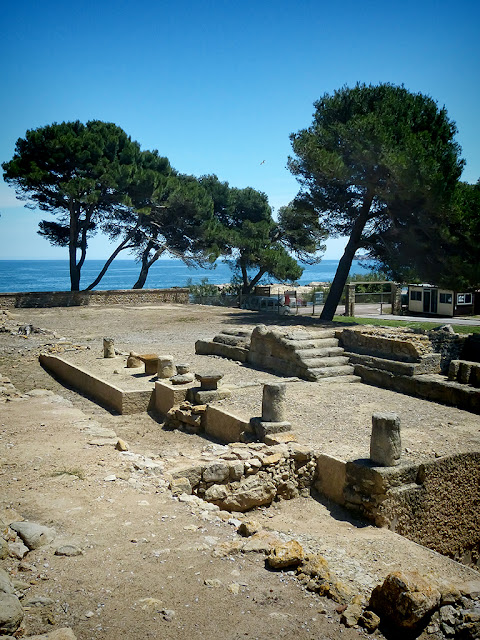
Antiquities from the excavations at Empúries onsite and in the Archaeological Museum of Catalonia in Barcelona, Spain

Image
Antiquities from the excavations at Empúries onsite and in the Archaeological Museum of Catalonia in Barcelona, Spain. Empúries was founded in 575 BCE by Greek colonists from Phocaea. After the invasion of Gaul from Iberia by Hannibal the Carthaginian general in 218 BCE, the city was occupied by the Romans (Latin: Emporiæ). After the conquest of Hispania by the Romans, Empúries remained an independent city-state. However, in t he civil war between Pompey and Julius Caesar, it opted for Pompey, and after his defeat it was stripped of its autonomy. A colonia of Roman veterans, named Emporiae, was established near Indika to control the region and a Roman mint operated there. A number of Roman mosaics have been preserved and sculptures of Asclepius, Demeter, Dionysos and possibly the Empress Livia have been recovered, too, as well as red-figured ceramics, oil lamps, articulated dolls, and coin hoards. Note: I had the wonderful opportunity to explore Empúries in 2013 taking the photogr...