Posts

Showing posts with the label Socrates

For the love of Sappho
Image
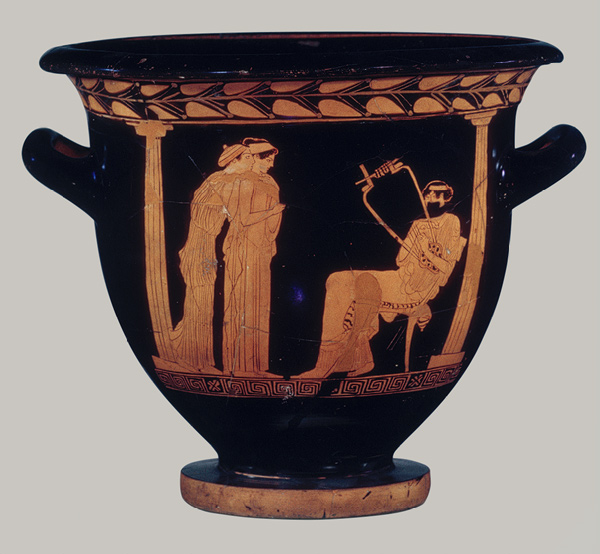
In antiquity Sappho's poetry was highly admired, and several ancient sources refer to her as the "tenth Muse". The earliest surviving poem to do so is a third-century BCE epigram by Dioscorides. She was sometimes also referred to as "The Poetess", just as Homer was "The Poet".  The scholars of Alexandria included Sappho in the canon of nine lyric poets. According to Aelian, the Athenian lawmaker and poet Solon asked to be taught a song by Sappho "so that I may learn it and then die". This story may well be apocryphal, especially as Ammianus Marcellinus tells a similar story about Socrates and a song of Stesichorus, but it is indicative of how highly Sappho's poetry was considered in the ancient world. Sappho's poetry also influenced other ancient authors. In Greek, the Hellenistic poet Nossis was described by Marilyn B. Skinner as an imitator of Sappho, and Kathryn Gutzwiller argues that Nossis explicitly positioned herself as an inhe...
Aristophanes: Comedian or Social Agitator?

Image
Aristophanes, known as "The Father of Comedy" and "the Prince of Ancient Comedy was a comic playwright of ancient Athens and a poet of what has been called Old Attic Comedy. Eleven of his forty plays survive virtually complete.  Born in 446 BC, his works, with their pungent political satire and abundance of sexual and scatological innuendo, effectively define the genre today. Aristophanes lampooned the most important personalities and institutions of his day, as can be seen, for example, in his buffoonish portrayal of Socrates in The Clouds, and in his racy anti-war farce Lysistrata.  His plays consistently espouse opposition to radical new influences in Athenian society. He caricatured leading figures in the arts (notably Euripides, whose influence on his own work however he once grudgingly acknowledged), in politics (especially the populist Cleon), and in philosophy/religion (where Socrates was the most obvious target). Such caricatures seem to imply that Aristophanes ...

The First Mirrors

Image
The earliest manufactured mirrors were pieces of polished stone such as obsidian, a naturally occurring volcanic glass. Examples of obsidian mirrors found in Anatolia (modern-day Turkey) have been dated to around 6000 BCE. Mirrors of polished copper were crafted in Mesopotamia beginning around 4000 BCE, and in ancient Egypt from around 3000 BCE. Polished stone mirrors from Central and South America date from around 2000 BCE onwards. Some of the earliest examples of Bronze Age copper mirrors were produced by the Qijia culture (2200 BCE-1600 BCE)  distributed around the upper Yellow River region of Gansu (centered in Lanzhou) and eastern Qinghai, China. Glass began to be used for mirrors in the 1st century CE, with the development of soda-lime glass and glass blowing. The Roman scholar Pliny the Elder claims that artisans in Sidon (modern-day Lebanon) were producing glass mirrors coated with lead or gold leaf in the back. The metal provided good reflectivity, and the glass provide...