Posts

Showing posts with the label Scythian

Sarmatians: Descendants of the Amazons?

Image
Herodotus (4.110–117) tells us some Amazons were captured in battle by Greeks in Pontus (northern Turkey) near the river Thermodon, and the captives were loaded into three boats. They overcame their captors while at sea, but were not able sailors. The boats were blown north to the Maeotian Lake (the Sea of Azov) onto the shore of Scythia near the cliff region (today's southeastern Crimea). After encountering the Scythians and learning the Scythian language, the Amazons agreed to marry Scythian men, but only on the condition that they move away from Scythia and not be required to follow the customs of Scythian women. Hippocrates described these warlike women. "Their women, so long as they are virgins, ride, shoot, throw the javelin while mounted, and fight with their enemies. They do not lay aside their virginity until they have killed three of their enemies, and they do not marry before they have performed the traditional sacred rites. A woman who takes to herself a husband no...

Nomads of the Golden Mountains of Altai

Image
Yesterday when I was researching the post about horses in the ancient world, I was intrigued by the detail image of a Persian horseman on the so-called Pazyryk carpet that Lloyd Llewellyn-Jones included in his blog post. The Pazyryk carpet is considered the oldest surviving example of a pile carpet in the world and is thought to have been made around 400 BCE in Armenia or Persia. It was discovered in a Scythian kurgan burial in the Pazyryk Valley of the Ukok plateau in the Altai Mountains, Siberia, south of the modern city of Novosibirsk, Russia. The tomb mounds discovered there are now part of the  Golden Mountains of Altai UNESCO World Heritage Site.  The horseman of the Pazyryk culture apparently  accumulated great wealth through horse trading with merchants in Persia, India and China as evidenced by the variety of grave goods including Chinese silk, the pile carpet,  horses decked out in elaborate trappings, and wooden furniture and a full-sized burial chariot fo...

The Scythian Police Force of Athens in the 6th-4th centuries BCE

Image
The Scythian archers, called taxotai, were a hypothesized police force of 6th-, 5th- and early 4th-century BCE Athens that is recorded in some Greek artworks and literature. The force is said to have consisted of 300 armed Scythians (a nomadic people living in the Eurasian Steppe) who were public slaves in Athens. They acted for a group of eleven elected Athenian magistrates who were responsible for arrests and executions and for some aspects of public order in the city including the Assembly and the Council. Their number is said to have swelled to 1,200 at some point, so they may have also been involved in wartime conflicts as well. Scholars agree that a Scythian police force of some sort existed in Athens in the 5th century BCE and possibly as early as the 6th century BCE, although no one knows when it was first established or how long it lasted. Swiss archaeologist Balbina Bäbler points to 4th century BCE grave steles including the stele of Getes as well as buried Scythian arrowhead...

Part of a throne with deity on a bull, ca. late 8th–7th century B.C.E., Urartian

Image
Assyrian inscriptions of Shalmaneser I (c. 1274 BCE) first mention Uruartri as one of the states of Nairi, a loose confederation of small kingdoms and tribal states in the Armenian Highlands in the thirteenth to eleventh centuries BCE which he conquered. It extended from northeastern Turkey into northwestern Iran with its cultural center around Lake Van. Its settlements were palace-fortresses that protected agricultural production and supported many crafts, especially an extensive metalworking industry.  The Nairi states were repeatedly subjected to further attacks and invasions by the Middle and Neo-Assyrian Empires.  But Urartu, united under King Arame (860-843 BCE),  reemerged in Assyrian language inscriptions in the ninth century BCE as a powerful northern rival to the Neo-Assyrian Empire. Urartologist Paul Zimansky speculated the Urartian ruling class were few in number and governed over an ethnically, culturally, and linguistically diverse population. This diversity...

Stag vessel, Anatolia, Hittite Empire, 14th–13th century B.C.E. at the Metropolitan Museum of Art

Image
From Syria, Mesopotamia, and Egypt in the south to Thrace, Anatolia, and the Caucasus in the north, and from regions as far west as mainland Greece all the way east to Iran, the great royal houses forged intense international relationships through the exchange of traded raw materials and goods as well as letters and diplomatic gifts during the Second Millennium BCE. This unprecedented movement of precious materials, luxury goods, and people resulted in a total transformation of the visual arts throughout a vast territory that spanned the ancient Near East and the eastern Mediterranean.  Cult scenes or religious processions are commonly represented in the art of this period. Hittite texts mention that animal-shaped vessels made of gold, silver, stone, and wood, in the appropriate animal form, were given to the gods for their own use. One such god, worshiped in animal form, was the stag god.  It is thought that the ‘Stag God’ originated in the steppes and was brought to Anatolia...

Silver Beaker with birds and animals, Thracian, 4th century BCE

Image
"From the mid-first millennium, such objects as ceremonial helmets, armor, cups, and ornamental gear for horses—worked from silver and sometimes gilded—have been discovered in graves and in finds that must have been the buried hoards of Thracian princes and chiefs. This silver beaker is a fine example of fourth century B.C. Thracian workmanship. It probably was made in the region of present-day Romania or Bulgaria, as similar beakers have been found in a princely tomb at Agighiol, near the delta of the Danube in eastern Romania. The beaker is raised from a single piece of silver with a stamped, chased, and repoussé design." - The Metropolitan Museum of Art   This view of the beaker features a stag-like creature with eight legs, although it may indicate the presence of two stags side by side. Its antlers extend into a border of tines ending in bird heads that circle the upper portion of the cup. The opposite side of the beaker depicts a horned bird of prey holding a fish in it...

Scythian gorytos

Image
 A gorytos is a type of leather case for a short composite bow and arrows used by the Scythians in classical antiquity. They are a combination of bow case and quiver in one, and are worn on the archer's left hip with the opening tilted rearward. Many gorytos were highly decorated and sometimes gilded. At least one surviving specimen was determined by scanning electron microscope to be made of human skin. Some have been found in Macedonian tombs, such as the tomb of Philip II in Macedon in Vergina of the 2nd half of the 4th century BCE. It is thought to have belonged to his sixth wife, the Thracian princess Meda of of Odessos, who hurled herself on his funeral pyre.  Her remains were found in the antechamber of Philip's tomb.  They were also used by the Persians. Indo-Greeks adopted the composite bow and the gorytos as part of their mounted archery equipment from around 100 BCE, as can be seen on their coins. In his 1913 book, Scythians and Greeks: A Survey of Ancient Hist...

The evolution of Scythian art

Image
 Early Scythian art was characterized by its use of animal motifs and appeared in eastern Europe in the 8th century BCE. Some scholars suggest the art style developed under Near Eastern influence during the military campaigns of the 7th century BCE, but the more common theory is that it developed on the eastern part of the Eurasian Steppe under Chinese influence. Others have sought to reconcile the two theories, suggesting that the animal style of the west and eastern parts of the steppe developed independently of each other, under Near Eastern and Chinese influences respectively. Regardless, the animal style art of the Scythians was distinctive and differed considerably from the cultures around it. Scythian animal style works are typically divided into birds, ungulates and beasts of prey. This probably reflects the tripartite division of the Scythian cosmos, with birds belonging to the upper level, ungulates to the middle level and beasts of prey in the lower level. Images of myth...

Griffins in ancient art

Image
 Early depictions of griffin-types in Ancient Greek art are found in the 15th century BCE frescoes in the Throne Room of the Bronze Age Palace of Knossos, as restored by Sir Arthur Evans. Bird-mammal composites were a decorative theme in Archaic and Classical Greek art, but became quite popular in the 6th and 5th centuries BCE, when the Greeks first began to record accounts of the "gryps" creature from travelers to Asia.  In Central Asia, the griffin image appeared in Scythian artifacts of the 6th–4th centuries BCE. Herodotus reported the Arimaspians,  a legendary tribe of one-eyed people of northern Scythia who lived in the foothills of the Riphean Mountains (either the Ural or the Carpathian mountains), battled these griffins for their deposits of gold. In his Naturalis Historia, Pliny the Elder wrote, "griffins were said to lay eggs in burrows on the ground and these nests contained gold nuggets."   Since griffins were said to guard particularly valuable trea...

Dacia Felix. Romania’s Glorious Past, October 19, 2019 - April 26, 2020 at the Gallo-Roman Museum in Tongeren, Belgium

Image
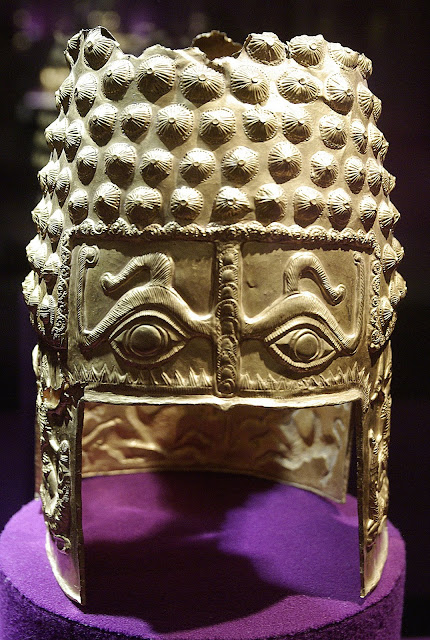
Dacia Felix. Romania’s Glorious Past,  October 19, 2019 - April 26, 2020 at the Gallo-Roman Museum in Tongeren, Belgium.  Over 300 ancient artifacts from the National Museum of Romanian History will be featured in the exhibition "Dacia Felix. Romania’s Glorious Past" October 19, 2019 - April 26, 2020 at the Gallo-Roman Museum in Tongeren in Belgium.  Included among the artifacts are a silver thyton dated to the 4th-3rd centuries BCE, a golden helmet of Coțofenești dating to the 4th century BCE, and pieces from the Sâncrăieni treasure dating to the 1st century BCE.  The exhibit includes the presentation of a documentary filmed at Sarmizegetusa Regia and other historic locations.  The province of Dacia was annexed to the Roman Empire in 106 CE after its conquest by the Roman emperor Trajan.  It was the ancient homeland of the Dacians and the Getae and a cultural crossroads for the Greeks, the Scythians, and the Celts, as well as the Romans. Images:...

"The Great Steppe: History and Culture” September 12 - October 12, 2019 at the Museum of Anatolian Civilizations in Ankara, Turkey.

Image
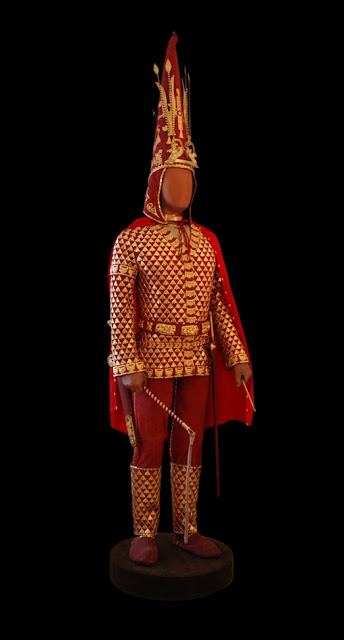
“The Great Steppe: History and Culture” September 12 - October 12, 2019 at the Museum of Anatolian Civilizations in Ankara, Turkey. This exhibit will feature more than 200 items from the collections of the Kazakhstan National Museum including the famous 5th century BCE "Golden Man", a Scythian warrior found in 1969 during the archaeological excavations at Saka. Some of the greatest examples from the Caspian and Central Asia r egions, where Turkic culture is dominant will be displayed. The tomb of the Golden warrior contained more than 4,000 items made of gold, such as details used to decorate clothes, as well as jewelry and household utensils. The golden ornaments found on his crown and depicting tulpar, a mythological winged horse similar to Pegasus, have become a state emblem of Kazakhstan. Next year, “Golden Man” is expected to visit the United States, Italy, Austria, France and Germany. Image: Rym Altynbekov's recreation of the Golden Man. Photo courtesy ...

Saka Golden Burials exhibits ongoing at the National Museum of the Republic of Kazakhstan in Astana, Kazakhstan

Image
Saka Golden Burials exhibits ongoing at the National Museum of the Republic of Kazakhstan in Astana, Kazakhstan.  The Saka were a group of nomadic Iranian peoples who inhabited the northern and eastern Eurasian Steppe and the Tarim Basin.  Although they are considered part of the wider Scythic culture they are distinguished from the Scythians of the Pontic Steppe and the Massagetae of the Aral Sea region.  Prominent archaeological remains of the Sakas include the Pazyryk burials, the Issyk kurgan, artifacts of the Ordos culture and possibly Tillya Tepe. It has been suggested that the ruling elite of the Xiongnu was of Saka origin.  Krym Altynbekov's recreation of the Golden Man. Photo courtesy of Krym Altynbekov Excellent article on Kazakhstan's golden burials with lots of quality images: https://en.tengrinews.kz/science/Reconstruction-shows-how-ancient-Scythian-Princess-255482/