Posts

Showing posts with the label Royal Ontario Museum

Mysterious names of ancient ceramics
Image
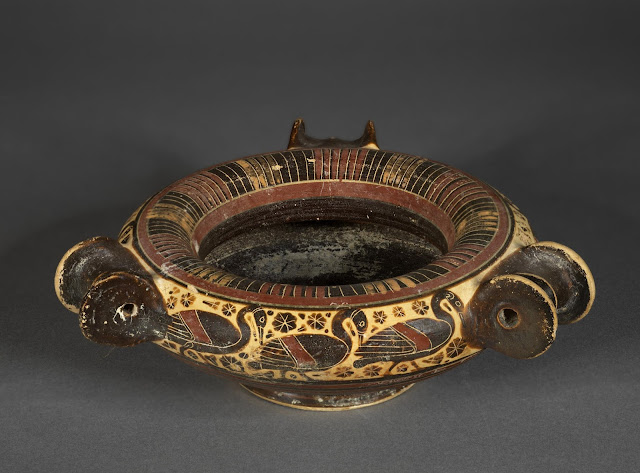
As I study ancient history I am always intrigued by the names that have been given to various ceramic vessels that have been recovered from archaeological sites.  Sometimes, the names of objects can be found in ancient sources.  Sometimes the names are given to objects by archaeologists because they resemble other fixtures that have been previously named.  In my translation of the Pompeianarum Antiquitatum Historia I have been a bit flustered by some of the names given objects by 18th and 19th century archaeologists because these names have not carried through to the 21st century or the objects have acquired a more common name since then. So, without accompanying illustrations, I have no idea what the artifacts actually look like. I've purchased texts purporting to be dictionaries of ancient ceramics but even they do not contain the terms I have found. Anyway, although I have photographed hundreds of Greek ceramics in museums around the world, this morning while searching...

Goddess Roma depicted with crested helmet, marble, from Italy 2nd century CE at the Royal Ontario Museum in Toronto, Canada.

Image
In ancient Roman religion, Roma was a female deity who personified the city of Rome and more broadly, the Roman state. She embodied Rome in complex ways and symbolized the ideal woman in society. Roman political and religious ideas were portrayed through Roma in different forms of media such as coins, sculptures and designs on architecture. In Roman art and coinage, she was usually depicted with a military helmet, and often other military equipment, although in the Greek-speaking east she more often wore a mural crown, signifying Rome's status as a loyal protector of Hellenic city-states.   After the assassination of Julius Caesar, his deification, and the development of the imperial cult, worship of such an individual posed a conflict with Republican values, so deified persons were worshiped jointly with Roma. In provincial Africa, temples to Roma and Augustus have been found at Leptis Magna and Mactar.  Tiberius built a temple to Roma and Augustus in Ostia. A total of s...

Distinctive gladiator helmet found in the Flavian Amphitheataer (Colosseum) in Rome, Italy, 300-500 CE at the Royal Ontario Museum in Toronto, Canada

Image
Distinctive gladiator helmet found in the Flavian Amphitheataer (Colosseum) in Rome, Italy, 300-500 CE at the Royal Ontario Museum in Toronto, Canada. Spectators preferred to watch highly skilled, well matched gladiators with complementary fighting styles. These were the most costly to train and to hire. A general melee of several, lower-skilled gladiators was far less costly, but also less popular. Even among the ordinarii, ma tch winners might have to fight a new, well-rested opponent, either a tertiarius, "a third choice gladiator," by prearrangement, or a "substitute" gladiator (suppositicius) who fought at the whim of the editor of the games as an unadvertised, unexpected "extra". This yielded two combats for the cost of three gladiators, rather than four. Such contests were prolonged, and in some cases, more bloody. The emperor Caracalla chose to test a notably skilled and successful fighter named Bato against first one supposicitius, whom he bea...

A Millennium of ancient Roman culture at the Royal Ontario Museum in Toronto, Onatario, Canada

Image
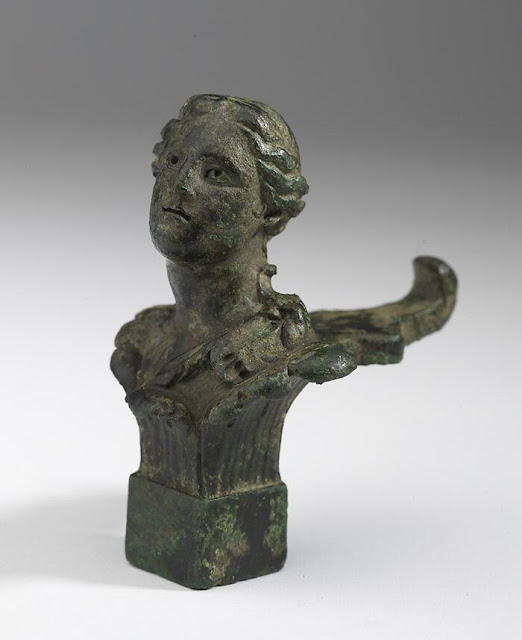
A Millennium of ancient Roman culture at the Royal Ontario Museum in Toronto, Onatario, Canada. The Eaton Gallery of Rome at the Royal Ontario Museum is home to a millennium of ancient Roman culture. It has the largest collection of classical antiquities in Canada, displaying more than 500 objects that range from marble or painted portraits of historical figures to magnificent Roman jewellery. The gallery also features the Bratty  Exhibit of Etruria that sheds some light on the Etruscans, a neighbouring civilization. The Joey and Toby Tanenbaum Gallery of Rome and the Near East depicts the lifestyle and culture of societies under Roman rule and their influence in the Near East and the Byzantine gallery reflects the history of the Byzantine Empire from 330 to 1453 CE. Other ancient cultures represented in the ROM's collections include ancient Cyprus, Egypt, Nubia, Bronze Age Aegean, and the Archaeic, Classical, and Hellenistic Periods of Greece. Image: Finial with the b...

When Istanbul was Constantinople - Ongoing. At the Royal Ontario Museum in Toronto, Canada

Image
When Istanbul was Constantinople - Ongoing. At the Royal Ontario Museum in Toronto, Canada Floor mosaic of Artemis 400-500 CE Eastern Mediterranean. Image courtesy of the Royal Ontario Museum. The dedication of Constantinople (now Istanbul) by the Emperor Constantine I in 330 CE began a new phase in the history of the Roman Empire. Power gradually shifted towards the eastern Mediterranean, and a new empire emerged. The people of this empire thought of themselves as Roman, but later historians have called it the Byzantine Empire –  named after Byzantion, the original town at Constantinople. The Byzantine Empire was crucial for the early history of eastern Christianity. It was here that the Orthodox Church was founded and continues to flourish to this day. This gallery encompasses the centuries from the dedication of Constantinople, through the fall of the classical Roman empire and the Medieval Crusades, to its final conquest by the Ottoman Turks. The exceptional objects...