Posts

Showing posts with the label Ronald Reagan Presidential Library and Museum

Objects recovered from the harbor of Alexandria and the underwater remains of the city of Thonis-Heracleion on display at the Egypt's Lost Cities exhibit in the Ronald Reagan Presidental Library and Museum

Image
Objects recovered from the harbor of Alexandria and the underwater remains of the city of Thonis-Heracleion on display at the Egypt's Lost Cities exhibit in the Ronald Reagan Presidental Library and Museum. Thonis-Heracleion, was an ancient Egyptian city located near the Canopic Mouth of the Nile, about 32 km (20 miles) northeast of Alexandria. Its ruins are located in Abu Qir Bay, currently 2.5 km off the coast, under 10 m (3 0 ft) of water. Heracleion is mentioned by many chroniclers in antiquity, including Herodotus, Strabo and Diodorus. The city was said by Herodotus to have been visited by Paris and Helen of Troy who sought refuge there on their flight from the jealous Menelaus before the Trojan War. In the Late Period of ancient Egypt it was the country's main port for international trade and collection of taxes. During the time when the city especially flourished between the 6th and 4th centuries B.C.E., a large temple of Amun-Gereb, the supreme god of the Egyptians ...

Hadrian in bronze and Osiris-Antinous, 2nd century CE, from the Greco-Roman Museum in Alexandria at the Egypt's Lost Cities exhibit in the Ronald Reagan Presidential Library and Museum through April 12, 2020

Image
Hadrian in bronze and Osiris-Antinous, 2nd century CE, from the Greco-Roman Museum in Alexandria at the Egypt's Lost Cities exhibit in the Ronald Reagan Presidential Library and Museum through April 12, 2020. Antinous, Hadrian's youthful companion, was deified after meeting the same fate as Osiris: death in the waters of the Nile. The new god Osiris-Antinous had a humber of manifestations, including that of the Apis bull. It is known that Antinous was born to a Greek family in the city of Claudiopolis, which was located in the Roman province of Bithynia in what is now north-west Turkey. It is possible that he was named after the character of Antinous, who is one of Penelope's suitors in Homer's epic poem, the Odyssey. Another possibility is that he was given the male equivalent of Antinoë, a woman who was one of the founding figures of Mantineia, a city which probably had close relations with Bithynia. Although many historians from the Renaissance onward a...

Priest holding a vase from the eastern harbor of Alexandria in the "Egypt's Lost Cities" exhibit at the Ronald Reagan Presidential Library and Museum

Image
Priest holding a vase from the eastern harbor of Alexandria in the "Egypt's Lost Cities" exhibit at the Ronald Reagan Presidential Library and Museum through April 12, 2020. This young priest, carved in black granite holds a vase depicting Osiris, whose cult flourished among Romano-Egyptians in the late 1st century CE. The cult of Isis and Osiris continued at Philae until at least the 450s CE, long after Roman imperial decrees o f the late 4th century that ordered the closing of temples to "pagan" gods. Philae was the last major ancient Egyptian temple to be closed. The ritual reenactment of Osiris's funeral rites were held in the last month of the inundation (the annual Nile flood), coinciding with Spring, and held at Abydos which was the traditional place where the body of Osiris drifted ashore after having been drowned in the Nile. Some elements of the ceremony were held in the temple, while others involved public participation in a form of theater. T...

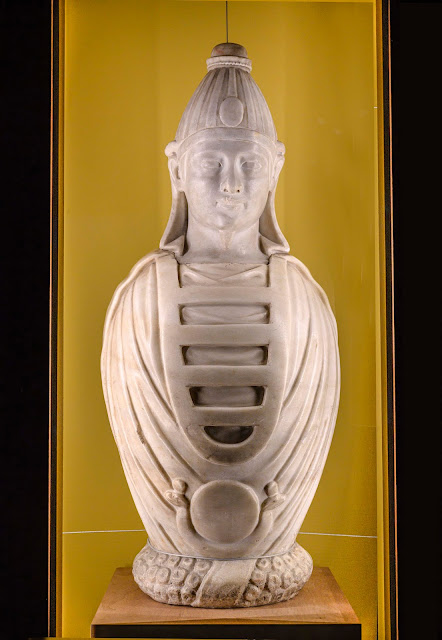
Osiris-Canopus and the awakening of Osiris at the Ronald Reagan Presidential Library and Museum

Image
Osiris-Canopus with stylized atef crown 2nd century CE from the Temple of Ras El-Soda and the awakening of Osiris crowned by a tcheni in precious metal 26th dynasty (664-525 BCE) from the Egypt's Lost Cities exhibit at the Ronald Reagan Presidential Library and Museum through April 12, 2020. Excavated in 1936 by Achille Adriani, director of the Alexandria Museum, the Temple of Ras El-Soda was originally found just east of ear ly 20th century Alexandria between the sea and the road to Abu Qir. It is a small Ionic prostyle tetrastyle temple constructed of limestone blocks and marble columns. In the cella were found five marble sculptures including Isis, Osiris-Canopus (also known as Osiris Hydreios) type A, Osiris-Canopus type B, Hermanoubis, and Harpokrates. The temple was dated to the second century CE based on the sylistic analysis of the statuary and the lettering of an inscription on a pillar. In Boëthius and Ward-Perkins' authoritative overview of Etruscan and Roman arc...

Gold and Lapis Lazuli Pectoral 22nd Dynasty from the reign of Sheshonq II

Image
Gold and Lapis Lazuli Pectoral 22nd Dynasty from the reign of Sheshonq II (945-925 BCE) at the Egypt's Lost Cities exhibit in the Ronald Reagan Presidential Library and Museum, Simi Valley, California through April 12, 2020. Excavated at Tanis in the tomb of Psusennes I and Sheshonq II, this pectoral depicts the solar boat sailing on the primordial waters under the starry sky. The blue sun is protected by the spreading wings o f Isis and Nephthys. The scene in the central disk depicts Ma'at venerating Amun-Re. Heqakheperre Sheshonq II (also spelled Shoshenq), was the only ruler of the 22nd Dynasty whose tomb was not plundered by tomb robbers. His final resting place was discovered within an antechamber of Psusennes I's tomb at Tanis by Pierre Montet in 1939. It proved to contain many jewel-encrusted bracelets and pectorals, along with a beautiful hawkheaded silver coffin and a gold funerary mask. A forensic examination of Shoshenq II's body by Dr. Douglas Derry, the...

Head of Serapis and Apis Bull from Egypt's Lost Cities exhibit now on view at the Ronald Reagan Presidential Librar and Museum in Simi Valley, California through April 12, 2020.

Image
Head of Serapis with Kalathos, 2nd century BCE (Ptolemaic Period) and granite statue of an Apis Bull from the Roman Period reign of Hadrian (117-138 CE) at the Egypt's Lost Cities exhibit now on view at the Ronald Reagan Presidential Library and Museum in Simi Valley, California through April 12, 2020. The cult of Serapis was introduced during the third century BCE on the orders of Pharaoh Ptolemy I Soter as a means to unify th e Greeks and Egyptians in his realm. There is evidence that the cult of Serapis existed before the Ptolemies came to power in Alexandria including a temple of Serapis in Egypt mentioned in 323 BCE by both Plutarch (Life of Alexander, 76) and Arrian (Anabasis, VII, 26, 2). The common assertion that Ptolemy "created" the deity is derived from sources which describe him erecting a statue of Serapis in Alexandria, the Ptolemaic capital. The cult of Serapis was then spread as a matter of deliberate policy by the Ptolemaic kings, who also built the i...