Posts

Showing posts with the label Priapus

The Wonders of the Horti Lamiani

Image
The Horti Lamiani (Lamian Gardens) was a luxurious complex of an ancient Roman villa with large gardens and outdoor rooms located on the Esquiline Hill in Rome, in the area around the present Piazza Vittorio Emanuele. They were created by the consul Lucius Aelius Lamia, a friend of Emperor Tiberius, and they soon became imperial property.  Along with other ancient Roman horti on the Quirinal, Viminal and Esquiline hills, they were discovered during the construction work for the expansion of Rome at the end of 1800s. The villa and gardens were scenically divided into pavillions and terraces adapted to the landscape, on a model of Hellenistic tradition. They were eventually filled with exceptional works of art, from original ancient Greek sculptures to exquisite frescoes and marble floors. A museum of the nymphaeum excavations is planned to open in 2021. The land for the horti Lamiani was originally a cemetery just outside the ancient Servian Wall but was purchased by Lucius Aelius L...
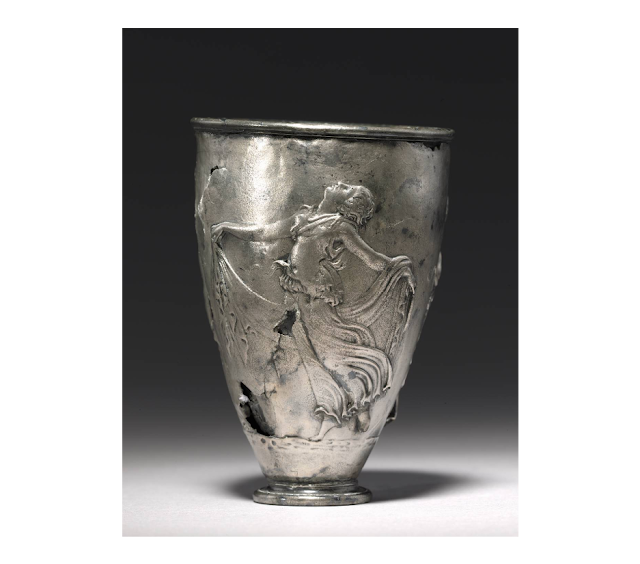
The Vicarello Goblet late 1st century BCE to early 1st century CE at the Cleveland Museum of Art

Image
The Vicarello Goblet late 1st century BCE to early 1st century CE at the Cleveland Museum of Art. This masterpiece of the Roman silversmith’s art was found north of Rome at Vicarello, the ancient Aquae Apollinares (the Springs of Apollo). Exquisitely worked in relief is a multifigure scene centered on a rustic shrine of the god Priapus. He is in the form of a stylized boundary marker placed atop a column. A woman approaching fr om the right seems to have brought him to life by touching him. To the left are votive offerings to the god arranged on top of and around a table. A satyr at the far left and a maenad at the far right dance ecstatically. - Cleveland Art Museum Image: Three views of the Vicarello Goblet from ancient Aquae Apollinares (Vicarello, Italy) courtesy of the museum.

A contemplative Priapus, son of Dionysus and Aphrodite at the Getty Villa exhibit "Buried by Vesuvius" through October 28, 2019

Image
A contemplative Priapus, son of Dionysus and Aphrodite at the Getty Villa exhibit "Buried by Vesuvius" through October 28, 2019. In Greek mythology, Priapus was a minor rustic fertility god, protector of livestock, fruit plants, gardens and male genitalia as well as the patron of merchant sailing. Although Priapus is usually depicted in erotic imagery, the bust of the god found in the Villa dei Papiri portrays a much different  aspect of the deity and was displayed alongside busts of poets and philosophers. Originally worshiped by Greek colonists in Lampsacus in Asia Minor, the cult of Priapus spread to mainland Greece and eventually to Italy during the 3rd century BCE. Lucian tells us that in Bithynia, Priapus was accounted as a warlike god, a rustic tutor to the infant Ares. Pausanius says this god is worshiped where goats and sheep pasture or there are swarms of bees - but by the people of Lampsacus he is more revered than any other god, being called by them a son of D...