Posts

Showing posts with the label Persia

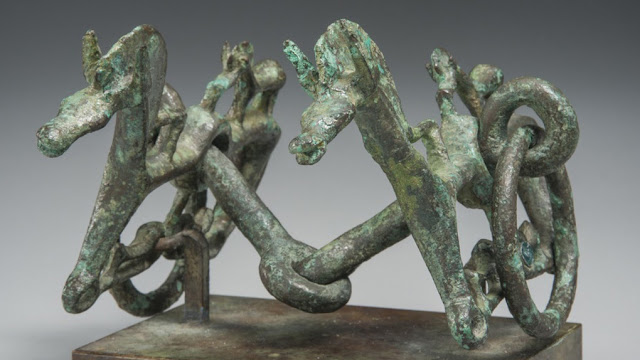
The horse: A perfect gift to a Persian (or Parthian)

Image
"For a nomadic people like the Persians, the horse had a significant practical and symbolic purpose and the importance of horses among the Iranian nobility is evidenced by the fact that many of them bore names compounded with the Old Persian word aspa – ‘horse’, observes Lloyd Llewellyn-Jones, Senior Lecturer in Ancient History at the University of Edinburgh.  "Several of Darius I’s inscriptions note that Persia was a land containing both good men and good horses (DZe §1; DPd §2) and Herodotus famously states that Persian fathers were intent on teaching their sons ‘to ride, to draw the bow, and to speak the truth’ (1. 136; see also Strabo 15. 3.18). The premium Persian horses were bred in the alfalfa-rich plains of Media, and it was here that the main royal stud farms were located (Polybius 10.70). Most prized of all were those steeds bred on the plains of Nisaea near Ecbatana and Bisitun, and Nisaean horses became celebrated for their magnificence, fine proportions, and swif...

Bust of a Priest with Silver Inlaid Eyes, Bronze and sliver, 3rd-4th century C.E., courtesy of the Miho Museum in Kyoto, Japan

Image
While I was researching the Cypriot ear spirals yesterday, I noticed this bronze bust of a priest with silver inlaid eyes dated from the 3rd - 4th century CE at the Miho Museum.  The museum identified it as late Roman but the museum's image had been shared on Flickr and I noticed that someone with the username eternal persia commented on the piece and insisted it was Sasanian.  He/she pointed to the monogram on the hat, clothes, hair design and leaves that decorate the bust and insisted these are Sasanian elements. Intrigued, I researched the item a little further.  At first, most Sasanian portrait sculptures I reviewed were all bearded.  Then I saw an image of a relief depicting Kartir, a high priest and vizier serving during the reigns of Shapur I, Hormizd I, Bahram I, and Bahram II. Not only is Kartir clean shaven, he sports the corkscrew curls and crested hat worn by the priest of the bust at the Miho Museum. Some scholars think Kartir may have been a eunuch, due...

Sasanian royals gifts of silver

Image
Sasanian silver plates were usually hammered into shape and then decorated using a variety of complex techniques.  Gilding was often used to highlight the hunter, usually the king, and sometimes extra pieces of metal were added to create high relief. The king as hunter became a standard image on silver plates during the reign of Shapur II (r. 310–379 CE). The motif symbolizes the prowess of Sasanian rulers, and these royal plates were often sent as gifts to neighboring and vassal courts.  Some plates included inscriptions with the king's name and the plate's weight.  With other plates, art historians must attempt to identify the king by his distinctive apparel or shape of the crown he wears.  Each Sasanian king wore a different personal crown, which became more and more elaborate during the four centuries of the dynasty. Fortunately, the different crowns have been identified from coins or sometimes compared with existing rock reliefs with inscriptions such as those a...

Phoenician sarcophagi of the Achaemenid Period

Image
The Phoenicians as a politically, religiously, and perhaps even ethnically distinct entity on the Levantine coast emerged at the end of the Late Bronze Age about 1200 BCE, as one of the successor cultures to the Canaanites.  From their homeland on the coast of the Levant, the Phoenicians spread throughout the Mediterranean and its islands including Cyprus, Sicily and Malta. Some scholars have observed that Iron Age Phoenicia was not a nation, but rather a collection of cities built around natural harbors along the coast. While they shared a common culture, these small states remained independent, competing with each other in the international marketplace.  "Depending on how evidence is weighed [based on Ugaritic texts and classical sources], Phoenician religion might be presented on the one hand as inclusive and diverse – a “conservatively” polytheistic society easily able to incorporate or syncretize new deities, customs and traditions or on the other hand as highly place-spe...

Persian cavalry before the cataphractarii

Image
The Persians did not use cavalry to a great extent until Cyrus the Great  gave the Persian nobility both horses and the wealth to maintain them from the proceeds of his western conquests. He encouraged them to ride and it became a source of disgrace for a Persian noble to be seen walking.  Cyrus then recruited his cavalry from the nobles, creating a regiment of 15,000 men drawn from the Huvaka or “kinsmen.” These kinsmen adopted brightly-colored trousers and shorter tunics that were more suitable for riding from the Medes.  Cyrus adopted cavalry tactics from the Khorassan horsemen of northeastern Iran, parts of modern Afghanistan and the southern parts of Central Asia. He initially armed his cavalry with the standard weapons of the Persian infantrymen: bows, battle-axes, and oval shields. Later, they were re-equipped with short stabbing swords and throwing javelins instead. Long lances and spears made of wood or entirely of metal were used too. In the mid-5th century Pers...

The Arch of Galerius

Image
The Roman emperor Galerius commissioned the triple Arch of Galerius, built in 298-299 CE and dedicated in 303 CE,  as an element of the imperial precinct linked to his palace in Thessaloniki, Greece. Galerius served as Caesar during the tetrarchy of Diocletian and married Diocletian's daughter.  Entrusted with the care of the Illyrian provinces, he campaigned against Sarmatians and Goths along the Danube then was  dispatched to Egypt to fight the rebellious cities Busiris and Coptos. From there, Galerius was sent to command the eastern forces between Carrhae and Callinicum in Syria. Then, in about 295 CE, Narseh, son of the king Shapur I and the seventh emperor of the Sassanid Persian Empire, declared war on Rome and invaded western Armenia. Narseh then moved south into Roman Mesopotamia, where he inflicted a severe defeat on Galerius. Diocletian may or may not have been present at the battle, but presented himself soon afterwards at Antioch, where the official version of...

Epic Iran (13 February 2021-30 August 2021) at the Victoria and Albert Museum in London

Image
Epic by name and epic by nature, this exhibition will cover an ambitious 5,000 years of Iranian history through 350 objects. Starting in 3,200BCE, the show will first explore the varied landscape of Iran before moving on to early Persian civilisations, the Persian Empire, and later Sassanid rule and Zoroastrianism. Split into ten, fairly chronological sections, it will have an “immersive design” that apparently sets it in a city, complete with a gatehouse, gardens, a palace and a library. The show will include works borrowed from collections in the US, Russia, France, Belgium and the UK. Image: An incense-burner in the shape of a lion (1000-1100 CE) is on show in the "Literary Excellence" section, demonstrating how texts decorated objects Photo: © Musee du Louvre Read more about it: https://www.theartnewspaper.com/news/epic-iran-preview

Alectryomancy and the sacred rooster

Image
Since antiquity, the rooster has been, and still is, a sacred animal in some cultures and deeply embedded within various religious belief systems and religious worship. In ancient Babylon the rooster was considered the bird form of the True Shepherd of Anu and was considered the ordained herald of the gods. Nergal, a deity whose name meant "dunghill cock" or fighting cock, was worshipped by the Assyrians, Babylonians, Phoenicians, and Persians.  The term "Persian bird" was given to the cock by the Greeks after Persian contact "because of his great importance and his religious use among the Persians." This stems from the sacred nature of the cock, attested to in the texts of Zoroastrianism,  during the legendary Kayanian Period from about 2000 BCE to about 700 BCE.  Perhaps because of their ancient association as a divine messenger, roosters played an important role in both Etruscan and Roman religion.  Observing a rooster's willingness to eat grain ker...

The contentious relationship between ancient Cyprus and Persia

Image
The early documented history of Cyprus begins with an inscribed stele commemorating a victory by Sargon II (722–705 BCE) of Assyria there in 709 BCE.  Assyrian domination of Cyprus appears to have begun earlier than this, though, during the reign of Tiglath-Pileser III (744–727 BCE), and ended with the fall of the Neo Assyrian Empire in 609 BCE, whereupon the city-kingdoms of Cyprus gained independence once more. Following a brief period of Egyptian domination in the sixth century BCE, Cyprus fell under Persian rule. Royal palaces excavated on Cyprus resemble the architecture of Achaemenid examples like Persepolis, with audience chambers, open courtyards, bathhouses, and stores.  Town fortifications and houses were built of mudbrick walls on stone foundations. Early Greek influence is reflected in Cypriot sculpture, however.  Archaic Greek art with its attractive smile on the face of the statue is found on many ritual pieces dating between 525–475 BCE although portrait sc...

Syncretistic religions of the Roman Imperial Period

Image
 Many religions of the ancient world were syncretistic, meaning that as they grew and came into contact with other religions, they adopted new beliefs and modified their practices to reflect their changing environment. Both Greek and Roman religious beliefs were deeply influenced by the so-called mystery religions of the East, including the Egyptian cult of Isis, which revealed beliefs and practices to the initiated that remained unexplained, or mysterious, to the uninitiated. Most popular Roman cults had associations with these mystery religions and included the prospect of an afterlife. Zeus Labraundos was a local version of Zeus from Mylasa in Caria (southwestern Asia Minor), of whom very few representations exist except on Roman coins. The front of his apron-like garment is decorated with images of divinities and astral symbols. On his head, he wears a tall headdress with lotus elements reflecting Egyptian influences and the eagle of Zeus at the front. - Walters Art Museum Rema...

The Oxus Treasure and the challenges of provenance

Image
The Oxus Treasure is a collection of about 180 surviving pieces of metalwork in gold and silver from the Achaemenid Persian period which were found by the Oxus river about 1877-1880.  The metalwork is believed to date from the sixth to fourth centuries BCE and is thought to belong to a temple where votive offerings were deposited over a long period. Sculptural objects include two model chariots in gold, one incomplete, plus figures of a horse and a rider that may belong to this or other model groups, as may two other horses cut out from sheet gold. The wheels of the complete chariot would originally have turned freely, and it had received at least one repair in antiquity. It is pulled by four horses (rather small, and with only nine legs surviving between them) and carries two figures, a driver and a seated passenger, both wearing torcs. The chariot has handrails at the open rear to assist getting in and out, while the solid front carries the face of the protective Egyptian dwarf-...

Achaemenid Lion Strangler at the Cleveland Museum of Art in Cleveland, Ohio

Image
Achaemenid Lion Strangler at the Cleveland Museum of Art in Cleveland, Ohio. A hero strangling a lion was an enduring motif in the ancient Middle East. Possibly referring to the myth of Gilgamesh or Herakles, it was considered a symbol of Persian royal power. As a royal symbol it was already fully developed in the art of the Protoliterate period beginning approximately in 3500 BCE. In its earliest manifestations, the lion str angler was thought to depict the hero protecting the sacred flocks of the goddess of fertility. This concept was gradually replaced by the idea it reflected the eternal conflict between man and beast where man represented the defender of order and civilized life against the the chaotic forces of nature. Likewise, Gilgamesh in the early Sumerian epic, slew several monsters including Huwawa and the Bull of Heaven in such symbolic contests. Eventually, though, the iconography of the lion strangler simply became a symbol of power favored by kings who viewed themse...

Art of the Ancient Western World at the Sidney and Lois Eskenazi Museum of Art, Indiana University Bloomington, Indiana

Image
Art of the Ancient Western World at the Sidney and Lois Eskenazi Museum of Art, Indiana University Bloomington, Indiana. Objects dating from 30,000 BCE through 1000 CE encompassing religious ritual, funerary practices, public ceremony, and daily life. Cultures represented include Sumerian, Assyrian, Egyptian, Persian, Minoan, Mycenaean, Etruscan, Greek, and Roman. Objects include sculpture, mosaics, ceramics, portrait busts, funerary models, gravestones, jewelry, and items used in personal care. Image: Etruscan bronze horse bit at the Eskenazi Museum of Art in Bloomington, Indiana courtesy of Eskenazi Museum of Art. See more at: https://wsimag.com/culture/49247-etruscan-and-italic

Ancient Iran: a glimpse of Persian art and architecture under the Sassanids

Image
Ancient Iran: a glimpse of Persian art and architecture under the Sassanids.  The Sassanid dynasty of ancient Persia was established in 224 CE when Ardashir I overthrew the Parthian empire.  Sassanid monuments in such cities as Ardashir Khurreh and Bishapur incorporate domes and squinches, or arched openings, in four sides of a square structure.  This architectural form, used extensively in religious architecture after the adoption of Zoroastrianism as the state religion, was continued during the subsequent Islamic era. It was also used in the grandiose palaces at Ctesiphon, Firuzabd, and Sarvestan.  It was during this period that the bas-reliefs on limestone cliffs, including  Bishapur, Naqsh-e Rostam and Naqsh-e Rajab in southern Iran were created.  In 2018, UNESCO added an ensemble of Sassanian historical cities in southern Iran, entitled “Sassanid Archaeological Landscape of Fars Region”, to its World Heritage list.  The Sassanids also practiced h...