Posts

Showing posts with the label Persephone

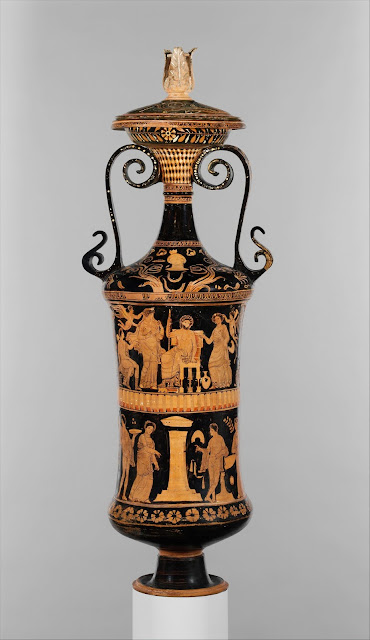
Terracotta loutrophoros (ceremonial funeral vase for water), Tarentine, 340–330 BCE, attributed to the Darius Painter, Apulian, south Italy
Image
The Tarentine predilection for disciplined yet exuberant embellishment is applied here to an imposing vase with deeply serious iconography. In the primary scene, Persephone and Aphrodite, who both laid claim to the beautiful hunter Adonis, await a judgment from the deity seated between them. He may be interpreted as Zeus or as Hades, ruler of the Underworld. Differing versions of the verdict allowed the hero to divide his time between the goddesses. In the zone below, a youth is isolated between a grave monument and a laver as figures approach from either side. The themes of death and the Underworld are complemented with luxuriant vegetation. The myth of the death and rebirth of Adonis is connected with seasonal change, and the abundant vegetation on this loutrophoros could symbolize rebirth, an appropriate theme for a funeral vase. - Metropolitan Museum of Art Apulian vase painting was the leading South Italian vase painting tradition between 430 and 300 BCE. Of the approximately 20,0...

The many names and faces of Persephone (Proserpina)

Image
The daughter of Zeus and Demeter, Persephone, often referred to as Kore, became queen of the underworld when she was abducted by Hades.  As a goddess associated with the spring fertility of vegetation, she was worshipped along with her mother Demeter in the rites of the  Eleusinian Mysteries, which promised the initiated a more enjoyable prospect after death.   However her cult was based on ancient agrarian rituals that were practiced around the Mediterranean at Minoan Crete, Egypt, Asia Minor, Sicily, Magna Graecia, and Libya far earlier.  In Minoan Crete, the female vegetation divinity was identified as Ariadne.  Some scholars suggest the name Ariadne was a "friendly" name, derived from the word for "pure," because of a superstitious taboo about speaking the real names of deities associated with the underworld. In another cult on Crete, Persephone was  conflated with Despoina, "the mistress" of a chthonic divinity, who was considered the unnameable d...

Tomb bust plaques in ancient Greece

Image
 Plaques in the form of a bust were sometimes placed in tombs of women in ancient Greece as token representations of ideal and perpetual maidenhood.  The female is sometimes depicted wearing a crown (polos) possibly alluding to tragic virgins of myth such as Persephone, the daughter of Zeus and Demeter who became the queen of the underworld through her abduction by Hades, the god of the underworld.  Persephone and her mother Demeter were the central figures of the Eleusinian Mysteries, which promised the initiated a more enjoyable prospect after death. Image: Painted Terracotta Tomb plaque made in Boeotia about 420-390 BCE that I photographed at the British Museum in 2016.