Posts

Showing posts with the label Parthian

Barbarians in Roman art

Image
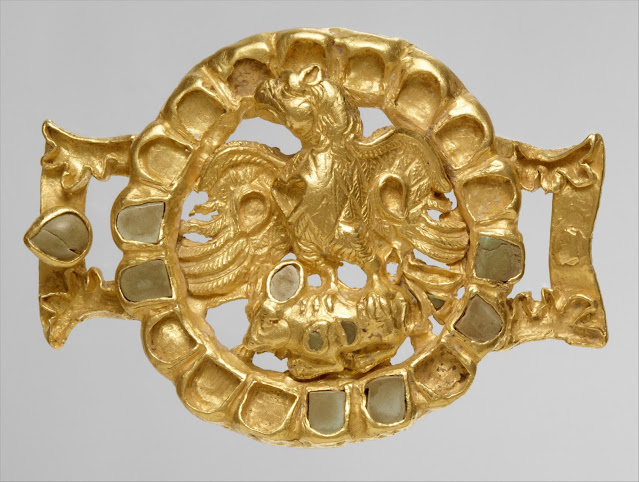
From the 1st century BCE onwards, the Roman army began to deploy "barbarians" to protect Roman frontiers. This trend continued into the Imperial Period and the expanded borders necessitated the use of increasing numbers of foederati to defend the empire.  By the 4th century CE, of more than 75,000 troops stationed in Gaul, most hailed from Germania, an area stretching as far north as Scandinavia and as far east as the Vistula River.   Fortunately for historians, the grave goods of these Germanic warriors both in and outside the empire have provided a treasure trove of information about the money, gifts, and often elaborately decorated military insignia these men acquired during their service to Rome.   "Promises of Roman citizenship and military and economic support encouraged barbarian leaders to assist their wealthy neighbor, primarily by providing troops," observes Melanie Holcomb in her paper, Barbarians and Romans, published by the Metropolitan Museum of Ar...

The Orphic Hymns and Incense use in the ancient Mediterranean World

Image
The word incense comes from Latin incendere meaning 'to burn'.  In ancient times incense was burnt to counteract or obscure malodorous products of human habitation, but was widely perceived to also deter malevolent demons and appease the gods with its pleasant aroma. Resin balls were found in many prehistoric Egyptian tombs in El Mahasna, giving evidence for the prominence of incense and related compounds in Egyptian antiquity. One of the oldest extant incense burners originates from the 5th dynasty of Egypt dating back to the 25th century BCE.  The Babylonians also used incense while offering prayers to divining oracles and it is thought Incense spread from there to Greece and Rome.  Incense burners, commonly known in ancient Greece as thymiateria, could take a wide variety of forms, ranging from simple earthenware pots to elaborate carved, moulded or cast items made from clay or bronze.  They were used in sacred rituals in sanctuaries and temples, during religious ...

Parthian metalwork from ancient Nahavand (Nihavend)

Image
Nahavand, located on the fertile Nisaean plain in the southernmost part of ancient Media (modern day Iran), has been inhabited since at least 5,000 BCE.  According to the ancient geographer and historian Strabo it was (re-)founded by Achaemenid King Xerxes the Great.  Nahavand lay about 96 kilometers from Ecbatana on the trunk road from Babylonia through Media to Bactria. In the Seleucid period, it became a Greek polis with magistrates and a Seleucid governor. According to the polymath Abu Hanifa Dinawari, in the Parthian period, Nahavand was the seat of the Parthian prince Artabanus, who later reigned as Artabanus I of Parthia from 127 to 124/3 BCE.  After Artabanus was killed in battle, he was succeeded by his son Mithridates II (known in antiquity as Mithridates The Great) who transformed the Parthian Empire into a superpower. Mithridates II was the first Parthian king to extend Parthian rule into Caucasus, where the kingdoms of Armenia, Iberia, and possibly Caucasian ...

Roman archery

Image
During most of the Republican period, there is little evidence that the Roman army employed the wide-spread use of archers.  This changed after the defeat of the army of Crassus by the Parthians at the battle of Carrhae in 51 BCE. By the time Pompey's troops occupied the Middle East, the Romans had introduced units of auxiliary archers, primarily from Syria, armed with composite bows and arrows with trilobate heads.   Large  quantities of these types of arrowheads, dated between the 1st and 3rd centuries CE, have been found at Masada, Herodium, and Dura-Europos. The discovery of a grave of a late Roman sagittarius, thought to be of Germanic origin, near Augsburg included arrows with heads ranging from bolt-like bodkin heads to leaf-shaped heads to barbed heads. The more rare incendiary arrows, with basket-like heads to hold combustible materials like oil-soaked hemp fibers, have been found at Straubing, Germany and at the site of the Illyrian fortified settlement at ...

Relief depicting a deified Trajan's posthumous Parthian triumph in 118 CE, from Praeneste at the Museo Archeologico Nazionale Palestrina

Image
There have been multiple theories proprosed for Trajan's war with Parthia that began in 113 Ce with the pretext that Rome disapproved of a puppet king placed on the throne of Armenia by the Parthians.  Some scholars point to the propaganda value of an Eastern conquest that would emulate, in Roman fashion, those of Alexander the Great.  An expansionist policy was supported by a powerful circle of conservative senators from Hispania, first among them being the all-powerful Licinius Sura as well.  I've previously discussed theories about attempts to balance trade relations with India.  Some scholars, though, think Trajan's original aims were purely military and quite modest: to assure a more defensible Eastern frontier for the Roman Empire, crossing Northern Mesopotamia along the course of the Khabur River in order to offer cover to a Roman Armenia.  Whatever the motivation, Trajan succeeded in placing a client king on the Parthian throne and if he had lived to re...

The World Between Empires: Art and Identity in the Ancient Middle East March 18, 2019 - June 23 2019 at the Metropolitan Museum of Art in New York

Image
The World Between Empires: Art and Identity in the Ancient Middle East March 18, 2019 - June 23 2019 at the Metropolitan Museum of Art in New York. For over three centuries, the territories and trading networks of the Middle East were contested between the Roman and Parthian Empires (ca. 100 B.C.–A.D. 250), yet across the region life was not defined by these two superpowers alone. Local cultural and religious traditions flourish ed, and sculptures, wall paintings, jewelry, and other objects reveal how ancient identities were expressed through art. Featuring 190 works from museums in the Middle East, Europe, and the United States, this exhibition will follow a journey along the great incense and silk routes that connected cities in southwestern Arabia, Nabataea, Judaea, Syria, and Mesopotamia, making the region a center of global trade. Image: Head of a bearded god from Dura-Europos, Syria 1st century CE from the Yale University Art Gallery.