Posts

Showing posts with the label Ovid

Ovid's Ibis

Image
In 1 BCE, the Roman poet Pūblius Ovidius Nāsō , known to us as Ovid, penned three books, the Ars amatoria (The Art of Love) instructing Romans in the techniques of seduction and love. The first book addresses men and teaches them how to seduce women, the second, also to men, teaches how to keep a lover. The third book addresses women and teaches seduction techniques. Ovid describes the places one can go to find a lover, like the theater, a triumph, which he thoroughly describes, or arena – and ways to get the girl to take notice, including seducing her covertly at a banquet. Ovid emphasizes care of the body for the lover and advises men to avoid giving too many gifts, keep up their appearance, hide affairs, compliment their lovers, and ingratiate themselves with slaves to stay on their lover's good side.  Ovid gives women detailed instructions on appearance telling them to avoid too many adornments. He advises women to read elegiac poetry, learn to play games, sleep with people of ...

Spurned Women: The violent death of Orpheus

Image
Orpheus is best known as a musician that could play so beautifully he charmed even the most violent animals.  As such he is portrayed in numerous mosaics, paintings, and on ceramics.  So I was surprised to see a red-figure calyx krater attributed to the Villa Giulia Painter and dated to 460-450 BCE depicting Orpheus being violently attacked by Thracian women, one with a spear and one with an axe. I realize taste in music is quite personal but this extreme response is so antithetical to all of those peaceful images I have seen of Orpheus surrounded by mesmerized animals that I had to research this event further. According to a Late Antique summary of Aeschylus' lost play Bassarids , Orpheus, towards the end of his life, disdained the worship of all gods except the sun, whom he called Apollo. One early morning he went to the oracle of Dionysus at Mount Pangaion to salute his god at dawn, but, like Pentheus, was ripped to shreds by Thracian maenads for not honoring his previous p...

The myth of Kallisto and lesbianism in the Classical World

Image
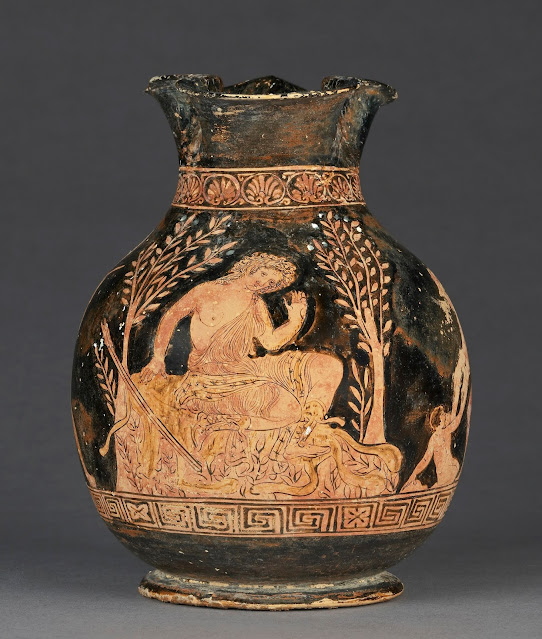
According to Greco-Roman myth, the mortal virgin Kallisto (also spelled Callisto), according to Hesiod the daughter of King Lycaon of Arcadia, spent her time in the Arcadian Mountains of Greece as a favorite hunting companion of Artemis, goddess of the hunt and childbirth. Like all of Artemis' nymph companions, Kallisto had vowed to remain chaste. The king of the Greek gods, Zeus, was attracted to Kallisto (when was Zeus never attracted to all of the voluptuous females cavorting around him?) and seduced her by disguising himself as Artemis, which resulted in the birth of a son, Arkas, who gave his name to the area of Greece known as Arcadia. Artemis, angered at Kallisto's betrayal, (or, according to another version, Zeus's wife Hera, enraged with jealousy) changed Kallisto into a bear. (Yes, it's another example of the rape victim being punished for male misbehavior!) Sixteen years later, her now almost grown son, Arcas, encountered the transformed Kallisto while huntin...

The beautification of Medusa

Image
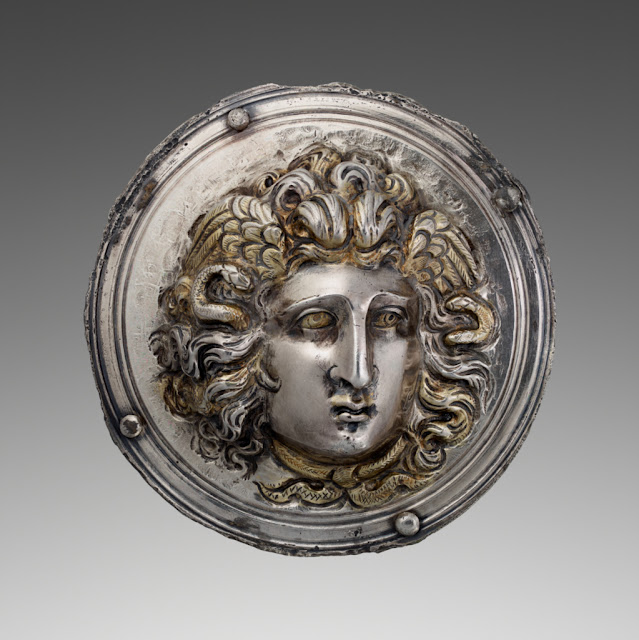
While ancient Greek vase-painters and relief carvers of the Archaic Period imagined Medusa and her two immortal sisters as having monstrous form that is both male and female, human and animal, with  round faces, wide eyes, beards, and gaping mouths with extended tongues and gnashing, sharp teeth, sculptors and vase-painters of the fifth century BCE began to envisage her as being beautiful as well as terrifying and she loses the frightful teeth and beard but retains her wild hair and her uncompromising riveting gaze. In an ode written in 490 BCE, Pindar already speaks of "fair-cheeked Medusa".  Art historians attribute this to the emergence of a new artistic emphasis on the ideal form that codified standards of perfection and beauty. In fact, the depiction of a snake-haired Medusa does not become widespread until much later in the 1st century BCE, further perpetuated by the Roman poet Ovid in his Metamorphoses (4.794–803), who explains that Medusa was originally a beautiful ma...

The Muses

Image
 According to Pausanias, who wrote in the later second century CE, there were originally three Muses, worshipped on Mount Helicon in Boeotia: Aoide ("song" or "tune"), Melete ("practice" or "occasion"), and Mneme ("memory").  The earliest known records of the Muses come from Boeotia and some ancient authorities point to Thrace as the origin of this myth.   Writing in the first century BCE, Diodorus Siculus claims Homer and Hesiod state there are actually nine Muses, though.  According to Hesiod's account (c. 600 BCE), generally followed by most writers of antiquity, the Nine Muses were the nine daughters of Zeus and Mnemosyne (i.e., "Memory" personified), which represented personifications of knowledge and the arts, especially poetry, literature, dance and music.  Ironically, Hesiod says the Muses brought to people forgetfulness, that is, the forgetfulness of pain and the cessation of obligations, though. For poet and ...

Mythical origins of the game of knucklebones in the Mediterranean World

Image
Beginning in 5000 BCE, the talus bones of hooved animals (also known as astragali) have been found in higher numbers than other bones and in contexts unrelated to food preparation in archaeological excavations.  Although the astragalus is not entirely symmetric, it is thought these bones were used like dice in games of chance. Sophocles, in a written fragment of one of his works, ascribed the invention of knucklebones to the mythical figure Palamedes, who taught it to his Greek countrymen during the Trojan War. Both the Iliad and the Odyssey contain allusions to games similar in character to knucklebones.  Palamedes was the warrior Agamemnon sent to Ithaca to retrieve Odysseus, who had promised to defend the marriage of Helen and Menelaus. Odysseus did not want to honor his oath, so he plowed his fields with an ass and an ox both hitched to the same plow, so the beasts of different sizes caused the plow to pull chaotically. Palamedes guessed what was happening and put Odysseus...

Pan: Purveyor of Music and Panic

Image
In Greek mythology, Syrinx was a forest Nymph. In her attempt to escape the affection of the god Pan (god of the wild, shephers, and flocks with the hindquarters, legs and horns of a goat), she was transformed into a water-reed or calamos (cane-reed). Then, Pan cut several reeds, placed them in parallel one next to the other, and bound them together to make a melodic musical instrument. Ancient Greeks called this instrument Syrinx, in honour of the Muse, and Pandean, or Pan-pipes or Pan-flute, after Pan. The Syrinx, a predominantly pastoral instrument for the Greeks, was adopted by the Etruscans who played it at their festivals and banquets called it a fistula. The Romans adopted both Pan, whose Roman counterpart was Faunus, father or Bona Dea, and the Syrinx from the Greeks and the Etruscans, and they too played it at their banquets, festivals, as well as in religious and funeral processions. Despite Homer's account of the chaste nature of Odysseus' wife Penelope in "The ...

One-eyed warriors and Gold-Guarding Griffins

Image
The relief on this elegantly worked roundel depicts a nude youth being attacked by a griffin. It relates to legends, first mentioned by the ancient Greek writer Herodotus, of the people called Arimasps who lived east of the Black Sea.Their land was rich in gold, but the gold was guarded by fierce griffins. The subject became popular during the Hellenistic period, especially for terracottas produced in Tarentum. It is likely that these South Italian models inspired the Central Italian adaptation on this bronze. - Metropolitan Museum of Art The Arimaspi were a legendary tribe of one-eyed people of northern Scythia who lived in the foothills of the Riphean Mountains, variously identified with the Ural or Carpathian mountains.  The tales of their struggles with gold-guarding griffins in the Hyperborean lands beyond Thrace, reported by Herodotus, were originally told in a lost archaeic poem, Arimaspea, by Aristeas,  a native of Proconnesus in Asia Minor, active during the 7th centu...

Cornelius Gallus, poet, orator, politician and first Roman prefect of Egypt

Image
Gaius Cornelius Gallus (c. 30 – 26 BCE) was a Roman poet, orator and politician who supported Octavian and was appointed prefect of Egypt after Octavian defeated Antony and Cleopatra VII.  While in Egypt, he led a campaign to subdue a revolt in Thebes then, perhaps, went too far and erected a monument in Philae to glorify his accomplishments. Octavian recalled him and appointed a new prefect, Aelius Gallus, who was the one who led the disastrous campaign in Arabia Felix (modern day Yemen).  Cassius Dio reports Cornelius Gallus committed suicide upon returning to Rome.   Gallus enjoyed a high reputation among his contemporaries as a man of intellect, and Ovid  considered him the first of the elegiac poets of Rome. He wrote four books of elegies chiefly on his mistress, Lycoris, (a poetical name for Cytheris, a notorious actress), in which he took for his model Euphorion of Chalcis. He also translated some of this author's works into Latin. He is often thought of ...