Posts

Showing posts with the label Osiris

Cloaked Official of the Middle Kingdom Dynasty 13

Image
The Twelfth and early Thirteenth Dynasties comprised one of the most creative artistic epochs in Egyptian history.  Artists introduced many new sculptural forms - some that continued for centuries and others that were soon abandoned.  One of the period's most dramatic and long lasting innovations was the cloaked statue.  The cloak symbolized the god Osiris, whose corpse was wrapped tightly in bandages and who was eventually reborn to everlasting life.  Individuals shown with their bodies shrouded in a thick mantle thus expressed the wish to be reborn following their own physical deaths. - The Brooklyn Museum. Image: Cloaked Official, Middle Kingdom, early Dynasty 13, 1759-1675 BCE, red quartzite, that I photographed at the Brooklyn Museum in 2014.

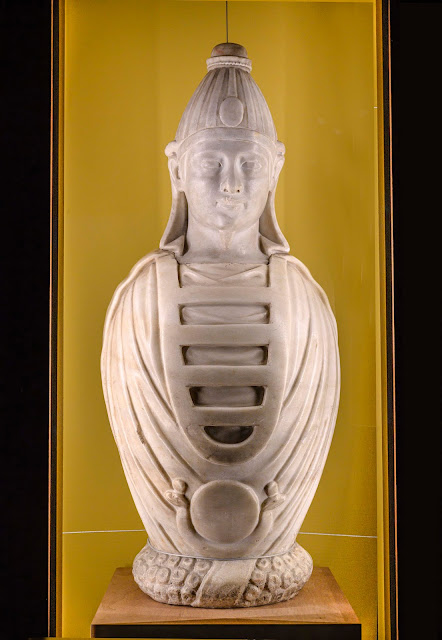
Priest holding a vase from the eastern harbor of Alexandria in the "Egypt's Lost Cities" exhibit at the Ronald Reagan Presidential Library and Museum

Image
Priest holding a vase from the eastern harbor of Alexandria in the "Egypt's Lost Cities" exhibit at the Ronald Reagan Presidential Library and Museum through April 12, 2020. This young priest, carved in black granite holds a vase depicting Osiris, whose cult flourished among Romano-Egyptians in the late 1st century CE. The cult of Isis and Osiris continued at Philae until at least the 450s CE, long after Roman imperial decrees o f the late 4th century that ordered the closing of temples to "pagan" gods. Philae was the last major ancient Egyptian temple to be closed. The ritual reenactment of Osiris's funeral rites were held in the last month of the inundation (the annual Nile flood), coinciding with Spring, and held at Abydos which was the traditional place where the body of Osiris drifted ashore after having been drowned in the Nile. Some elements of the ceremony were held in the temple, while others involved public participation in a form of theater. T...

Osiris-Canopus and the awakening of Osiris at the Ronald Reagan Presidential Library and Museum

Image
Osiris-Canopus with stylized atef crown 2nd century CE from the Temple of Ras El-Soda and the awakening of Osiris crowned by a tcheni in precious metal 26th dynasty (664-525 BCE) from the Egypt's Lost Cities exhibit at the Ronald Reagan Presidential Library and Museum through April 12, 2020. Excavated in 1936 by Achille Adriani, director of the Alexandria Museum, the Temple of Ras El-Soda was originally found just east of ear ly 20th century Alexandria between the sea and the road to Abu Qir. It is a small Ionic prostyle tetrastyle temple constructed of limestone blocks and marble columns. In the cella were found five marble sculptures including Isis, Osiris-Canopus (also known as Osiris Hydreios) type A, Osiris-Canopus type B, Hermanoubis, and Harpokrates. The temple was dated to the second century CE based on the sylistic analysis of the statuary and the lettering of an inscription on a pillar. In Boëthius and Ward-Perkins' authoritative overview of Etruscan and Roman arc...

Res Mortis: Matters of Death in the Ancient Mediterranean. Ongoing, at the Utah Museum of Fine Arts in Salt Lake City, Utah.

Image
Res Mortis: Matters of Death in the Ancient Mediterranean. Ongoing, at the Utah Museum of Fine Arts in Salt Lake City, Utah. Votive sarcophagi in the shape of a hawk that would contain an image of Osiris constructed with wheat and Nile river mud. Egypt. Ptolemaic Period 323-30 BCE. Photographed at the Utah Museum of Fine Arts in Salt Lake City, Utah. Drawn from the permanent collection of Egyptian, Greek, and Roman antiquities, this exhibition focuses on the rich mortuary cult traditions of ancient civilizations around the Mediterranean and features funerary objects at the center of each belief. For ancient Egyptians, funerary objects reflected their  intense preparation to protect and sustain one's Ka, or spirit, in the afterlife. In classical Greece, ceramics were a popular funerary offering in place of costly metal vessels. Initially, decorated ceramics were repurposed as gifts for the dead. Roman sarcophagi frequently portrayed pagan symbolism pointing to a happy af...