Posts

Showing posts with the label Odyssey

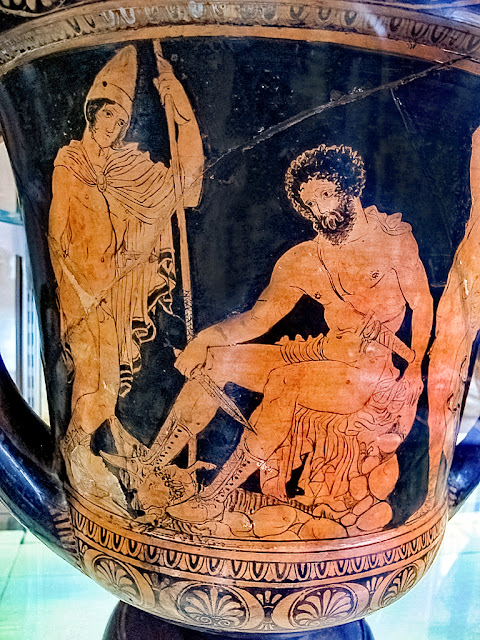
Tiresias, Soothsayer extraordinaire
Image
In Greek mythology, Tiresias was a blind prophet of Apollo in Thebes, famous for clairvoyance  and for being transformed into a woman for seven years. Like other oracles, how Tiresias obtained his information varied: sometimes, he would receive visions, other times he would listen for the songs of birds, or ask for a description of visions and pictures appearing within the smoke of burnt offerings or entrails, and so interpret them. Pliny the Elder credits Tiresias with the invention of augury. In his text De Divinatione, Cicero admits several other nations besides the Romans paid attention to the patterns of flying birds as signs from the gods as well.  Tiresias became a common title for soothsayers throughout Greek legendary history. According to the mythographic compendium Bibliotheke, different stories were told of the cause of Tiresias' blindness, the most direct being that he was simply blinded by the gods for revealing their secrets. An alternative story told by Pherecy...

The "Self-Crowning Athlete"

Image
This sculpture of a self-crowning athlete may have been offered in gratitude by an athlete following a victory.  It shows a young man placing an olive wreath on his head, a symbol of victory, but also a symbol of citizenship.  The "self-crowning athlete" came to represent democracy in ancient Athens where the right to self-rule could be earned through citizenship.   The relief was found at Sounion, within the territory of the Leontis tribe.  The earliest literary reference to Sounion is in Homer's Odyssey (III. 278–285). The story recounts that as the various Greek commanders sailed back from Troy, the helmsman of the ship of King Menelaus of Sparta died at his post while rounding "Holy Sounion, Cape of Athens." Menelaus then landed at Sounion to give his companion full funeral honors with a cremation on a funeral pyre on the beach.  Sounion was fortified in the nineteenth year of the Peloponnesian War (413 BCE) for the purpose of protecting the passage of ...

Odysseus the reluctant hero

Image
Odysseus the reluctant hero. Before the Trojan War when Helen is abducted, Menelaus calls upon the other suitors to honor their oaths and help him to retrieve her, an attempt that leads to the Trojan War. Odysseus tries to avoid the quest by feigning lunacy, as an oracle had prophesied a long-delayed return home for him if he went. He hooks a donkey and an ox to his plow (as they have different stride lengths, hindering the efficiency of t he plow) and (some modern sources add) starts sowing his fields with salt. Palamedes, at the behest of Menelaus' brother Agamemnon, seeks to disprove Odysseus' madness and places Telemachus, Odysseus' infant son, in front of the plow. Odysseus veers the plow away from his son, thus exposing his stratagem. Odysseus holds a grudge against Palamedes during the war for dragging him away from his home. This tale is attributed to the mythographers Pseudo-Apollodorus and Hyginus, who lived many centuries after Homer. Image: Odysseus...