Posts

Showing posts with the label Odysseus

Tiresias, Soothsayer extraordinaire
Image
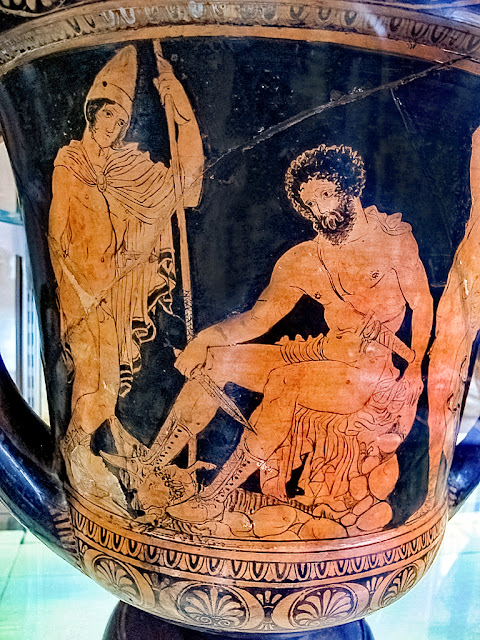
In Greek mythology, Tiresias was a blind prophet of Apollo in Thebes, famous for clairvoyance  and for being transformed into a woman for seven years. Like other oracles, how Tiresias obtained his information varied: sometimes, he would receive visions, other times he would listen for the songs of birds, or ask for a description of visions and pictures appearing within the smoke of burnt offerings or entrails, and so interpret them. Pliny the Elder credits Tiresias with the invention of augury. In his text De Divinatione, Cicero admits several other nations besides the Romans paid attention to the patterns of flying birds as signs from the gods as well.  Tiresias became a common title for soothsayers throughout Greek legendary history. According to the mythographic compendium Bibliotheke, different stories were told of the cause of Tiresias' blindness, the most direct being that he was simply blinded by the gods for revealing their secrets. An alternative story told by Pherecy...

Mythical origins of the game of knucklebones in the Mediterranean World

Image
Beginning in 5000 BCE, the talus bones of hooved animals (also known as astragali) have been found in higher numbers than other bones and in contexts unrelated to food preparation in archaeological excavations.  Although the astragalus is not entirely symmetric, it is thought these bones were used like dice in games of chance. Sophocles, in a written fragment of one of his works, ascribed the invention of knucklebones to the mythical figure Palamedes, who taught it to his Greek countrymen during the Trojan War. Both the Iliad and the Odyssey contain allusions to games similar in character to knucklebones.  Palamedes was the warrior Agamemnon sent to Ithaca to retrieve Odysseus, who had promised to defend the marriage of Helen and Menelaus. Odysseus did not want to honor his oath, so he plowed his fields with an ass and an ox both hitched to the same plow, so the beasts of different sizes caused the plow to pull chaotically. Palamedes guessed what was happening and put Odysseus...

The Blinding of Polyphemus at the Villa of Tiberius

Image
Yesterday while researching the Pasquino group, I came across a picture of the sculptures depicting the blinding of Polyphemus, the cyclops, that was found in a grotto connected to the Villa of Tiberius.  According to Tacitus and Suetonius, the roof of the grotto collapsed while Tiberius was dining, and Sejanus rushed to save Tiberius, for which Tiberius in gratitude promoted him, launching his rise to power. Tiberius moved to Capri after 26 CE. Some of the sculptures are now housed in the museum in Sperlonga and include the assault of Scylla on Odysseus' ship, the blinding of Polyphemus, the theft of the Palladium and Odysseus lifting Achilles's corpse. The works have been attributed to Rhodian sculptors Agesander, Athenedoros and Polydoros, and are thought to be the same authors of the group of "Laocoön and His Sons" (as attributed by Pliny the Elder). Yet whether the very same artists are responsible is questionable. Some scholars believe them to be related, but...

Dogs, a symbol of faithfulness, in ancient art

Image
Domesticated dogs appeared in prehistoric paintings at sites like Bhimbetka in central India that date back more than 100,000 years. During the Bronze Age statues, children's toys, and ceramics depicted dogs. Hunting dogs were most commonly portrayed but pet dogs, valued for their faithfulness and courage were also subjects of ancient art. Dogs were often seen on Greek and Roman reliefs and ceramics as symbols of fidelity and given as gifts among lovers.  Homer's Odyssey reinforced this concept of a dog's faithfulness by telling the story of Odysseus' dog who was the only one that recognized him when he returned home after years of wanderings, even though he was disguised to conceal his appearance. Sadly, because dogs were revered for their loyalty, they were also sometimes sacrificed in special religious rituals.  During Xanthika, a spring purification of the Macedonian army, a dog was sacrificed.  The Spartans sacrificed a dog to Enyalius, the son of Ares, in one o...

Odysseus the reluctant hero

Image
Odysseus the reluctant hero. Before the Trojan War when Helen is abducted, Menelaus calls upon the other suitors to honor their oaths and help him to retrieve her, an attempt that leads to the Trojan War. Odysseus tries to avoid the quest by feigning lunacy, as an oracle had prophesied a long-delayed return home for him if he went. He hooks a donkey and an ox to his plow (as they have different stride lengths, hindering the efficiency of t he plow) and (some modern sources add) starts sowing his fields with salt. Palamedes, at the behest of Menelaus' brother Agamemnon, seeks to disprove Odysseus' madness and places Telemachus, Odysseus' infant son, in front of the plow. Odysseus veers the plow away from his son, thus exposing his stratagem. Odysseus holds a grudge against Palamedes during the war for dragging him away from his home. This tale is attributed to the mythographers Pseudo-Apollodorus and Hyginus, who lived many centuries after Homer. Image: Odysseus...