Posts

Showing posts with the label Nubia

Meroitic Period and retainer sacrifice in ancient Nubia

Image
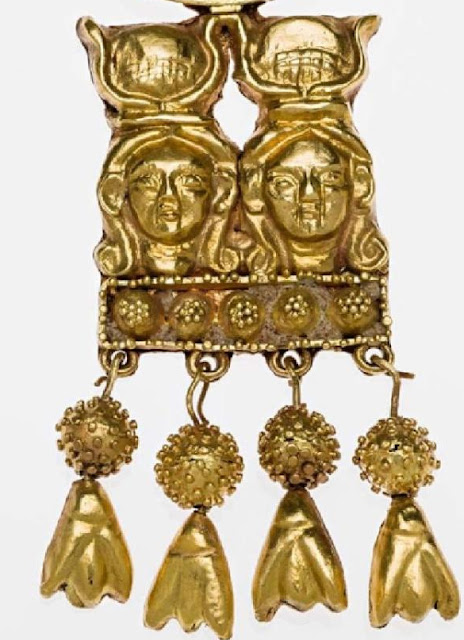
Meroë in ancient Nubia, superseded Napata as the capital of the Kingdom of Kush under King Aspelta in about 591 BCE. Meroe's wealth was centered around a strong iron industry, as well as international trade in jewelry, pottery and textiles involving India and China. Meroitic metal workers engaged in both iron and Nubia's longstanding gold production were considered among the best in the world. The kingdom thrived until the 4th century CE and numerous kings and queens were buried in Meroë's royal cemeteries.  The remains of Meroë were rediscovered by a French mineralogist Frédéric Cailliaud who published an illustrated folio in 1821. The first formal expedition led by Giuseppe Ferlini was launched in 1834. Ferlini primarily recovered mostly jewelry items which are now in the collections of museums in Berlin and Munich.  Then in 1844, C.R. Lepsius examined the ruins and produced plans and sketches of the site. These inspired E. A. Wallis Budge to lead an expedition to Meroë i...

Africans in Greek and Roman Art

Image
The Bronze Age Minoans of Crete were probably the first Greeks to come into contact with Ethiopians, a Greek name meaning those with "burnt" faces.  The tomb of Rekhmire, governor of Thebes and vizier during the reigns of the pharaohs Thutmosis III and Amenhotep II, circa 1400 BCE, includes one of the earliest depictions of both African and Aegean peoples, thought to be Nubians and Minoans.  However, the collapse at the end of the Late Bronze Age severed Greek connections with Egypt and even the Near East. Trade between the Greeks and the northern periphery of Africa finally resumed in the 8th and 7th centuries BCE including the establishment of trading centers along the Nile and at Cyrene on the northern coast of Africa. Then depictions of Africans began to appear in Aegean art. All black Africans were known as Ethiopians to the ancient Greeks, as the fifth-century BCE historian Herodotus tells us, with their black skin color being the primary identifying physical characteri...

Ancient Nubia Now from October 13, 2019 to January 20, 2020 at the Boston Museum of Fine Arts

Image
Ancient Nubia Now from October 13, 2019 to January 20, 2020 at the Boston Museum of Fine Arts. Between 2400 BCE and 300 CE, a series of kingdoms flourished in what is today the Sudanese Nile Valley, a region known in antiquity as Kush and by modern scholars as Nubia. Ruling from the capitals of Kerma (2400–1550 BCE), Napata (800–300 BCE), and Meroe (300 BCE–300 CE), Nubian kings and queens controlled vast empires and trade netwo rks, rivalling—and even for a brief time conquering—their more famous neighbors, the Egyptians. The Nubians left behind the remains of cities, temples, palaces, and pyramids, and their artists and craftspeople produced magnificent jewelry, pottery, metalwork, furniture, and sculpture. “Ancient Nubia Now” features more than 400 highlights from the collection, many never before exhibited. Among the highlights are the exquisite jewels of Nubia’s queens, the nearly lifesize statue of Senkamanisken from the sacred mountain of Gebel Barkal, the army of funerary f...

Ancient Art from the Palace of Ramesses III at the Boston Museum of Fine Arts in Boston, Massachusetts

Image
Ancient Art from the Palace of Ramesses III at the Boston Museum of Fine Arts in Boston, Massachusetts. Ramesses III was the last great military pharaoh of the New Kingdom. In his fifth year on the throne he defeated the Libyans and brought them back to Egypt as slaves. In his eighth year he faced an even greater threat: a confederation of displaced eastern Mediterranean tribes on the move, including Greeks and Philistines, known  collectively as the Sea Peoples. Fresh from their victory over the Hittites, the Sea Peoples attempted to invade Egypt with the intention of settling there. Ramesses roundly defeated them both by sea and by land, recording his victories on the walls of his mortuary temple at Medinet Habu, "United with Eternity," which remains the best-preserved royal mortuary temple on the west bank of Thebes. Images: Tiles depicting a Hittite chief, a Nubian Chief, and a Syrian Chief recovered from the Palace of Ramesses III at Medinet Habu, Egyp...