Posts

Showing posts with the label Museum of Fine Arts Boston

Achilles and Briseis popular motifs in Late Roman and Early Byzantine Periods

Image
This ivory/bone relief is part of a larger plaque that illustrated a scene from the life cycle of the Greek hero Achilles from the Iliad. What remains is a composition of 4 figures, two females (one holding her left hand to her face in a gesture of concern, the other kneeling at her feet offering a stringed instrument—the lyre of Achilles) and two males (one older with balding head and beard, the other younger who is seen from behind) from the left side of the fuller scene, now lost. The use of the architectural setting (a colonnade with fluted columns) and the figure of the draped and worried woman suggests that this a scene from the life cycle of Achilles.The closest composition is found on a large silver luxury plate found in France (now in the Cabinet des Médailles, Paris) seems to be a combination of the leading away of Briseis, the embassy of Phoenix, and the death of Patroclus. The plaque was probably part of a larger group of decorated bone panels that were attached to a wooden...
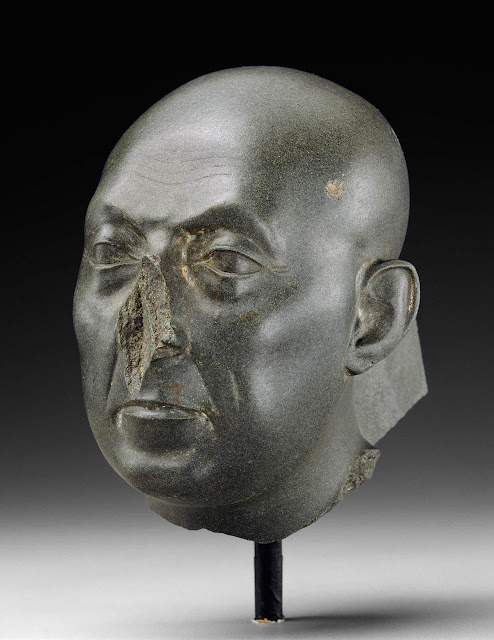
Head of a priest known as the Boston Green Head, Egypt, Late Period, Dynasty 30

Image
Head of a priest known as the Boston Green Head, Egypt, Late Period, Dynasty 30, 380-332 BCE from the Museum of Fine Arts Boston, Massachusetts.  The face of this Egyptian priest is wonderfully lifelike and individual. Light wavy lines indicate the furrows of his brow, and crow’s feet radiate from the outer corners of his eyes. The top of his nose has a pronounced bony ridge. Deep creases run from the edges of his nose to the corners of his mouth. Thin lips and a downturned mouth impart an expression of strength and determination. The slight wart on his left cheek is unique in Egyptian art and also introduces an element of asymmetry an attribute typically incorporated  by artists of the Late Period.  The head was discovered at Saqqara in the Serapeum in 1857-1858 during excavations by Auguste Mariette.  It was subsequently given by Muhammad Said Pasha, viceroy of Egypt, to Prince Napoleon Joseph Charles Paul Bonaparte.  It was then  acquired by collector...

Gold earring with Nike driving a two-horse chariot, Greek, at the Museum of Fine Arts Boston

Image
Gold earring with Nike driving a two-horse chariot at the Museum of Fine Arts Boston. This beautifully detailed earring dates from 350 - 325 BCE. Wearing a belted chiton (tunic), a full-length skirt, and several items of jewelry, Nike, the granddaughter of Poseidon, leans forward, her left hand pulling on the reins of the horses, whose front legs rear sharply. In Greek mythology, Nike flew around battlefields rewarding the vi ctors with glory and fame, symbolized by a wreath of laurel leaves. When Zeus was assembling allies for the Titanomachy against the older deities, Nike assumed the role of the divine charioteer, in which she is often portrayed in Classical Greek art like this exquisite piece of jewelry. The features on the goddess's face are crisp and her expression resolute, while the animals appear startled and tense. Raised as if in flight, Nike's elaborate, feathery, and finely chased wings provide an elegant counterbalance to the dynamic composition. The ornament ...

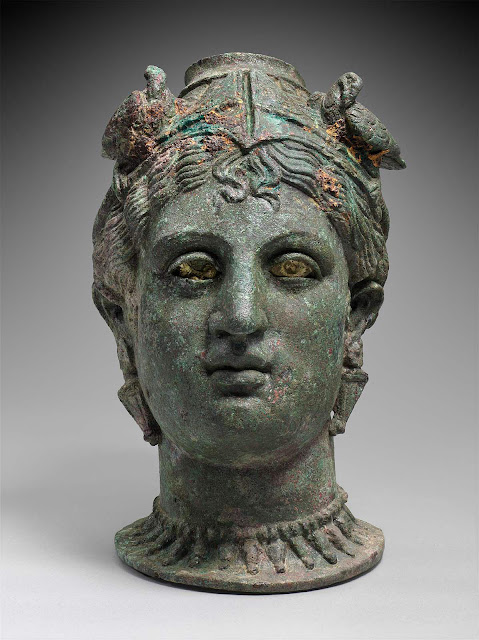
Perfume jar (balsamarium) in the shape of a female head (Aphrodite or Turan?) late 3rd to early 2nd century BCE Italic, Etruscan at the Museum of Fine Arts Boston

Image
Perfume jar (balsamarium) in the shape of a female head (Aphrodite or Turan?) late 3rd to early 2nd century BCE Italic, Etruscan at the Museum of Fine Arts Boston.  This balsamarium or perfume vase is in the shape of a woman's head, most likely the goddess of love, Turan or the Lassae, Etruscan spirits of beauty who waited on divine and mortal women at their toilet. As it was found in a tomb in Etruria (between Ferentinum and Bomarzo), most likely it was a prized possession of a wealthy Etruscan lady. The head is decorated with a diadem with two doves (associated with the worship of Aphrodite), elongated drop earrings, and a necklace of pendants. The eyes were inserted--probably glass irises were set into a fine lime paste. The base is decorated with a rosette.  It was purchased from collector Edward petty Warren for over $69,000.  Its dimensions are 4 1/8 by 3 by 2 1/2 inches. Perfume jar (balsamarium) in the shape of a female head (Aphrodite or Turan?) late 3rd t...