Posts

Showing posts with the label Mithras

The Phrygian cap in Greek and Roman art

Image
The Phrygian cap later known as a liberty cap is a soft conical cap with the apex bent over, associated in antiquity with several peoples in Eastern Europe and Anatolia, including Phrygia, Dacia, and the Balkans.  By the 4th century BCE (early Hellenistic period) the Phrygian cap was associated with Phrygian Attis, the consort of Cybele, the cult of which had by then become graecified. At around the same time, the cap appears in depictions of the legendary king Midas and other Phrygians in Greek vase-paintings and sculpture. The Phrygian cap also came to be applied to several other non-Greek-speaking peoples ("barbarians" in the classical sense). Most notable of these extended senses of "Phrygian" were the Trojans and other western Anatolian peoples, who in Greek perception were synonymous with the Phrygians, and whose heroes Paris, Aeneas, and Ganymede were all regularly depicted with a Phrygian cap.  While the Phrygian cap was of wool or soft leather, in pre-Helle...

Roman Mithraism

Image
 Although scholars argue about whether Roman Mithraism arose in the 1st century BCE or the 1st century CE, Plutarch mentions the pirates of Cilicia were practicing secret rites of Mithras in 67 BCE. Plutarch says these pirates were especially active during the Mithridatic wars (between the Roman Republic and King Mithridates VI of Pontus) in which they supported the king. The association between Mithridates and the pirates is also mentioned by the ancient historian Appian. The 4th century commentary on Vergil by Servius says that Pompey settled some of these pirates in Calabria in southern Italy. However, the unique underground temples or mithraea appear suddenly in the archaeology in the last quarter of the 1st century CE.   The earliest monument showing Mithras slaying the bull thought to have been found in Rome bears an inscription that tells us it was dedicated by a certain Alcimus, steward of T. Claudius Livianus, commander of the Praetorian guard in 101 CE. The firs...

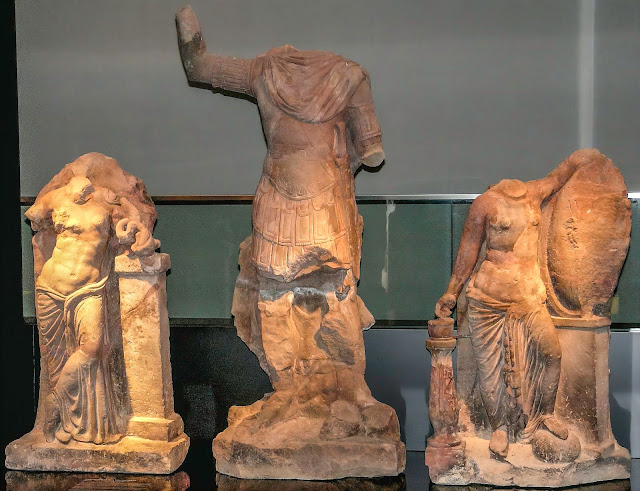
Remains of a Mithraem and Roman religious sculpture at the Roman Museum of Osterburken in the Baden-Württemberg region of Germany

Image
Remains of a Mithraem and Roman religious sculpture at the Roman Museum of Osterburken in the Baden-Württemberg region of Germany. The collections exhibited are primarily finds from the northern Baden Limes region. Objects on display include statuary, architectural elements, funerary monuments, votive objects, models, ceramics, and the remains of a Roman Mithraeum including a statuary group of deities and a figure in Roman military dress. Image: Statue group from the watchtower known as "Tailor's Hedge" courtesy of Wikimedia Commons contributor Hartmann Linge.