Posts

Showing posts with the label Minerva

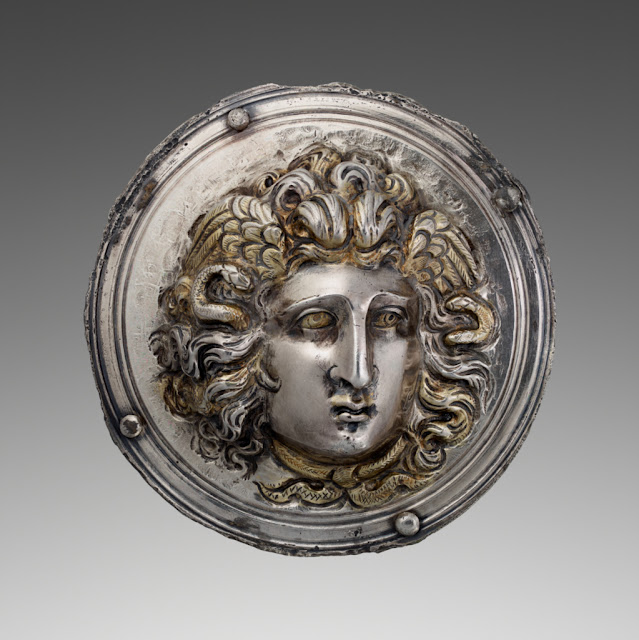
The beautification of Medusa
Image
While ancient Greek vase-painters and relief carvers of the Archaic Period imagined Medusa and her two immortal sisters as having monstrous form that is both male and female, human and animal, with  round faces, wide eyes, beards, and gaping mouths with extended tongues and gnashing, sharp teeth, sculptors and vase-painters of the fifth century BCE began to envisage her as being beautiful as well as terrifying and she loses the frightful teeth and beard but retains her wild hair and her uncompromising riveting gaze. In an ode written in 490 BCE, Pindar already speaks of "fair-cheeked Medusa".  Art historians attribute this to the emergence of a new artistic emphasis on the ideal form that codified standards of perfection and beauty. In fact, the depiction of a snake-haired Medusa does not become widespread until much later in the 1st century BCE, further perpetuated by the Roman poet Ovid in his Metamorphoses (4.794–803), who explains that Medusa was originally a beautiful ma...

The Roman nature of Neptune

Image
Some scholars argue that Indo-European people, having no direct knowledge of the sea as they originated from inland areas, reused the theology of a deity originally either chthonic or wielding power over inland freshwaters for the god of the sea as contact was made with seafaring peoples. They then paired him with Salacia, the goddess of saltwater who subsequently came to represent the virile force of Neptune.  This conclusion was arrived at by the numerous findings of inscriptions mentioning Neptune in the proximity of such locations. Servius the grammarian also explicitly identified Neptune as the deity in charge of all the rivers, springs, and waters. Before the 1st century BCE, the Romans thanked the god Portunus or Fortunus for naval victories, but Neptune supplanted him in this role by at least the first century BCE when Sextus Pompeius, younger son of Pompey Magnus, called himself "son of Neptune."  Like Poseidon, Neptune was also worshipped by the Romans as a god of h...

Minerva or Bellona?

Image
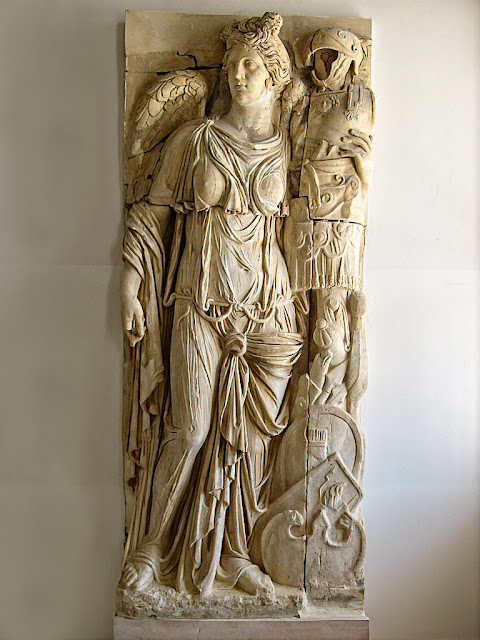
Despite the Roman association between Minerva and Athena and the frequent depiction of both goddesses with armor, unlike Athena, Minerva was not considered a war goddess in the Roman pantheon. The Romans had their own war goddess Bellona, originally an ancient Sabine goddess of war identified with Nerio, the consort of the war god Mars, and later with the Greek war goddess Enyo.  Bellona's main attribute is the military helmet that was worn on her head much like Athena.  Bellona  is often depcicted holding a sword, spear, or shield, and brandishing a torch or whip as she rides into battle in a four-horse chariot.  Bellona had a temple near the Theatre of Marcellus dedicated in 296 BCE near the Circus Flaminius by Appius Claudius Caecus, during the war with the Etruscans and Samnites. The Roman Campus Martius area, in which Bellona’s temple was situated, had extraterritorial status. Ambassadors from foreign states, who were not allowed to enter the city proper, stayed...

Roman pectoral with relief representations of the Capitoline Triad at the Cleveland Museum of Art in Cleveland, Ohio

Image
Roman pectoral with relief representations of the Capitoline Triad at the Cleveland Museum of Art in Cleveland, Ohio. The three deities who are most commonly referred to as the "Capitoline Triad" are Jupiter, the king of the gods; Juno (in her aspect as Iuno Regina, "Queen Juno"), his wife and sister; and Jupiter's daughter Minerva, the goddess of wisdom. This grouping of a male god and two goddesses was highly unusual in anci ent Indo-European religions, and is almost certainly derived from the Etruscan trio of Tinia, the supreme deity, Uni, his wife, and Menrva, their daughter and the goddess of wisdom. Jupiter, Juno and Minerva were honored in temples known as Capitolia, which were built on hills and other prominent areas in many cities in Italy and the provinces, particularly during the Augustan and Julio-Claudian periods. The earliest known example of a Capitolium outside of Italy was at Emporion (now Empúries, Spain). Although the word Capitolium could...

Remains of ancient Oiasso ongoing at the Oiasso Roman Museum in Irun, Spain

Image
Remains of ancient Oiasso ongoing at the Oiasso Roman Museum in Irun, Spain. This museum's archaeological collections include objects worked in leather and wood that reflect an urban settlement developed during the first centuries of the common era as a result of its busy port, located on the Atlantic sea route and mines in the vicinity. The collections are organized in three rooms. The Impact Room presents the Vascon indigeno us world and objects from the first contacts between it and the Roman colonizers. During the Sertorian War of 80-72 BCE Pompey established his headquarters in the territory of the Vascones and it is claimed that he founded Pompaelo, modern day Pamplona, but later studies show it was already the chief town of the Vascones. The Puerto room of the museum, displays ancient artifacts from commerce and fishing. Finally, the Oiasso room focuses on the daily aspects of a Roman city of the high imperial period - diet, clothing, writing, leisure and religion. Visit...