Posts

Showing posts with the label Mesopotamian

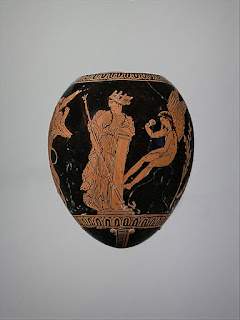
Eggs and Oonoi: Symbols of birth and rebirth in the ancient world
Image
In many myths, ranging from Egypt to the Far East, the initial process of creation and birth begins when a cosmic egg. sometimes fertilized by a serpent but more often laid in the primeval sea by a giant bird. From these sacred eggs, the sun (the golden yolk)  is hatched leading to the division of earth and sky and the multiplicity of life, natural and supernatural. Eggs are well attested as funerary offerings—real eggs, artistic counterparts in marble and terracotta or diminutive vases of egg shape.  Between approximately 65,000 and 55,000 years ago, African hunter-gatherers scratched on eggshells at Diepkloof Rock Shelter in South Africa.  Eggs were found in the Royal Cemetery at Ur dating to 3800 BCE. In archaeological sites of predynastic Egypt (Naqada II period - 3600-3200 BCE) ostrich eggs were found in graves, partially cut and used as containers or placed in graves whole. Many of the eggs were decorated with incised or painted designs which took the form of geomet...

Ancient Art of the Mediterranean. Ongoing at the Seattle Art Museum in Seattle,

Image
Ancient Art of the Mediterranean. Ongoing at the Seattle Art Museum in Seattle, Washington. The permanent collection of ancient art at the Seattle Art Museum includes a wide variety of sculpture, ceramics, glass, reliefs, portraiture, utilitarian objects, and funerary art from Egypt, Mesopotamia, Greece, and Rome. Alabaster head of a Qatabanian (Roman Arabia Felix - ancient Yemen) 3rd - 1st century BCE. The large eye cavities once held typical Near Eastern inlays. Photographed at the Seattle Art Museum, Seattle, Washington.

From Stone to Silicone. Ongoing. At the Harvard Semitic Museum. in Cambridge, Massachusetts

Image
From Stone to Silicone. Ongoing. At the Harvard Semitic Museum. in Cambridge, Massachusetts. - This exhibit features striking silicone replicas of millennia-old reliefs from majestic Assyrian palaces in Nimrud and Nineveh (present-day Iraq). The reliefs can be less than a foot, or more than 12 feet tall. While some are free-standing, others stretch up to 14 feet long.  Using special characters and pictorial text, the reliefs describe King Ashurnasirpal of Assyria engaging in epic battles, speaking to the people of his empire, hunting lions, and boasting of his accomplishments. There are stories about soldiers and prisoners, as well as narratives of lavish celebrations with music and libation. Newly fabricated cast of an ancient relief that once adorned a Mesopotamian palace wall. Meticulously created by museum curators and Harvard students, these relief sculptures show how the ancient kings commemorated their military triumphs and civic achievements. For ancient audiences, the...