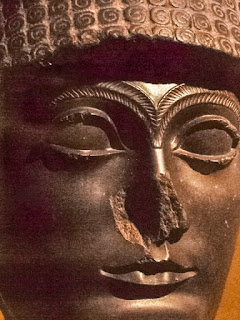
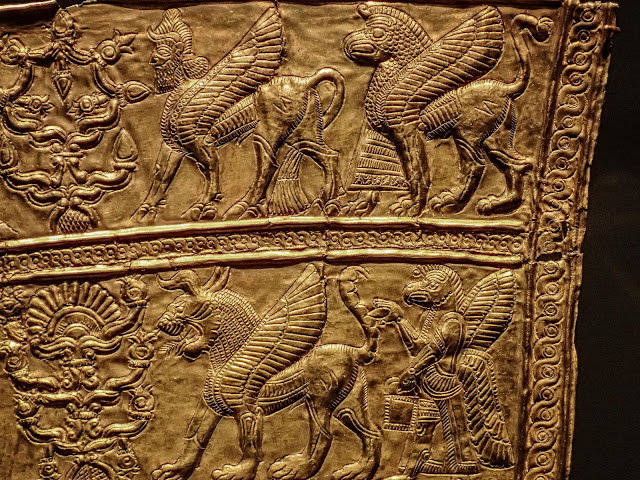
The use of color on early Mesopotamian sculpture

Researchers using ultraviolet-visible spectroscopy have discovered ancient Mesopotamian art, like classical art of Greece and Rome, was often brightly colored although studies have shown the number of colors used appears to be limited to shades of red and black. "Red pigments consist almost entirely of haematite, black is either bitumen or a carbonized product. White is almost non-existent (white lead, gypsum), apart from rare cases where it is used as color lightener for the skin. We did not find either blue or green. It is difficult to judge whether this lack reflects an ancient reality or not. On statues, as well as in most wall paintings, pigments were hardly ever mixed. This seems to be a conscious choice, as mixing pigments is not technically difficult." - Astrid Nunn, Adjunct Professor for Near Eastern Archaeology (retired) at the University of Würzburg. However, scholars noted distinct shifts in color intensity over time. Skin color in the third millennium was ...