Posts

Showing posts with the label Juno

Roman pectoral with relief representations of the Capitoline Triad at the Cleveland Museum of Art in Cleveland, Ohio

Image
Roman pectoral with relief representations of the Capitoline Triad at the Cleveland Museum of Art in Cleveland, Ohio. The three deities who are most commonly referred to as the "Capitoline Triad" are Jupiter, the king of the gods; Juno (in her aspect as Iuno Regina, "Queen Juno"), his wife and sister; and Jupiter's daughter Minerva, the goddess of wisdom. This grouping of a male god and two goddesses was highly unusual in anci ent Indo-European religions, and is almost certainly derived from the Etruscan trio of Tinia, the supreme deity, Uni, his wife, and Menrva, their daughter and the goddess of wisdom. Jupiter, Juno and Minerva were honored in temples known as Capitolia, which were built on hills and other prominent areas in many cities in Italy and the provinces, particularly during the Augustan and Julio-Claudian periods. The earliest known example of a Capitolium outside of Italy was at Emporion (now Empúries, Spain). Although the word Capitolium could...
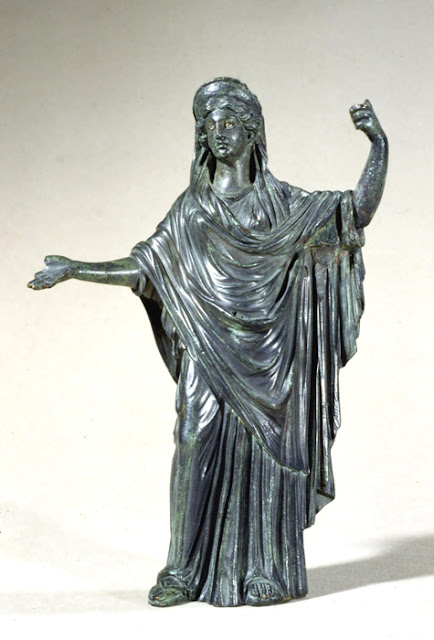
Greco-Roman, African, and Asian antiquities at the Ackland Art Museum of the University of North Carolina at Chapel Hill

Image
Greco-Roman, African, and Asian antiquities at the Ackland Art Museum of the University of North Carolina at Chapel Hill. The collection of the Ackland Art Museum includes over 19,000 works of art. It's ancient works of art include sculpture, glassware, coins, jewelry and ceramics dating as far back as the second millennium. Among some of the more unusual pieces, is a sculpture of a man carrying a fish identified as possibly 4 th century CE Anglo Roman. The African collection includes a sculpture created by the Nok culture of ancient Nigeria dated from 100 BCE - 200 CE. Also, don't miss a painting of a peasant offering Cleopatra VII a basket of figs with an asp by French artist Eugène Delacroix painted in 1838. Images: The goddess Juno, Roman, bronze, 150-200 CE, Man carrying a fish, 4th century CE, Anglo-Roman, and a Nok figural sculpture from ancient Nigeria 100 BCE - 200 CE. All images courtesy of the museum.