Posts

Showing posts with the label Julius Caesar

Disability and the politics of "Divine Disfavor" in the Greco-Roman world
Image
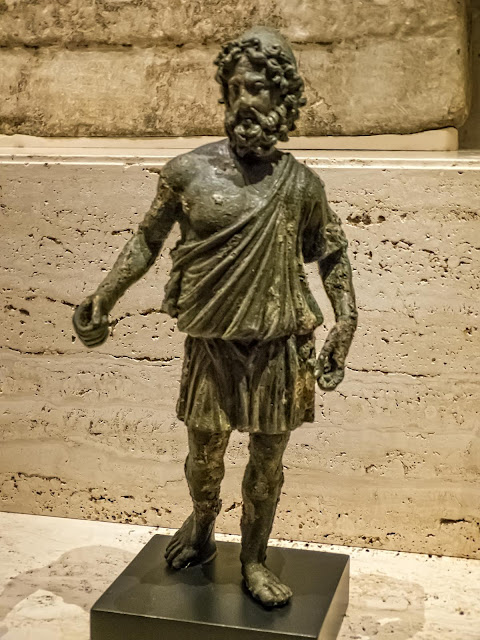
I was reading Classical Wisdom's newsletter in preparation for this weekend's virtual symposium and found their article "Hephaestus:The Humane God" particularly interesting. Although most of us think of Hephaestus as the divine metalworker that forged magical armor and weapons like the shield of Achilles, Sean Kelly pointed out that he was also the only god in the Greek pantheon (and Roman under the name Vulcan) who suffered from a physical impairment.  Hephaestus attempted to intervene in a quarrel between  Zeus and Hera, and an enraged Zeus  cast him from Mount Olympus, injuring his legs.  Thereafter he was the subject of derision because of his lameness although he was respected for his smithing skills. He forged Hermes' winged helmet and sandals, the Aegis breastplate, Aphrodite's famed girdle, Agamemnon's staff of office, Achilles' armour, Diomedes' cuirass, Heracles' bronze clappers, Helios' chariot, the shoulder of Pelops, and even E...

Forgeries of ancient engraved gems

Image
The J. Paul Getty Museum has some spectacular ancient engraved gems in their collections and I have featured a number of them in my posts.  But, during the pandemic one of their curators, Kenneth Lapatin, researched one gem in their collection with a portrait of Marc Antony engraved upon it, and discovered, unfortunately, it was not ancient at all but a 19th century forgery produced by Giovanni Calandrelli for Prince Stanislas Poniatowski, nephew and heir to the King of Poland and Lithuania, and one of the richest men in Europe. Alerted by a friend, the late Gertrud Platz from the Berlin Antikensammlung, who had  just published a study of Giovanni Calandrelli, Lapatin learned she had recently examined a plaster impression that was made of one of Calandrelli's forgeries featuring a portrait of Marc Antony.  Platz suspected the Getty gem was the same work.  So Lapatin sent an impression of the Getty gem to her and they were found to be virtually identical. "There are t...

Germanic or Gallo-Roman prick spur, 2nd - 3rd century CE

Image
Early spurs had a neck that ended in a point, called a prick, riveted to the heel band. The spur was used by the Celts during the La Tène period (which began in the fifth century BCE), and is also mentioned by Xenophon (circa 430 - 354 BCE.) in his treatise "On Horsemanship".   When the horse is about to leap over any obstacle, Xenophon recommends applying the spur on takeoff, so that the horse will use his whole body over the obstacle and make a safer jump. If this is not done, Xenophon points out, he may lag with his hind end. Xenophon goes on to admonish those wishing to make a horse "showy" to spare the spur. He emphasized that the rider should not pull on the bit nor spur or whip the horse, as this type of riding causes the opposite effect, simply distracting and frightening the animal and causing him to dislike being ridden. Instead, Xenophon urges, the horse must enjoy himself. He should be trained to be ridden on a loose rein, to hold his head high, arch his...

A Ptolemaic Prince thought to be possibly Caesarion at the Brooklyn Museum

Image
The young Egyptian kinglet stands with his arms by his sides and hands clenched holding cylinders. His hair is in a naturalistic Roman style and he wears a narrow diadem with uraeus. His eyes were originally inlaid. Could this be one of the few portrayals of Caesarion, Cleopatra's son by Julius Caesar? There is actually little historical mention of Caesarion as a young man until he is named in the Donations of Antioch in 36 BCE. Surprisingly, Octavian gave public approval to the Donations of Antioch, which have been described as an Antonian strategy to rule the East making use of Cleopatra's unique royal Seleucid lineage in the regions donated. However, Octavian did not greet the news of the Donations of Alexandria with a positive response. In that ceremony, Marc Antony proclaimed Caesarion to be a god, son of a god, and "King of Kings" as well as Caesar's true son and heir. Octavian used Roman resentment over the Donations of Alexandria ...

Artifacts from the last battle between the Gauls and Julius Caesar on display through August 31, 2019 at the Museum of Uxellodunum in Vayrac, France

Image
Artifacts from the last battle between the Gauls and Julius Caesar on display through August 31, 2019 at the Museum of Uxellodunum in Vayrac, France. This exhibition presents objects from archaeological excavations of the hilltop oppidum of Uxellodunum including weapons and reconstructed Roman armament. Additional materials can be viewed at the Gallo-Roman Museum located in the Palais de la Raymondie in nearby Martel. The Sieg e of Uxellodunum was one of the last battles of the Gallic Wars. Uxellodunum was heavily fortified, both by its natural position surrounded by a river and by its impressive fortifications built by the Carduci tribe. So, Julius Caesar decided to target the city's water supply, having noticed the difficulty the Gauls had climbing down a very steep slope to reach the riverbank. Caesar stationed archers and balista near the river to cover any attempt to gather water from this main source. When the Gauls resorted to a secondary spring, Caesar ordered his engin...