Posts

Showing posts with the label J. Paul Getty Museum

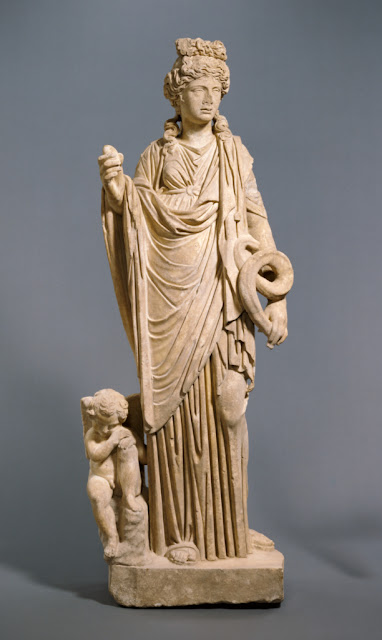
Salus, personification of the security and welfare of the Roman people
Image
 Salus, personification of the security and welfare of the Roman people, 200-250 CE Salus was the Roman personification of health and well being, and came to be very closely associated with the Greek goddess Hygieia, the daughter of the healing god Asclepius. She is often represented in works of art with the same attributes as Hygeia – in particular both are frequently depicted with a snake wrapped around one arm. However, they each kept their own separate identities, and served very different functions. While both deities protected individual health, Salus was also responsible for the prosperity of the Roman state and its rulers. In this regard, she personified the security and welfare of the Roman people, and was therefore an especially important deity for the city of Rome. She had a temple and cult on the Quirinal Hill in Rome, and various representations of the goddess appeared on Imperial Roman coins. Because the Getty’s statue is close to life-size, it may have been a cult im...

Bronze head of Bacchus, Roman, 1st century CE, at the Getty Villa in Pacific Palisades, California.

Image
Bronze head of Bacchus, Roman, 1st century CE, at the Getty Villa in Pacific Palisades, California. "Although only the lower portion of the head survives today, this fragment comes from an elaborate half life-size statue of Bacchus, the Roman god of wine. The jagged edge of the neck shows where the head broke from the body. The now-missing top of the head was cast separately and fitted into the lower part. The head depicts Bacchus  as a young man with long, wavy hair pulled back and originally knotted into a bun at the back of his neck. A headband worn around his forehead holds back his hair, and also hides the seam where the two pieces of the head joined." "The head as originally cast was a relatively simple piece, but the unknown artist added many colorful details to enliven the work. The heavily incised line around the lips suggests that they were made separately of copper and inserted into the head. The eyes were inlaid with a contrasting material. A silver in...