Posts

Showing posts with the label Italic

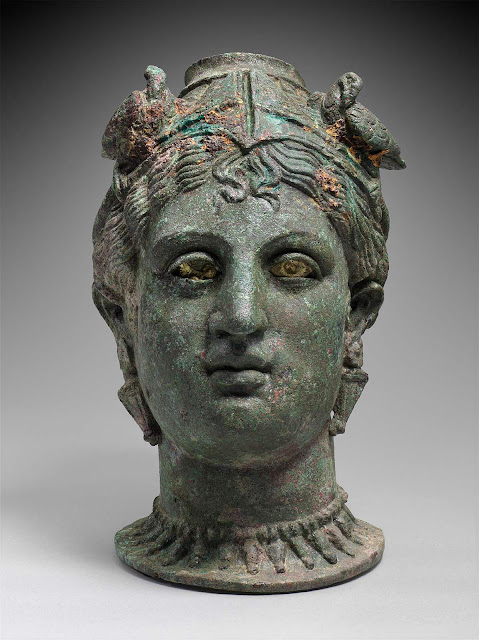
Perfume jar (balsamarium) in the shape of a female head (Aphrodite or Turan?) late 3rd to early 2nd century BCE Italic, Etruscan at the Museum of Fine Arts Boston
Image
Perfume jar (balsamarium) in the shape of a female head (Aphrodite or Turan?) late 3rd to early 2nd century BCE Italic, Etruscan at the Museum of Fine Arts Boston.  This balsamarium or perfume vase is in the shape of a woman's head, most likely the goddess of love, Turan or the Lassae, Etruscan spirits of beauty who waited on divine and mortal women at their toilet. As it was found in a tomb in Etruria (between Ferentinum and Bomarzo), most likely it was a prized possession of a wealthy Etruscan lady. The head is decorated with a diadem with two doves (associated with the worship of Aphrodite), elongated drop earrings, and a necklace of pendants. The eyes were inserted--probably glass irises were set into a fine lime paste. The base is decorated with a rosette.  It was purchased from collector Edward petty Warren for over $69,000.  Its dimensions are 4 1/8 by 3 by 2 1/2 inches. Perfume jar (balsamarium) in the shape of a female head (Aphrodite or Turan?) late 3rd t...

Italic disc with mythological relief that possibly served as a shield boss at the Saint Louis Art Museum in Saint Louis, Missouri

Image
Italic disc with mythological relief that possibly served as a shield boss at the Saint Louis Art Museum in Saint Louis, Missouri. Today's artifact is another interesting piece from the collections of the Saint Louis Art Museum. A bronze disc with a relief depicting mythological creatures and stylized human figures thought to be a shield boss from the 7th to early 6th century BCE Italic people of Tuscany near the settlement of V etulonia, formerly the Etruscan city of Vatluna. The city was part of the Etruscan League of twelve cities that opposed Rome in the 7th century B.C.E. According to Silius Italicus, the Romans adopted their magisterial insignia, the Lictors' rods and fasces and the curule seat, from Vetulonium (its Roman name). In 1898, a tomb in the necropolis was discovered with a bundle of iron rods with a double-headed axe in the centre, and soon afterwards, a grave stela inscribed for Avele Feluske was discovered, on which the fasces were pictured. The city...

Museo delle Palafitte of Fiavé, Italy.

Image
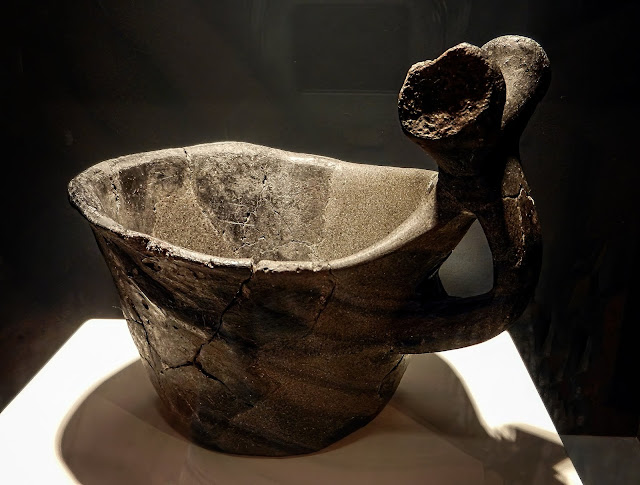
Museo delle Palafitte of Fiavé, Italy.  On the shores of Lake Carera, of glacial origin, and a nearby peat bog, man has lived at least since the Mesolithic Period (7th millennium BCE) to the end of the Bronze Age. Between the fourth and second millennium BCE, there were villages of pile-dwellings, still visible today in the nearby archaeological area of ​​the Fiavé bog. In the museum there is a selection of the extraordinary objects found by archaeologists including ceramic tableware, bronze and - very rare at the time - Baltic amber and gold jewelry.  The objects in wood are exceptional, too, and are among the oldest in the world, having been preserved for 3800-3400 years: cups, ladles, whisks, trays, buckets, bats, sickles, drills, ax handles. Food remains that the people cultivated and harvested are also displayed. Guided tours of the museum and archaeological site are available. Image: A mug recovered at the archaeological site near Fiavé, Italy.  Image courte...