Posts

Showing posts with the label Isis

Rome's integration of Isis

Image
In the first millennium BCE, Osiris and Isis became the most widely worshipped Egyptian deities, and Isis absorbed traits from many other goddesses. Rulers in Egypt and its neighbor to the south, Nubia, built temples dedicated primarily to Isis, and her temple at Philae was a religious center for Egyptians and Nubians alike. Her reputed magical power was greater than that of all other gods, and she was said to protect the kingdom from its enemies, govern the skies and the natural world, and have power over fate itself. In the Hellenistic period (323–30 BCE), when Egypt was ruled and settled by Greeks, Isis was worshipped by Greeks and Egyptians, along with a new god, Serapis. Their worship diffused into the wider Mediterranean world. Isis's Greek devotees ascribed to her traits taken from Greek deities, such as the invention of marriage and the protection of ships at sea, and she retained strong links with Egypt and other Egyptian deities who were popular in the Hellenistic world, ...

Social Integration in Roman Period Egypt

Image
The social structure in Aegyptus under the Romans was both unique and complicated. On the one hand, the Romans continued to use many of the same organizational tactics that were in place under the leaders of the Ptolemaic period. At the same time, the Romans saw the Greeks in Aegyptus as “Egyptians”, an idea that both the native Egyptians and Greeks would have rejected. To further compound the whole situation, Jews, who themselves were very Hellenized overall, had their own communities, separate from both Greeks and native Egyptians. The Romans began a system of social hierarchy that revolved around ethnicity and place of residence. The Augustan takeover introduced a system of compulsory public service, which was based on poros (property or income qualification), which was wholly based on social status and power. Other than Roman citizens, a Greek citizen of one of the Greek cities had the highest status, and a rural Egyptian would be in the lowest class. In between those classes was t...

Foot end of a Roman coffin with both Roman and Egyptian iconography 3rd century CE

Image
This rectangular panel is the foot end of a coffin from Roman Egypt.  It was originally connected to the rest of the coffin through dowels placed in the various holes around the perimeter. The unpainted edges of the panel were likely covered up when the coffin was whole. The scene depicts a funerary banquet in which the deceased is enjoying life in the next world. It reflects Graeco-Roman iconography to which various elements of ancient Egyptian iconography have been added.  The central figure is the deceased who reclines on the funerary couch or bed.  The wing and the floral wreath worn on the head indicate the successful passage of the deceased to the Afterlife. At the head of the bed is a dancing figure playing the double flute (aulos).  The flute player stands on a base in the shape of an Egyptian shrine decorated with a cavetto cornice and sun disc with pendant uraeii snakes.  Below is depicted a female figure holding two vertical snakes. She is a protectiv...

Roman worship of the Egyptian goddess Isis

Image
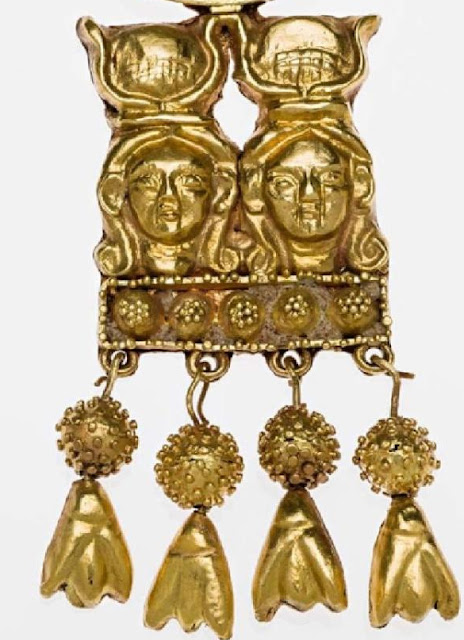
 Greeks were aware of Egyptian deities, including Isis, at least as early as the Archaic Period (c. 700–480 BCE), and her first known temple in Greece was built during or before the fourth century BCE by Egyptians living in Athens. The conquests of Alexander the Great late in that century created Hellenistic kingdoms around the Mediterranean and Near East, including Ptolemaic Egypt, and put Greek and non-Greek religions in much closer contact. The resulting diffusion of cultures allowed many religious traditions to spread across the Hellenistic world in the last three centuries BCE.  Isis's cult reached Italy and the Roman sphere of influence at some point in the second century BCE. It was one of many cults that were introduced to Rome as the Roman Republic's territory expanded in the last centuries BCE. Authorities in the Republic tried to define which cults were acceptable and which were not, as a way of defining Roman cultural identity amid the cultural changes brought on b...

Isis-Aphrodite, Roman symbols of fertility and rebirth in the Second Century CE

Image
Isis-Aphrodite is a form of the great goddess Isis that emphasizes the fertility aspects associated with Aphrodite. She was concerned with marriage and childbirth and, following very ancient pharaonic prototypes, also with rebirth. Figures depicting this goddess are found in both domestic and funerary contexts. Popular already in the 3rd to 2nd centuries B.C., they continued to be made in Roman times. Dating technology places these pieces in the Roman period. These statuettes were created between 161 - 180 CE and are thought to be possibly reflecting the image of Empress Faustina Minor, wife of Marcus Aurelius. Statuettes with a vulture cap have been found in both Egypt and Syria. Images courtesy of The Metropolitan Museum of Art. Isis-Aphrodite resembling the Roman Empress Faustina Minor, wife of Marcus Aurelius, 1st - 2nd century CE Egypt Isis-Aphrodite with vulture cap that resembles Roman Empress Faustina Minor wife of Marcus Aurelius 161-180 CE Egypt

Ancient Nubia Now from October 13, 2019 to January 20, 2020 at the Boston Museum of Fine Arts

Image
Ancient Nubia Now from October 13, 2019 to January 20, 2020 at the Boston Museum of Fine Arts. Between 2400 BCE and 300 CE, a series of kingdoms flourished in what is today the Sudanese Nile Valley, a region known in antiquity as Kush and by modern scholars as Nubia. Ruling from the capitals of Kerma (2400–1550 BCE), Napata (800–300 BCE), and Meroe (300 BCE–300 CE), Nubian kings and queens controlled vast empires and trade netwo rks, rivalling—and even for a brief time conquering—their more famous neighbors, the Egyptians. The Nubians left behind the remains of cities, temples, palaces, and pyramids, and their artists and craftspeople produced magnificent jewelry, pottery, metalwork, furniture, and sculpture. “Ancient Nubia Now” features more than 400 highlights from the collection, many never before exhibited. Among the highlights are the exquisite jewels of Nubia’s queens, the nearly lifesize statue of Senkamanisken from the sacred mountain of Gebel Barkal, the army of funerary f...