Posts

Showing posts with the label House of the Faun

Persian cavalry before the cataphractarii

Image
The Persians did not use cavalry to a great extent until Cyrus the Great  gave the Persian nobility both horses and the wealth to maintain them from the proceeds of his western conquests. He encouraged them to ride and it became a source of disgrace for a Persian noble to be seen walking.  Cyrus then recruited his cavalry from the nobles, creating a regiment of 15,000 men drawn from the Huvaka or “kinsmen.” These kinsmen adopted brightly-colored trousers and shorter tunics that were more suitable for riding from the Medes.  Cyrus adopted cavalry tactics from the Khorassan horsemen of northeastern Iran, parts of modern Afghanistan and the southern parts of Central Asia. He initially armed his cavalry with the standard weapons of the Persian infantrymen: bows, battle-axes, and oval shields. Later, they were re-equipped with short stabbing swords and throwing javelins instead. Long lances and spears made of wood or entirely of metal were used too. In the mid-5th century Pers...
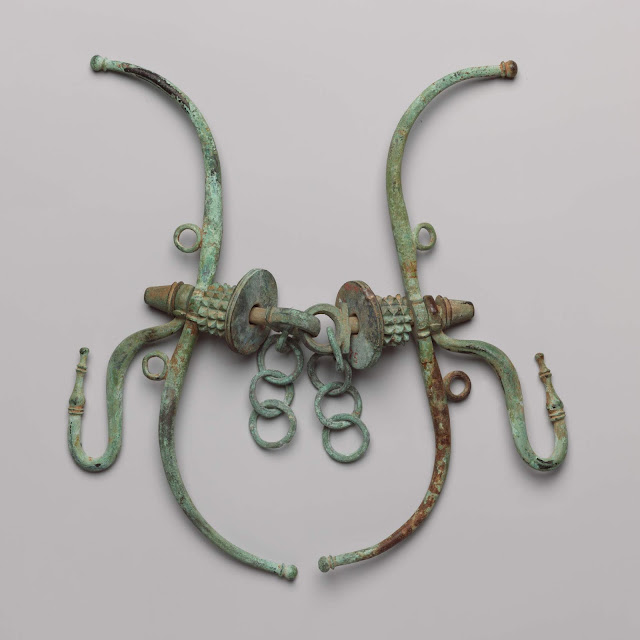
The bit that controlled the mighty Bucephalus

Image
There is evidence of the use of bits to control horses, located in two sites of the Botai culture in ancient Kazakhstan, dated about 3500–3000 BCE.  Nose rings appear on the equids portrayed on the Standard of Ur, circa 2600–2400 BCE. To date, the earliest known artistic evidence of use of some form of bitless bridle comes in illustrations of Synian (Syrian?) horseman, dated approximately 1400 BCE.  Metal bits came into use between 1300 and 1200 BCE, originally made of bronze.   The need for control of horses in warfare drove extensive innovation in bit design, producing a variety of prototypes and styles over the centuries. This bit is of a distinctive type attested in Northern Greece and used for horses that are ridden rather than driven. Its most noteworthy occurrence is on the mount of Alexander of Macedon in the famous Alexander mosaic from the Casa del Fauno in Pompeii and now in the Archaeological Museum, Naples. Bronze bit, Greek, 4th-3rd century BCE at...

Roman viridaria: Islands of tranquility in a brutal world

Image
Roman gardens and ornamental horticulture became highly developed under Roman civilization. The Gardens of Lucullus (Horti Lucullani), on the Pincian Hill in Rome, introduced the Persian garden to Europe around 60 BCE. It was seen as a place of peace and tranquillity, a refuge from urban life, and a place filled with religious and symbolic meaning. (Although the gardens of Lucullus are no longer fully extant, the Villa Borghese gardens cover 17 acres on what was once the site.) Even though Lucullus was mocked for his horticultural passion with Pompey calling him the Roman Xerxes and Tubero calling him Xerxes in a toga, as Roman culture developed and became increasingly influenced by foreign civilizations, the use of gardens expanded. Roman pleasure gardens were adapted from the Greek model, where such a garden also served the purpose of growing fruit. The Roman peristyle garden, adapted from the Greeks, was used to beautify temple groves and create recreational spaces. Open peristy...