Posts

Showing posts with the label Horus

The Transformation of Pharaonic deities to household gods in Roman Egypt

Image
The iconography and style of depictions of Horus and other traditional Egyptian deities were influenced by Hellenistic and, later, Roman traditions of representation, often combining trappings of power in ways that are striking to modern observers. "Roman period depictions of  the falcon-headed Horus have been  found  in  a  variety  of   materials  throughout  the  empire,  from  Egypt  to  Oxfordshire.  Usually  dressed  in  Roman  military costume, falcon-headed Horus is sometimes depicted on horseback, but more often standing, while seated figures are rare. Although smaller figures may have been dedicatory, larger stone and metal sculptures were probably objects of  public or private devotion." - Polychromy in Roman Egypt: A study of a limestone sculpture of the Egyptian god Horus by Joanne Dyer, Elisabeth R. O"Connell, and Antony Simpson. Sir Harold Bell observes, "...a new reli...

Bronze Romano-Egyptian Sword hilt in the form of the falcon-god Horus instead of an eagle, Roman Imperial Period, 1 -400 CE, at the Royal Ontario Museum in Toronto.

Image
This cast bronze hilt of a sword depicts a bird's head, which is actually the Horus falcon, as it has the crown of Upper and Lower Egypt on its head. Such influences from Ancient Egypt were common in Ptolemaic and Roman Egypt. The best known parallel we have to this sword grip are the hilts of swords depicted as being carried by the Emperor Diocletian and the Tetrarchy, dated to about 300 CE; but these and other known Roman swords are clearly eagles. The eagle was the primary symbol of the Roman army from the time of the reforms of Marius in 104 BCE, but Horus is far more ancient, being an important god in Predynastic Egypt (before 3,200 BCE). As the religion and pantheon of Ancient Egypt grew and synthesized with political unification, Horus remained important. Under the influence of the monotheistic Achaemenid Persians, who ruled Egypt between 525-402 BCE and again in 343-332 BCE, Egyptian religion seemed to become more centered around the Osiris-Isis-Horus trinity. This develope...

Cultural mingling in the Roman provinces of the 3rd century CE

Image
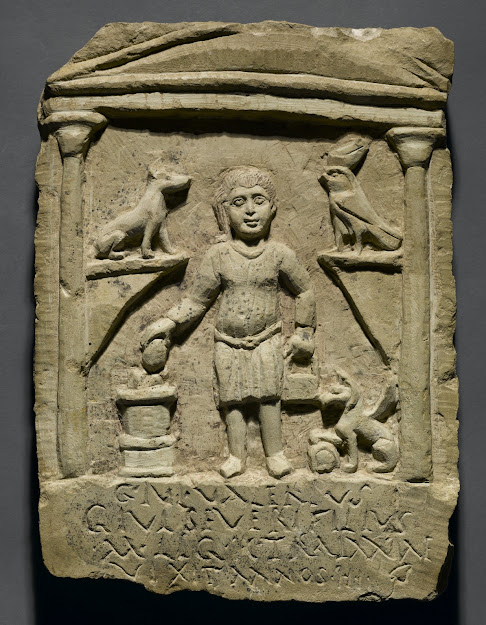
This funerary stela shows a boy who died when he was three. His father, a Roman soldier, was stationed near Alexandria. His Egyptian mother is not mentioned. The child’s costume and pose are Roman, but his long sidelock of hair is traditionally Egyptian, as are the jackal god Anubis and the falcon god Horus above his head. The griffin in the lower right corner represents the classical goddess Nemesis, who controlled life and death and appears to show Greek influence. In his left hand is a bucket perhaps a type of situla used as a libation vessel.  With his right hand he grasps a circular object, perhaps an offering he is about to place on the small altar. He is probably intended to represent Horus.  The Latin inscription provides the boy's name and age at death.  Extensive but faint traces of bright red paint remain on the hatched background. It is thought this monument was recovered at Terenouthis, Egypt, located in the western Nile Delta, about 70 km northwest of Cairo....