Posts

Showing posts with the label Hermes

Winged deities of Greco-Roman mythology

Image
Winged male figures that are distinct from Hermes appear quite frequently in Attic art of the mid-sixth century B.C.E. Without inscriptions they are difficult to identify. In all of Greek art, the distinction between the human and the divine, the tangible and intangible, is elusive. Although we do not know all of their names, these figures surely move between various orders of reality.  - Metropolitan Museum of Art Besides Hermes, one of the best known of these winged deities is Morpheus, the son of sleep and associated with sleep and dreams.   In Ovid's Metamorphoses, he is one of the thousand sons of Somnus and he appears in dreams in human form.   According to Ovid "no other is more skilled than he in representing the gait, the features, and the speech of men. The clothing also and the accustomed words of each he represents." Ovid gives names to two more of these sons of Sleep. One called Icelos ('Like'), by the gods, but Phobetor ('Frightener') by men,...

The Anthesteria

Image
The three-day festival of the Anthesteria was celebrated around the time of the full moon in January or February.  It celebrated the beginning of spring, particularly the maturing of the wine stored at the previous vintage, whose pithoi were now ceremoniously opened. During the feast, small gifts were exchanged and social order was interrupted or inverted, much like Roman Saturnalia, with the household slaves allowed to participate. The Anthesteria also had aspects of a festival of the dead.  Both the Keres, female spirits who bewailed violent death on the battlefield, or the Carians were ritually entertained and thought to roam the city until they were expelled at the conclusion of the festival.  A Greek proverb, said of those who pestered for continued favors,  "Out of doors, Keres! It is no longer Anthesteria!" On day one of the festival, known as Pithoigia, the jars of wine from the previous year were opened, libations offered to Dionysus, and the entire househol...

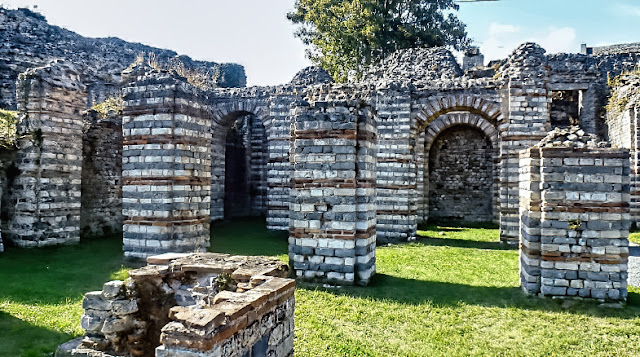
Gallo-Roman remains of ancient Bavacum, once the capital for the Nervii tribe in Bavay, France

Image
Gallo-Roman remains of ancient Bavacum, once the capital for the Nervii tribe in Bavay, France. Local legends point to the city of Bavay's founding by a cousin of Priam fleeing the destruction of Troy in the 12th century BCE. But archaeologists have been unable to find remains dating that far into antiquity. However, the site served as a capital of the Nervii tribe, connecting their city to the capital cities of neighbouring  Amiens via Arras, Tongeren, Cassel, Trier in the east and Reims in the south, until their defeat by Julius Caesar during the Gallic Wars. The location then became known as Bavacum (or Bagacum) when it was designated a Roman civitas as the result of a reorganization by Augustus between 16 and 13 BCE. The town became an important commercial junction of seven roads on the trade routes between Germania and the naval port of Boulogne-sur-Mer. During the Claudian period through the dynasty of the Flavians, a forum, thermal baths fed by an aqueduct bringing water...