Posts

Showing posts with the label Hercules

The Painters of Pompeii: Roman Frescoes from the National Archaeological Museum, Naples

Image
The Painters of Pompeii: Roman Frescoes from the National Archaeological Museum, Naples will open June 26, 2021 at the Oklahoma City Museum of Art.  It will be on display until October 17, 2021. Tickets will be available on a timed entry basis with limited capacity to ensure adequate social distancing.  Although masks are encouraged, they are not required for fully vaccinated visitors.  Eighty artifacts and artworks from Pompeii and Herculaneum will be presented. During the exhibition, the museum plans to host a series of lectures in the Noble Theater with several of the most renowned scholars in the field of Ancient Roman Art and History.  Topics include the rediscovery of Pompeii, Food & Wine in Pompeii, Roman Painting, and Powerful Elite Women in Imperial Rome. The exhibit notice says its appearance at the Oklahoma City Museum of Art will be its only US presentation. Image: Polyphemus hears of the arrival of Galatea (or Hercules and Omphale), ancient Roman fre...

Heracles (Hercules) and the Lernaean Hydra

Image
The Lernaean Hydra or Hydra of Lerna more often known simply as the Hydra, is a serpentine water monster in Greek and Roman mythology. Its lair was the lake of Lerna in the Argolid. Lerna was reputed to be an entrance to the Underworld, and archaeology has established it as a sacred site older than Mycenaean Argos. In the canonical Hydra myth, the monster is killed by Heracles (Hercules) as the second of his Twelve Labors. The oldest extant Hydra narrative appears in Hesiod's Theogony, while the oldest images of the monster are found on a pair of bronze fibulae dating to c. 700 BCE. In both these sources, the main motifs of the Hydra myth are already present: a multi-headed serpent that is slain by Heracles and Iolaus. While these fibulae portray a six-headed Hydra, its number of heads was first fixed in writing by Alcaeus (c. 600 BCE), who gave it nine heads. Simonides, writing a century later, increased the number to fifty, while Euripides, Virgil, and others did not give an exac...

Bust of a Boy or Eros with the Attributes of Herakles, 150-100 BCE, Roman Period, Greece

Image
This thinly-cast bust depicts a youth wearing a lion-skin over his head and a quiver strap across the chest. The figure has delicate features and fine hair that is drawn up in a braid with tendrils falling onto his forehead. The figure may depict a young Herakles, or an unidentifiable youth in the guise of the great hero. A third possibility is that this young man is Eros, who was often depicted with attributes associated with Herakles. Two small holes at the bottom edge may have been used to attach this bust to a piece of furniture.  While in wealthy households beds were used for sleeping in the bedrooms (lectus cubicularis), and couches for banqueting while reclining were used in the dining rooms (lectus tricliniaris), the less well off might use the same piece of furniture for both functions. The two types might be used interchangeably even in richer households, and it is not always easy to differentiate between sleeping and dining furniture. The most common type of Roman bed to...

Heracles and the Cretan Bull

Image
According to Jeremy McInerney, the iconography of the bull permeates Minoan culture. The cult of the bull was also prominent in southwestern Anatolia. Bernard Clive Dietrich notes that the most important animal in the Neolithic shrines at Çatalhöyük was the bull. The bull was a chthonic animal associated with fertility and vegetation. It figured in cave cults connected with rites for the dead.   According to Greek myth, to confirm his right to rule, King Minos of Crete prayed to Poseidon to send him a snow-white bull as a sign. Poseidon sent Minos the bull, with the understanding that bull would be sacrificed to the god. Deciding that Poseidon's bull was too fine of a specimen to kill, Minos sent the bull to his herds and substituted another, inferior bull for sacrifice. Enraged, Poseidon had Aphrodite cause Pasiphaë, wife of Minos, to fall in love with the bull. She subsequently gave birth to the half-man, half-bull, Minotaur. Poseidon passed on his rage to the bull, causing ...

Tales of Telephus

Image
In Greek mythology, Telephus (also Telephos - meaning "far-shining") was the son of Auge, a priestess of Athena who was raped by Heracles.  When her father, King Aleus of Tegea learned of her violation, he attempted to dispose of mother and child. But they ended up in Asia Minor at the court of Teuthras, king of Mysia, where Telephus was adopted as the childless king's heir. How mother and son ended up in Asia Minor is explained in a variety of versions. In the oldest extant account from a fragment of Hesiod's "Catalogue of Women, 6th century BCE, Auge goes to Mysia, is raised as a daughter by Teuthras, raped by Heracles when he arrives seeking the horses of Laomedon, and Telephus is born there. In some accounts Telephus arrives in Mysia as an infant with his mother, where Teuthras marries Auge, and adopts Telephus. In still another tale, while Auge (in various ways) is delivered to the Mysian court where she again becomes wife to the king, Telephus is instead le...

Mycenaean frescos from the palace of Tiryns

Image
Tiryns is the site of a Mycenaean palace and city where the hero Heracles is thought to have resided while he performed his twelve labors.  Although it originated before the Bronze Age, it reached its height between 1400 and 1200 BCE and was considered one of the most important centers of the Mycenaean world, especially in Argolis.  Tiryns is first referenced by Homer, who praised its massive walls. Ancient tradition held that the walls were built by the Cyclopes because only giants of superhuman strength could have lifted the enormous stones.  Tradition also associates the walls with Proetus, the sibling of Acrisius, king of Argos. According to the legend Proetus, pursued by his brother, fled to Lycia. With the help of the Lycians, he managed to return to Argolis. There, Proetus occupied Tiryns and fortified it with the assistance of the cyclopes. The city's  acropolis was constructed in three phases, the first at the end of the Late Helladic II period (1500–1400 BC...

Bronze Herm of Herakles

Image
This type of bronze pillar herm of Herakles wrapped in a lion skin  and wearing an ivy wreath, found in the sea off the coast of Halikarnassos, was often used as a boundary marker for gymnasia and palaestrae (exercise yards).  Marble examples have been found on the island of Delos.  Similar reliefs of Herakles have also been found  in east Greece on Hellenistic graves. I photographed this herm on my last visit to the British Museum in 2016.  It is dated between 200-100 BCE. Bronze herm of Herakles Greek 200-100 BCE Halikarnassos.  Photographed at The British Museum in London.

Philoctetes and compassion for Hercules on the Pyre

Image
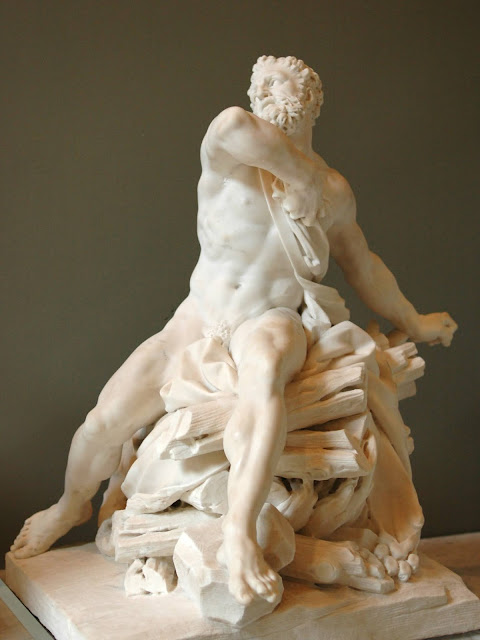
According to the most common legend of Hercules' death, no one but Hercules' friend Philoctetes,  son of King Poeas of the city of Meliboea in Thessaly, would light his funeral pyre. For his compassion, Philoctetes  received Hercules' bow and arrows. Later, Philoctetes as one of the many eligible Greeks who competed for the hand of Helen, the Spartan princess, was required to participate in the Trojan War to reclaim Helen for Menelaus when she was stolen away by Paris.  On his way to the Trojan War, Philoctetes was bitten by a snake that Hera sent to molest him as punishment for his service to Hercules. The wound festered and began to smell so his Greek companions stranded Philoctetes on the island of Lemnos. When the Greeks reached Troy, Helenus, the prophetic son of King Priam, revealed under torture that one of the conditions for the Greeks to win the war was that they needed the bow and arrows of Hercules as some of the arrows were those dipped in the poison bloo...

Giambologna brings Heracles to life

Image
Yesterday, I featured the beautiful sculpture, "Kidnapping of the Sabine Women" by Giambologna displayed at the Loggia Dei Lanzi in Florence, Italy. Another spectacular work of Giambologna displayed there as well portrays the battle between Heracles and the centaur Nessus. Nessus was a famous centaur who carried off Deianeira, the wife of Heracles, and tried to force himself on her.  Heracles saw him from across the river and shot a Hydra-poisoned arrow into Nessus's breast. As he lay dying, in a final act of malice, Nessus told Deianeira that his blood would ensure that Heracles would be true to her forever, knowing the blood to be infected with the hydra's poison.  Sometime later, Deianeira's trust in Heracles began to wane because of his unrequited love for Iole, the daughter of King Eurytus of Oechalia. Heracles had been forbidden to marry Iole because her father, the king, feared she would meet the same fate as Heracles' first wife, Megara, who, alon...

Samian ware flask from Southern Gaul, 1st century CE, depicting Heracles killing Laomedon, King of Troy, at the Museo Civico Archeologico della Valle Sabbia in Gavardo (Brescia)

Image
Samian ware flask from Southern Gaul, 1st century CE, depicting Heracles killing Laomedon, King of Troy, at the Museo Civico Archeologico della Valle Sabbia in Gavardo (Brescia). In one version of mythology, Laomedon, king of Troy, was the father of Ganymede. Zeus fell in love with the beautiful boy and, disguised as an eagle, kidnapped the child. Laomedon grieved so much for his son Zeus sent Hermes to Laomedon with two magn ificent horses so swift they could run across water. Hermes also assured the king that Ganymede would become immortal and would thereafter be the distinguished cup bearer for the gods. Sometime later, Laomedon began constructing walls around his city of Troy and promised a reward to Apollo and Poseidon for their assistance. But after the walls were completed Laomedon refused to give them the promised payment. So the gods, in their anger, sent a pestilence and a sea monster to ravage the land. An oracle revealed to Laomedon that the only way to save Troy would ...

Arts of Africa and the Americas. Ongoing. At the Minneapolis Institute of Art. Minneapolis, Minnesota

Image
Arts of Africa and the Americas. Ongoing. At the Minneapolis Institute of Art. Minneapolis, Minnesota Bronze Graeco-Egyptian sculpture of a Ptolemaic ruler in the guise of Herakles 2nd century BCE. Image courtesy of the Minneapolis Institute of Art in Minneapolis, Minnesota. The Arts of Africa and the Americas Department is dedicated to the immense creativity of Native peoples across the world, from prehistory to the present. The collection has grown significantly since the department was founded more than 30 years ago, and now numbers more than 5,500 objects, including masterworks of sculpture, ceram ics, textiles, metalsmithing, painting, basketry, and bead, shell, and quillwork, reflecting the diversity of these regions and cultures.