Posts

Showing posts with the label Han dynasty

Terracotta Warriors of the Han Dynasty

Image
Most people are familiar with the life-sized terracotta warriors from the Qin Emperor but many people are unaware there are terracotta armies from Han dynasty tombs as well, although they are about a foot tall instead of life-sized.  The first Han era-army was discovered in 1984 and it is displayed near the museum in Xuzhou.  The terracotta warriors and horses excavation site covers 6,000 square meters (1.48 acres) and includes 4,800 pieces of terracotta warriors and horses interred during the burial of Liu Wu, the third king of the Chu Kingdom during the Western Han Dynasty. The sculptures were found in 1984 in six pits, three infantry pits, one pottery-guard pit, one cavalry pit and one chariot pit. But, only two infantry pits and the pottery-guard pit have been fully excavated. The two infantry pits yielded 2,393 figures but they are smaller in size, about a foot tall, than the life-sized Xi'an terracotta warriors and horses from the Qin Dynasty. The figures were arranged ...

East Meets West: Rome and the Han Dynasty of China

Image
Ancient Rome and the Han Dynasty of China exchanged goods, not only over the famous Silk Road but by sea as well. Unfortunately, intermediate empires such as the Parthians and Kushans, seeking to maintain lucrative control over the silk trade, initially inhibited direct contact between Rome and China. Although ancient Chinese geographers demonstrated a general knowledg e of West Asia and Rome's eastern provinces, Roman histories of the 1st century BCE offer only vague accounts of China and the silk-producing Seres people of the Far East. In classical sources, the problem of identifying references to ancient China is exacerbated by the interpretation of the Latin term Seres, whose meaning fluctuated and could refer to several Asian peoples in a wide arc from India over Central Asia to China. But, by the 1st-century CE, geographer Pomponius Mela asserted that the lands of the Seres formed the centre of the coast of an eastern ocean, flanked to the south by India and to the ...

Three Kingdoms: Unveiling The Story exhibition in the Tokyo National Museum

Image
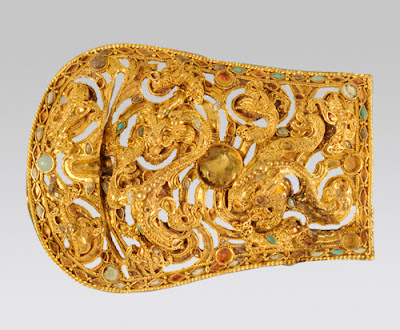
Three Kingdoms: Unveiling The Story exhibition in the Tokyo National Museum. This special exhibition includes 161 relics from recent discoveries srrounding China’s tumultuous transition from the Han Dynasty (206-220) to the Three Kingdoms period (220-280). The Han Dynasty’s decline at the end of the second century ignited a prolonged power struggle between unrelenting military leaders. The country was split into three kingdoms called Wei, Shu, and Wu, a major event that would lead to a new era in China’s history. In recent years, research into this period has been reinvigorated by the excavation of the Cao Cao Mausoleum. The artifacts recovered there present their own version of this period’s history with a persuasive candor far surpassing written historical accounts. Image:  Gold Metal Belt Fitting with Animal Design, Eastern Han dynasty, 2nd century CE, Excavated at Shouchun Ancient Tomb, Shou County, Huainan City, Anhui.  Image courtesy of the exhibition.

Classical antiquities, ancient Asian and pre-Columbian American art ongoing at the Portland Art Museum in Portland, Oregon

Image
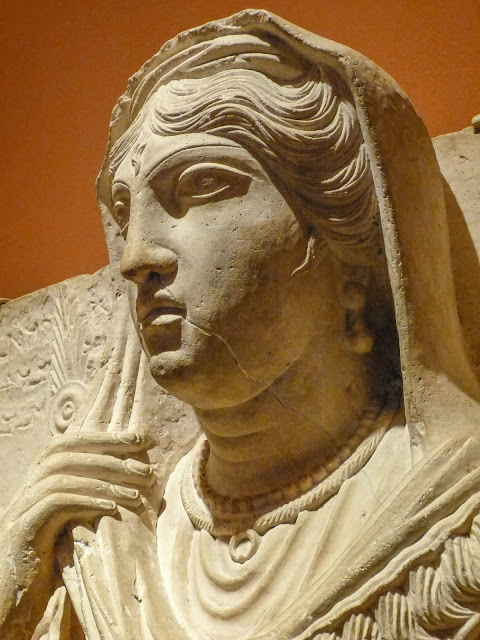
Classical antiquities, ancient Asian and pre-Columbian American art ongoing at the Portland Art Museum in Portland, Oregon. Museum founder Winslow B. Ayer purchased 100 plaster casts of Greek and Roman sculptures in 1895 to form the core of the museum's early European collection. These sculptures have been augmented over the years with a selection of Greek, Roman, and Etruscan objects, including red- and black-figure vases, sm all bronzes, funerary art including monuments from Palmyra, Syria and glassware. The museum's Chinese collection includes objects that date as far back as the Neolithic Period and include tomb objects from the Han (206 BCE - 220 CE) and Tang (618-907 CE) dynasties. In the last few years, major gifts of Han and pre–Han objects including an array of ceramic court nobles, dancers, and musicians — not to mention dogs, horses, and supernatural creatures have brought even more prominence to the museum's Asian collection. Roman Funerary Monument from ...

Immortal Dead: Treasures from Sichuan in Ancient China through October 18, 2018 in Trajan's Market in Rome, Italy

Image
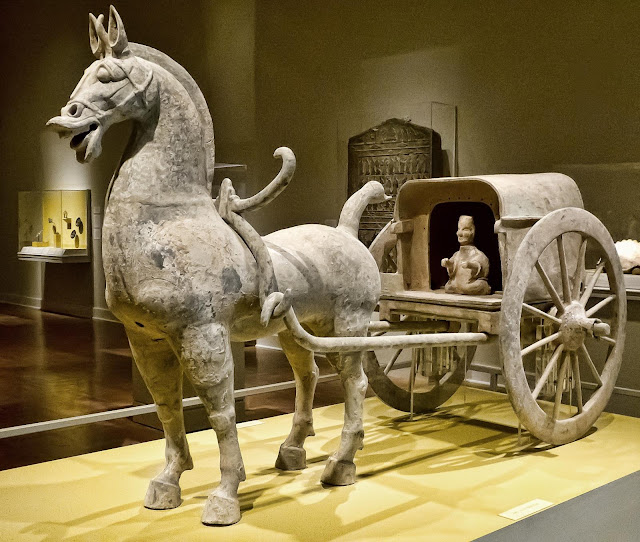
Immortal Dead: Treasures from Sichuan in Ancient China through October 18, 2018 in Trajan's Market in Rome, Italy.  This show is a grand display of the myths of Chinese archaeology through the lens of the Sichuan civilisation, which developed along the Min River, colloquially known as the Blue River. Comprised of digital reconstructions, photos, videos, and interactive tools, the exhibition allows visitors to explore artifacts from the Sanxingdui and Jinsha archaeological sites from eight Chinese musuems, amidst the backdrop of the ancient Roman site of Trajan's Market, highlighting connections between ancient China and Imperial Rome.  Artifacts on display include objects in bronze, gold, jade, and terracotta from the 2nd millennium B.C. to the 2nd century A.C., such as ritual statues and vases, masks, daggers, and scepters. Image:  Horse and carriage Eastern Han Dynasty Sichuan Province China 1st-2nd century CE Gray earthenware with traces of pigment photographed...