Posts

Showing posts with the label Hadrian

Death of Antinous

Image
In my travels I have photographed a number of sculptures of Hadrian's companion, Antinous.  Over 100 sculptures of the tragic young man have survived to modern times and classicist Caroline Vout has noted more images have been identified of Antinous than of any other figure in classical antiquity with the exceptions of Augustus and Hadrian himself.  This is probably attributable to Hadrian's deification of the young man after his death and the subsequent cult of Antinous that became widespread throughout much of the Roman Empire.  Although officially, Hadrian announced that Antinous fell into the Nile and drowned, there have been a number of hypotheses about the young man's death.  Hadrian's entourage at the time is thought to have included  Lucius Ceionius Commodus, a young aristocrat whom Antinous might have deemed a rival to Hadrian's affections. In fact, soon after Antinous died, gossip quickly spread that Antinous had been intentionally killed.  Despit...

Mars, The Roman God of War

Image
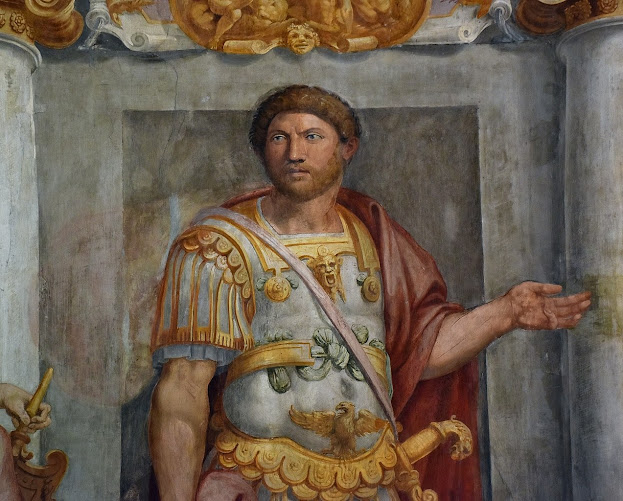
Statue of the Roman emperor Hadrian as Mars, God of War, 117–125 CE, that I photographed at the Capitoline Museums, Rome, Italy In ancient Roman religion and myth, Mars was the god of war and also an agricultural guardian, a combination characteristic of early Rome. He was the son of Jupiter and Juno, and he was the most prominent of the military gods in the religion of the Roman army.  Under the influence of Greek culture, Mars was identified with the Greek god Ares, whose myths were reinterpreted in Roman literature and art under the name of Mars. But the character and dignity of Mars differed in fundamental ways from that of his Greek counterpart, who is often treated with contempt and revulsion in Greek literature. Mars' altar in the Campus Martius, the area of Rome that took its name from him, was supposed to have been dedicated by Numa, the peace-loving semi-legendary second king of Rome. Although the center of Mars's worship was originally located outside the sacred boun...

Relief of a Falling Warrior, 100-200 CE Roman copy of a 5th century Greek original by Pheidias

Image
 Around 435 BCE, the Greek sculptor Pheidias adorned the front of the shield at the side of his gold-and-ivory statue of Athena in the Parthenon with scenes of Greeks battling Amazons in the Trojan War. In Roman times, certain figures from this complex struggle were lifted out of their original context and enlarged to become decorative reliefs for the walls of a colonnade or courtyard. Here a wounded Greek warrior collapses to the ground after being struck a mortal blow from behind. The dying warrior’s noble countenance, the fillet or ribbon tied around his forehead, and his powerful, athletic body epitomize what Pheidias and his pupils sought to project as the ideal of mature male dignity in the decade when Athens was at the height of its power in the eastern Mediterranean world. Some five centuries later, collectors such as the Roman emperor Hadrian sought this Pheidian style, translated from a circular golden shield to a rectangular marble relief, to decorate their palaces and v...

The emperor Hadrian and the Castel Sant'Angelo

Image
The emperor Hadrian's tomb was erected on the right bank of the Tiber, between AD 134 and 139. Now known as the Castel Sant'Angelo, originally the mausoleum was a decorated cylinder, with a garden top and golden quadriga. Hadrian's ashes were placed here a year after his death in Baiae in 138, together with those of his wife Sabina, and his first adopted son, Lucius Aelius, who died in 138. Following this, the remains of succeeding emperors were also placed here, the last recorded deposition being Caracalla in 217 CE. But much of the tomb  contents and decorations were lost when the building was converted to a military fortress in 401 CE then subsequently included in the Aurelian Walls by Flavius Honorius Augustus. The urns and ashes were scattered by Visigoth looters during Alaric's sack of Rome in 410, and the original decorative bronze and stone statuary were thrown down upon the attacking Goths when they besieged Rome in 537, as recounted by Procopius.  In the 14th ...

Insight provided by Roman funerary inscriptions

Image
Insight provided by Roman funerary inscriptions Roman tombstone (PD) Roman Funerary inscriptions on tombstones provide invaluable insight into the lives of ordinary Romans. Funerary inscriptions revealed that many women worked. Many of them were doctors. For example: ‘To the departed spirit of Julia Saturnina, 45 years of age, wonderful wife, excellent physician, most blameless woman. Erected by her husband Cassius Philippus out of gratitude. She lies here, and may the earth rest lightly upon her.’ Other professions attested to women’s tombstones included scribe: ‘To Hapate, short-hand writer of Greek. She lived for 25 years. Pittosus erected this monument to his most affectionate wife,’ or merchant: ‘Thymele, Marcella’s dealer in silk’ or actress: ‘Luria Privata, an actress in mime shows, lived 19 years. Bleptus made this monument.’ The epitaphs of men also illustrated a variety of jobs, from humble laborers like ‘Publius Marcius Philodamus, construction worker, freedman ...

PERGAMON. Masterpieces from the Ancient Metropolis with a 360° Panorama by Yadegar Asisi at the Pergamonmuseum temporary exhibition building in Berlin, Germany.

Image
PERGAMON. Masterpieces from the Ancient Metropolis with a 360° Panorama by Yadegar Asisi at the Pergamonmuseum temporary exhibition building in Berlin, Germany. This exhibition incorporates approximately 80 of the Antikensammlung’s most important works from Pergamon – including the largest piece of the Telephos frieze from the Pergamon Altar. In preparation for the show, the originals underwent extensive conservation and restorat ion. This is especially true of the large statues of women from the courtyard of the Pergamon Altar, and the sculptures from its roof. With the exception of the Statue of Athena Parthenos from the Pergamon Library (on loan to the Metropolitan Museum in New York), all of the city’s famous sculptures are on view, including the so-called Beautiful Head, the colossal head of Herakles, portrait sculptures of the king, the Archaistic Dancer from the palace, the Prometheus group, and the Athena with cross-strapped aegis. The panorama takes visitors back to the ye...

Hadrian in bronze and Osiris-Antinous, 2nd century CE, from the Greco-Roman Museum in Alexandria at the Egypt's Lost Cities exhibit in the Ronald Reagan Presidential Library and Museum through April 12, 2020

Image
Hadrian in bronze and Osiris-Antinous, 2nd century CE, from the Greco-Roman Museum in Alexandria at the Egypt's Lost Cities exhibit in the Ronald Reagan Presidential Library and Museum through April 12, 2020. Antinous, Hadrian's youthful companion, was deified after meeting the same fate as Osiris: death in the waters of the Nile. The new god Osiris-Antinous had a humber of manifestations, including that of the Apis bull. It is known that Antinous was born to a Greek family in the city of Claudiopolis, which was located in the Roman province of Bithynia in what is now north-west Turkey. It is possible that he was named after the character of Antinous, who is one of Penelope's suitors in Homer's epic poem, the Odyssey. Another possibility is that he was given the male equivalent of Antinoë, a woman who was one of the founding figures of Mantineia, a city which probably had close relations with Bithynia. Although many historians from the Renaissance onward a...

The annual meeting of the American Numismatic Association will be held February 27-29, 2020 in Atlanta, Georgia

Image
The annual meeting of the American Numismatic Association will be held February 27-29, 2020 in Atlanta, Georgia.  Educational displays on every area of numismatics including ancient coins and artifacts, tokens and medals, and world coins.  Members share their knowledge, research, creativity and collections with not only other members but the general public. See more:  https://www.money.org/ Image:  Beautifully detailed Roman coin depicting a galley minted by Hadrian in 131 CE.

Hadrian and Athens: Conversing with an Ideal World. Through November 2018 at the National Archaeological Museum in Athens

Image
Closing soon! Hadrian and Athens: Conversing with an Ideal World. Through November 2018 at the National Archaeological Museum in Athens. Portrait Head of the Emperor Hadrian found in Athens 130-138 CE courtesy of the National Archaeological Museum in Athens By promoting the integration of Greek intelligentsia with Roman tradition, Hadrian contributed decisively to forging a common cultural base that served as a fundamental element of western culture. Portraits of the Emperor Hadrian are on display centrally in an imaginary philosophical dialogue about Greek culture with emblematic figures of intellectuals such as Metrodorus, Antonius Polemon and Herodes Atticus. Portraits of Plato and Aristotle, standing as symbols of Greek philosophical thought, observe the imagined conversation, along with the Kosmetai, the officials who were responsible for the intellectual and physical education of the ephebes in the Athenian gymnasia of the imperial period.