Posts

Showing posts with the label Greek

Disability and the politics of "Divine Disfavor" in the Greco-Roman world
Image
I was reading Classical Wisdom's newsletter in preparation for this weekend's virtual symposium and found their article "Hephaestus:The Humane God" particularly interesting. Although most of us think of Hephaestus as the divine metalworker that forged magical armor and weapons like the shield of Achilles, Sean Kelly pointed out that he was also the only god in the Greek pantheon (and Roman under the name Vulcan) who suffered from a physical impairment.  Hephaestus attempted to intervene in a quarrel between  Zeus and Hera, and an enraged Zeus  cast him from Mount Olympus, injuring his legs.  Thereafter he was the subject of derision because of his lameness although he was respected for his smithing skills. He forged Hermes' winged helmet and sandals, the Aegis breastplate, Aphrodite's famed girdle, Agamemnon's staff of office, Achilles' armour, Diomedes' cuirass, Heracles' bronze clappers, Helios' chariot, the shoulder of Pelops, and even E...

The Syncretization of Zeus Ammon and the Oracle of Siwa

Image
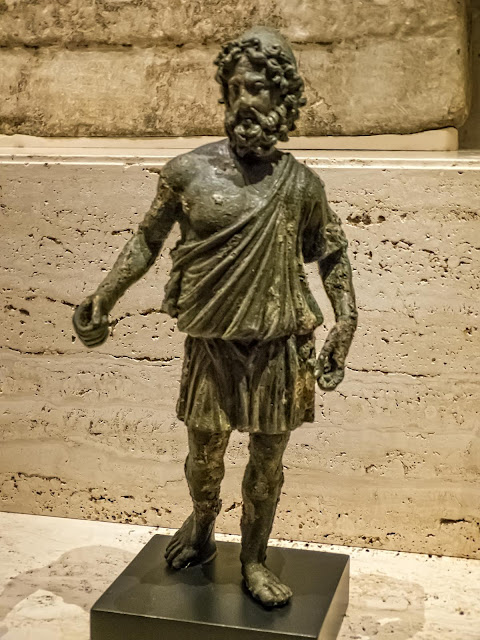
Zeus was identified with the Roman god Jupiter and associated in the syncretic classical imagination with various other deities, such as the Etruscan Tinia and the Egyptian Amun (Ammon). He, along with Dionysus, absorbed the role of the chief Phrygian god Sabazios as well in the syncretic deity known in Rome as Sabazius. Ammon was origiinally a Libyan deity.  His oracle, situated in the Siwa oasis, 500 kilometers west of Memphis became known by the Egyptians as "Amun of Siwa, lord of good counsel." Siwa is believed to have been occupied as early as Paleolithic and Neolithic times, and some believe at one time it was the capital of an ancient kingdom that may have included Qara, Arashieh and Bahrein.  According to one myth the temple at Siwa was founded by the Greek god Dionysus. While lost in the Western Desert, Dionysus was perishing of thirst when a man appeared and guided him to the spring at Aghurmi. In gratitude, Dionysus erected the temple. In other myths, the Oracle of...

Red-figured fish plates of the 5th century BCE

Image
Throughout my travels to various museums around the world I have often encountered red-figured fish plates. First developed in Athens, these beautifully detailed serving pieces became especially popular in South Italy and Sicily in the 400s BCE. I stumbled across this excellent video about them and learned that fish plates produced in Magna Graecia were usually more colorful with white accents and the fish are portrayed with their bellies facing inwards towards the small central depression that is thought to have contained dipping sauce like garum. Fish on plates produced in Athens are painted with their bellies facing outwards. I thought this is quite a peculiar style difference.  There also seems to be disagreement among scholars as to whether these plates were actually used in everyday life or produced for funerary purposes only, as almost all of the 1,000 examples that have been recovered came from ancient burials. Art historian Lucas Livingston points out that many of the reco...

The transformative shrew in Greco-Roman mythology

Image
When I saw this carefully detailed bronze sculpture of a common shrew from Egypt's Greco-Roman Period, I wondered why the ancients thought this creature worthy of such expense. Although this sculpture is part of the collections of the Cleveland Museum of Art, the Metropolitan Museum of Art also has a similar, though less detailed example from the same period as does the Museum of Fine Arts in Budapest.   According to The Met, the ancient Egyptians named the shrew, "the voracious", because of its feeding habits. In ancient Egyptian mythology, the shrew represented the blind aspect of the solar deity, “the one with no eyes in his face” (Mechenti-n-irti in old Egyptian) that was complemented by the ichneumon, “the one whose eyes (the Sun and the Moon) are in his face” (Mechenti-irti in old Egyptian), a creature with very keen eyesight. This god with the dual nature was revered in Letopolis as one of the aspects of Horus, who, as myth has it, was blind at birth.  According to...

The Meidias Painter: Art amidst the Peloponnesian War

Image
The Meidias Painter was an Athenian red-figure vase painter active in the last quarter of the 5th century BCE (fl. c. 420 to c. 400 BCE). He is named after the potter whose signature was found on a large hydria, depicting the rape of the daughters of Leucippus (Leukippos), prince of Messenia, by the Dioscuri, excavated from an Etruscan tomb.  John D. Beazley, renowned connoisseur of Greek vases, said of Meidias' work, "Here there is beauty: The gleam of gold, loves and ladies with soft limbs, in soft raiment, and all that is shining, easeful and luxurious: perfume, honey and roses."  The Meidias Painter was known for combining his theatrical “florid” style with his “flying drapery.”  He worked during the period of the Peloponnesian War and his depiction of many Attic legends, particularly those involving Erichtonios, son of Hephaistos, points to "a clear assertion of local pride prompted by the Athenians' decisive role in the fight against the barbarian" acc...

Ancient Amber

Image
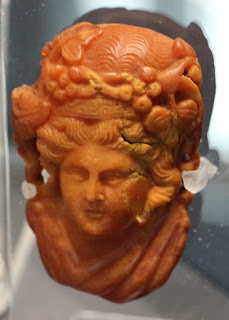
Despite fanciful descriptions by some ancient sources like Nicias (470-415 BCE) that amber "is a liquid produced by the rays of the sun, and that these rays, at the moment of the sun's setting, striking with the greatest force upon the surface of the soil, leave upon it an unctuous sweat, which is carried off by the tides of the Ocean, and thrown up upon the shores of Germany", Roman naturalist Pliny the Elder cited sources who were well aware of amber's actual origin from tree resin. In Book 37, section XI of Natural History, Pliny wrote: "Amber is produced from a marrow discharged by trees belonging to the pine genus, like gum from the cherry, and resin from the ordinary pine. It is a liquid at first, which issues forth in considerable quantities, and is gradually hardened [...] Our forefathers, too, were of opinion that it is the juice of a tree, and for this reason gave it the name of "succinum" and one great proof that it is the produce of a tree o...