Posts

Showing posts with the label Gandhara

Sea monsters in ancient art

Image
The iconography of the Greek kētos (Latinized as cetus) was established in the Archaic period (ca. 600–480 BCE) and remained amazingly consistent for centuries, long into Roman Imperial times. It is one of the creatures that after the conquests of Alexander the Great (r. 331–323 BCE) traveled to the East, where it appeared in Gandharan art and influenced representations of monsters from Afghanistan to India. The kētos has even been suggested as a partial inspiration for the Chinese dragon. - Metropolitan Museum of Art According to Greek mythology, Perseus slew Cetus to save Andromeda from being sacrificed to it. In a different story, Heracles slew Cetus to save Hesione.The term cetacean (for marine mammals like whales or porpoises) was derived from cetus. In Greek art, ceti were depicted as serpentine fish, sometimes with the head of a greyhound and the body of a whale or dolphin with a divided fan-like tail.  In Greek translations of the Hebrew Bible, Jonah's "great fish...

Seated Buddha, early 2nd century CE, ancient Gandhara (modern day Pakistan)

Image
This small bronze Buddha is probably one of the earliest iconic representations of Shakyamuni from Gandhara. He sits in a yogic posture holding his right hand in abhaya mudra (a gesture of approachability). His unusual halo has serrations that indicate radiating light. His hairstyle, the form of his robes, and the treatment of the figure reflect stylistic contacts with the classical traditions of the West. This Buddha shows closer affinities to Roman sculpture than any other surviving Gandharan bronze. - Metropolitan Museum of Art, New York City. Buddhism developed as early as the 6th century BCE. But, before the late 1st to early 2nd century CE, the Buddha was represented by symbols and not in human form.  In this early human incarnation of the Buddha, he is shown with a mustache, considered a symbol of princely status.  This aspect, found only on very early depictions of the Buddha, was not included when representations of the Buddha in a variety of postures with varying ges...

Buddhist sculpture of the 4th and 5th centuries CE

Image
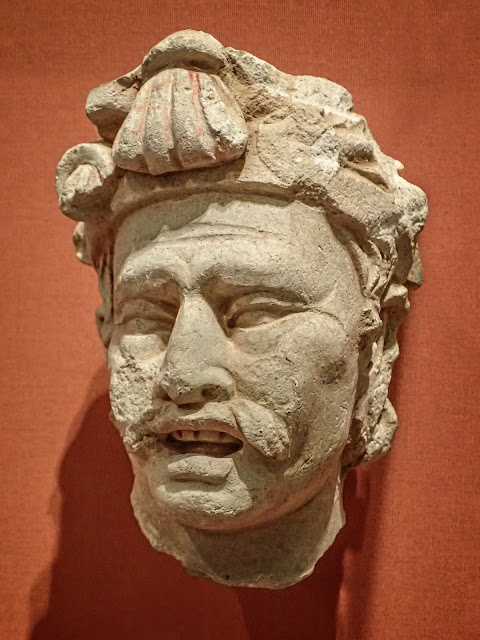
Buddhist monuments of the 4th and 5th century CE were decorated with elaborate scenes in stucco.  The heads were sometimes made separately and pegged in place, so they often became detached. This Head may be Kuvera or possibly a warrior belonging to the army of the evil god Mara, a demonic celestial king who tempted Prince Siddhartha (Gautama Buddha) by trying to seduce him with the vision of beautiful women who, in various legends, are often said to be Mara's daughters.  In Buddhist cosmology, Mara is associated with death, rebirth and desire. Modeled of lime composition, this sculpture reflecting Hellenistic influence introduced into the region by Alexander the Great, was found in Hadda, Afghanistan and is part of the collections of the Victoria and Albert Museum in London that I photographed in 2016.

Roman trading partners: The Kushans

Image
Gandhāra was an ancient region in the Peshawar basin in the north-west of the ancient Indian subcontinent, corresponding to present-day north-west Pakistan and north-east Afghanistan. The centre of the region was at the confluence of the Kabul and Swat rivers, bounded by the Sulaiman Mountains on the west and the Indus River on the east. Gandhara was conquered by the Achaemenid Empire in the 6th century BCE. Conquered by Alexander the Great in 327 BCE, it subsequently became part of the Maurya Empire and then the Indo-Greek Kingdom. The region was a major centre for Greco-Buddhism under the Indo-Greeks and Gandharan Buddhism under later dynasties. Gandhara attained its height from the 1st century to the 5th century CE under the Kushan Empire. The Kushans moved into Gandhāra from Central Asia after the fall of the Parthian dynasty about 75 CE. The Kushan dynasty had diplomatic contacts with the Roman Empire, Sasanian Persia, the Aksumite Empire and the Han dynasty of China and...