Posts

Showing posts with the label Etruscan

Eudaimonia and the corruption of excess

Image
"Excess generally causes reaction, and produces a change in the opposite direction, whether it be in the seasons, or in individuals, or in governments." - Plato In the case of drinking to excess, this change could result in the loss of virtue and well-being or, as the Greek philosophers termed it, Eudaimonia. Plato believed that individuals naturally feel unhappiness when they do something they know and acknowledge to be wrong. Plato's student, Aristotle, agreed that although the pursuit of virtue, excellence, and the best within us was necessary to achieve eudaimonia, virtue in itself was not sufficient alone.   "Aristotle believes that happiness and well-being come from how we live our lives,"   explains psychologist Catherine Moore, "And that's not in pursuit of material wealth, power, or honor." Aristotle expounds upon ways to achieve the happy life in his work "Nichomacean Ethics." "To be honest, a lot of Nichomacean Ethics is a...

Deciphering Iconography of a late Classical Period Etruscan sarcophagus

Image
The sarcophagus of Etruscan priest Laris Partunus found in the Tarquinian necropolis was produced in the late Classical Period.  This exquisite sarcophagus crafted of Parian marble is painted with scenes of the Amazonomachy.  The Greeks are shown in hoplite armor while the Amazons are wearing chitons. Surprisingly, the Amazons are depicted winning most of the paired battles instead of an equal number of victories as depicted on the Amazon sarcophagus also from Tarquinia. The Partunus sarcophagus also depicts blue-skinned demons, but unlike the fearsome blue demons seen in the Tomb of the Blue Demons, also in Tarquinia, these figures appear to be gently guiding an aristocratic lady to her family like Greek psychopomps,  creatures, spirits, angels, or deities in many religions whose responsibility is to escort newly deceased souls from Earth to the afterlife.  The painting on the long side of the sarcophagus depicts the execution of Trojan prisoners. They too are accom...

From Etruscan Lasa to Roman Lare

Image
Although art historians are not certain whether a Lasa was a major or minor Etruscan deity, it is thought the domain and purpose of the lasa morphed into a being known as a Lar to the Romans. Lares are thought to have been hero-ancestors, guardians of the hearth, fields, boundaries, or fruitfulness, or an amalgamation of these. Roman writers sometimes conflated the Lares with domestic Penates but the Lares had much broader domains. Roadways, seaways, agriculture, livestock, towns, cities, the state, and its military were all under the protection of their particular Lar or Lares. Those who protected local neighborhoods (vici) were housed in the crossroad shrines (Compitalia), which served as a focus for the religious, social, and political lives of their local, overwhelmingly plebeian communities. Their cult officials included freedmen and slaves, otherwise excluded by status or property qualifications from most administrative and religious offices. Despite official bans on non-Christia...

Ancient Amber

Image
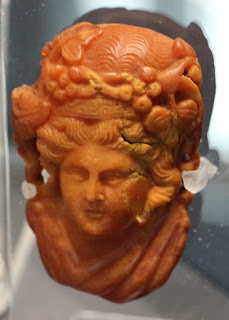
Despite fanciful descriptions by some ancient sources like Nicias (470-415 BCE) that amber "is a liquid produced by the rays of the sun, and that these rays, at the moment of the sun's setting, striking with the greatest force upon the surface of the soil, leave upon it an unctuous sweat, which is carried off by the tides of the Ocean, and thrown up upon the shores of Germany", Roman naturalist Pliny the Elder cited sources who were well aware of amber's actual origin from tree resin. In Book 37, section XI of Natural History, Pliny wrote: "Amber is produced from a marrow discharged by trees belonging to the pine genus, like gum from the cherry, and resin from the ordinary pine. It is a liquid at first, which issues forth in considerable quantities, and is gradually hardened [...] Our forefathers, too, were of opinion that it is the juice of a tree, and for this reason gave it the name of "succinum" and one great proof that it is the produce of a tree o...

Symposia and drunken women

Image
The Greek symposium was a key Hellenic social institution. It was a forum for men of respected families to debate, plot, boast, or simply to revel with others. They were frequently held to celebrate the introduction of young men into aristocratic society. Symposia were also held by aristocrats to celebrate other special occasions, such as victories in athletic and poetic contests. Symposia were usually held in the andrōn - the men's quarters of the household. The participants, or "symposiasts", would recline on pillowed couches arrayed against the three walls of the room away from the door. Due to space limitations, the couches would number between seven and nine, limiting the total number of participants to somewhere between fourteen and twenty seven.  If any young men took part, they did not recline but sat up. However, in Macedonian symposia, the focus was not only on drinking but hunting, and young men were allowed to recline only after they had killed their first wil...