Posts

Showing posts with the label Egyptian

Eggs and Oonoi: Symbols of birth and rebirth in the ancient world
Image
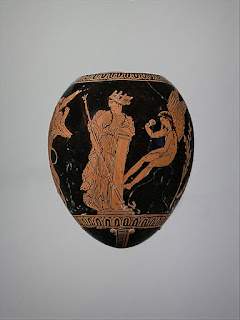
In many myths, ranging from Egypt to the Far East, the initial process of creation and birth begins when a cosmic egg. sometimes fertilized by a serpent but more often laid in the primeval sea by a giant bird. From these sacred eggs, the sun (the golden yolk)  is hatched leading to the division of earth and sky and the multiplicity of life, natural and supernatural. Eggs are well attested as funerary offerings—real eggs, artistic counterparts in marble and terracotta or diminutive vases of egg shape.  Between approximately 65,000 and 55,000 years ago, African hunter-gatherers scratched on eggshells at Diepkloof Rock Shelter in South Africa.  Eggs were found in the Royal Cemetery at Ur dating to 3800 BCE. In archaeological sites of predynastic Egypt (Naqada II period - 3600-3200 BCE) ostrich eggs were found in graves, partially cut and used as containers or placed in graves whole. Many of the eggs were decorated with incised or painted designs which took the form of geomet...

Syro-Phoenician Ivories

Image
  Built by the Assyrian king Ashurnasirpal II, the palaces and storerooms of Nimrud housed thousands of pieces of carved ivory. Most of the ivories served as furniture inlays or small precious objects such as boxes. While some of them were carved in the same style as the large Assyrian reliefs lining the walls of the Northwest Palace, the majority of the ivories display images and styles related to the arts of North Syria and the Phoenician city-states. Phoenician style ivories are distinguished by their use of imagery related to Egyptian art, such as sphinxes and slender elongated figures wearing pharaonic crowns, and the use of elaborate carving techniques such as openwork and colored glass inlay. Some were also adorned with gold leaf. North Syrian style ivories tend to depict stockier figures in more dynamic compositions, carved as solid plaques with fewer added decorative elements. However, some pieces do not fit easily into any of these three styles. Most of the ivories were p...

Pre-Achaemenid, Greek, Roman, Egyptian and ancient Asian art at the Miho Museum in Sigaraki, Japan.

Image
Pre-Achaemenid, Greek, Roman, Egyptian and ancient Asian art at the Miho Museum in Sigaraki, Japan. The Miho Museum is located southeast of Kyoto, Japan, near the town of Shigaraki. Among the objects in its 2,000-piece permanent collection are more than 1,200 objects that appear to have been produced in Achaemenid Central Asia. Some scholars have claimed these objects are part of the famous Oxus Treasure, lost shortly after its  discovery in 1877 and rediscovered in Afghanistan in 1993, although both the Miho and British Museum's material from this period point to unique findspots. In addition to the Persian objects, the museum houses Roman, Greek, and Egyptian antiquties as well as art from ancient China, Japan, and southeast Asia. Image: 1 ) Vessel with Bull Attacked by a Lion Pre-Achaemenid Period 8th-6th centuries BCE. The wounded bull is extremely serene, looking more as though the lion was embracing him. This vessel symbolizes the order of the cosmos, as the t...

Ancient Greek, Roman, and Egyptian Galleries at the Rhode Island School of Design Museum of Art in Providence, Rhode Island

Image
Ancient Greek, Roman, and Egyptian Galleries at the Rhode Island School of Design Museum of Art in Providence, Rhode Island. Roman marble portraits and sarcophagi, wall paintings from the vicinity of Pompeii, floor mosaics from the Roman province of Syria, as well as Etruscan and Italic ceramics and bronzes are on view in the Weiss Ancient Art Gallery. A gallery of ancient Greek art is organized around the themes of early Greece , gods and goddesses, religion, funerary customs, everyday life, and the symposium. A third gallery, devoted to materials and technology, elucidates various creative processes and explains the effects of time on materials including marble, ceramics, metals, and glass. Objects in the Egyptian Gallery served functional or ritual purposes in everyday life, temple worship, or funerary practices. Image: Image: Roman-Egyptian votive panel with a painting of the god Heron 300 CE. Heron is believed to have originated as a guardian god for travelers along th...

Greek, Roman, Egyptian, and Nabatean Art at the Cincinnati Art Museum in Cincinnati, Ohio.

Image
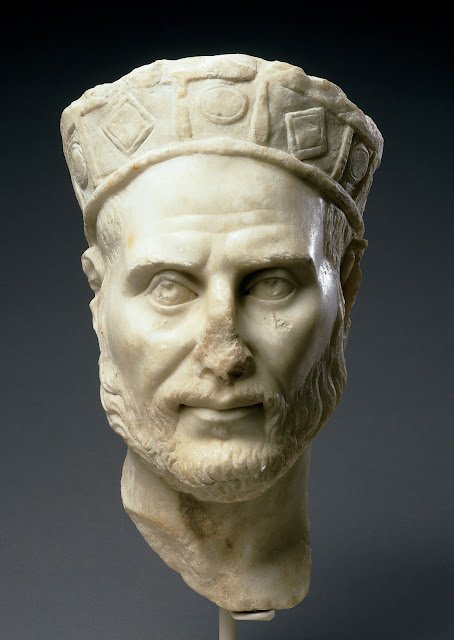
Greek, Roman, Egyptian, and Nabatean Art at the Cincinnati Art Museum in Cincinnati, Ohio.  Portrait head of a priest or magistrate from Greece or Asia Minor, 3rd century CE. Image courtesy of the Cincinnati Art Museum. The Cincinnati Art Museum possesses a distinguished collection of ancient art from the Mediterranean region and the Near East. Spanning some four thousand years from the fourth millennium B.C.E. to the early centuries C.E. This notable collection features major examples of stone sculpture, decorated metalwork, painted wall carvings  and ceramic vessels from ancient Egypt, Greece and Rome as well as an exceptional collection of Nabataean sculpture and decorated architecture—the largest collection of material of its kind outside of Jordan.

Roman epigraphy, pre-Columbian ceramics and even an Egyptian mummy. Ongoing at The Carmo Archaeological Museum in Lisbon, Portugal

Image
Roman epigraphy, pre-Columbian ceramics and even an Egyptian mummy.  Ongoing at The Carmo Archaeological Museum in Lisbon, Portugal.  Peruvian Mummy at the Carmo Archaeological Museum in Lisbon, Portugal.  Image courtesy of Trip Advisor. Founded in 1864 by the Association of Portuguese Archaeologists (1863) in the ruins of the old Carmo church in Lisbon, this museum houses an eclectic collection of Roman epigraphy, pre-Columbian ceramics and mummies, an Egyptian sarcophagus and mummy, plus a vast array of objects recovered from the excavation of Castro de Vila Nova de S. Pedro (CalcolĂ­tico c. 3500 BC) , in Azambuja. Related links: https://en.wikipedia.org/wiki/Carmo_Convent_(Lisbon) https://en.wikipedia.org/wiki/Castro_of_Vila_Nova_de_S%C3%A3o_Pedro