Posts

Showing posts with the label Dionysus

Spurned Women: The violent death of Orpheus

Image
Orpheus is best known as a musician that could play so beautifully he charmed even the most violent animals.  As such he is portrayed in numerous mosaics, paintings, and on ceramics.  So I was surprised to see a red-figure calyx krater attributed to the Villa Giulia Painter and dated to 460-450 BCE depicting Orpheus being violently attacked by Thracian women, one with a spear and one with an axe. I realize taste in music is quite personal but this extreme response is so antithetical to all of those peaceful images I have seen of Orpheus surrounded by mesmerized animals that I had to research this event further. According to a Late Antique summary of Aeschylus' lost play Bassarids , Orpheus, towards the end of his life, disdained the worship of all gods except the sun, whom he called Apollo. One early morning he went to the oracle of Dionysus at Mount Pangaion to salute his god at dawn, but, like Pentheus, was ripped to shreds by Thracian maenads for not honoring his previous p...

Mystery religions as a response to concepts of a bleak afterlife

Image
Yesterday I posted about incense and the types of incense required for each Olympian god or hero as specified in the Orphic hymns.   "Faced with the thought of a bleak existence in the Underworld, some individuals in the ancient Mediterranean sought to improve their lot while they were alive. Virtuous behavior might not be sufficient, and one way to obtain a happier afterlife was thought to be through initiation into mystery cults associated with Orpheus and Dionysos. Self-styled preachers offered followers transformative experiences that mainstream practice could not provide. Their rites were shrouded in secrecy and remain little understood today" - J. Paul Getty Museum Initiates were sometimes buried with thin sheets of gold, termed Orphic tablets by modern scholars, inscribed with guidance for their journey into the Underworld much like the Book of the Dead for ancient Egyptians, although much shorter. The text might reference landmarks along the journey, such as a spring,...

The Late Antique Roman Villa of Noheda

Image
In 1897, Spanish geographer Francisco Coello reported the existence of Roman ruins, with tesserae, in the district of Noheda. But the 291 square meter  figural mosaics in the triclinium of the Late Period Roman Villa were not formally  documented until  1984 when a local peasant plowing a field belonging to José Luis Lledó Sandoval stumbled over the stones. Even then, archaeological excavations did not begin until the end of 2005.  The villa, which lies about 17 km north of Cuenca near the ruins of the ancient cities of Segóbriga , Ercávica and Valeria, was finally opened to the public in 2019. The interpretation center has been established in Villar de Domingo Garcia. The obviously wealthy owner may have profited from the mining of lapis specularis, a variety of translucent gypsum much appreciated at the time for the manufacture of window glass.  Pliny the Elder mentions this material was mined in "100,000 places around Segóbriga" and Pliny assures us that "the...

The Wonders of the Horti Lamiani

Image
The Horti Lamiani (Lamian Gardens) was a luxurious complex of an ancient Roman villa with large gardens and outdoor rooms located on the Esquiline Hill in Rome, in the area around the present Piazza Vittorio Emanuele. They were created by the consul Lucius Aelius Lamia, a friend of Emperor Tiberius, and they soon became imperial property.  Along with other ancient Roman horti on the Quirinal, Viminal and Esquiline hills, they were discovered during the construction work for the expansion of Rome at the end of 1800s. The villa and gardens were scenically divided into pavillions and terraces adapted to the landscape, on a model of Hellenistic tradition. They were eventually filled with exceptional works of art, from original ancient Greek sculptures to exquisite frescoes and marble floors. A museum of the nymphaeum excavations is planned to open in 2021. The land for the horti Lamiani was originally a cemetery just outside the ancient Servian Wall but was purchased by Lucius Aelius L...

Spotted cats: Mythological beasts of both the Old World and the New

Image
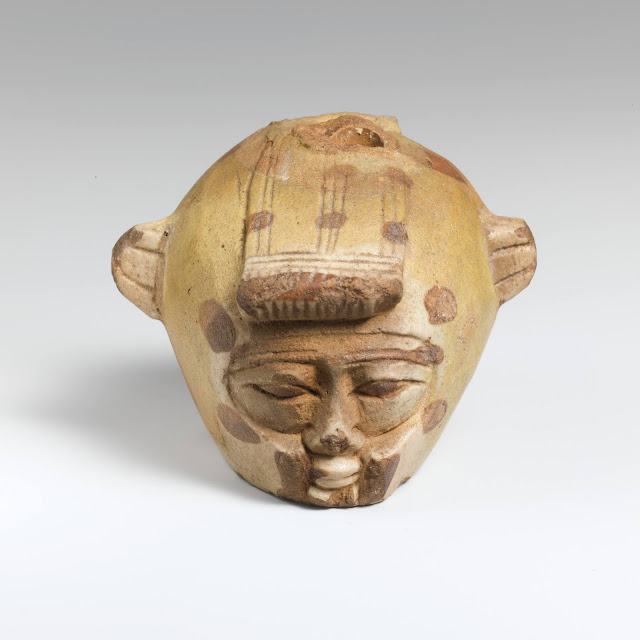
This unusual vase shows a human head of which all but the area of the eyes, nose, and mouth is enclosed in the head of an animal. The softness of the pelt is indicated by the way in which it tightly fits the human head. The small ears and spots are further animal attributes. It is difficult to identify the figure. It may possibly be a very Egyptianized interpretation of Herakles wearing the lion skin. - Metropolitan Museum of Art This vessel caught my attention because it reminded me very much of ancient pre-Columbian American art.  All major Mesoamerican civilizations prominently featured a jaguar god, and for many, such as the Olmec, the jaguar was an important part of shamanism. The jaguar's formidable size, reputation as a predator, and its evolved capacities to survive in the jungle made it an animal to be revered. The Olmec and the Maya witnessed this animal's habits, adopting the jaguar as an authoritative and martial symbol, and incorporated the animal into their mythol...

A Christianized Roman mosaic of the 3rd - 4th century CE

Image
The central panel of this extraordinary mosaic depicts a scene from Classical mythology, the moment when Dionysos, the Greek god of wine, first sees his future wife, the Cretan princess Ariadne. It seems to have been a popular subject for floor mosaics in Syria during the third and fourth centuries C.E. One of the most compelling aspects of this mosaic is its apparent transformation from a purely pagan image to one with Christian overtones. At some point in the mosaic's later history, a bloody wound that recalls the right ribcage injury sustained by Christ at the hands of the Roman soldiers who crucified him was added to Dionysos's left side. Apparently at the same time the red wound was added to Dionysos's side, a flat, vessel-like object was placed in his right hand. The identification of the object is uncertain, but it may represent either a shallow bowl for wine, previously the province of Dionysos but which in Christian iconography represented the blood of Christ, or a...

The Anthesteria

Image
The three-day festival of the Anthesteria was celebrated around the time of the full moon in January or February.  It celebrated the beginning of spring, particularly the maturing of the wine stored at the previous vintage, whose pithoi were now ceremoniously opened. During the feast, small gifts were exchanged and social order was interrupted or inverted, much like Roman Saturnalia, with the household slaves allowed to participate. The Anthesteria also had aspects of a festival of the dead.  Both the Keres, female spirits who bewailed violent death on the battlefield, or the Carians were ritually entertained and thought to roam the city until they were expelled at the conclusion of the festival.  A Greek proverb, said of those who pestered for continued favors,  "Out of doors, Keres! It is no longer Anthesteria!" On day one of the festival, known as Pithoigia, the jars of wine from the previous year were opened, libations offered to Dionysus, and the entire househol...