Posts

Showing posts with the label Dionysos

A Christianized Roman mosaic of the 3rd - 4th century CE

Image
The central panel of this extraordinary mosaic depicts a scene from Classical mythology, the moment when Dionysos, the Greek god of wine, first sees his future wife, the Cretan princess Ariadne. It seems to have been a popular subject for floor mosaics in Syria during the third and fourth centuries C.E. One of the most compelling aspects of this mosaic is its apparent transformation from a purely pagan image to one with Christian overtones. At some point in the mosaic's later history, a bloody wound that recalls the right ribcage injury sustained by Christ at the hands of the Roman soldiers who crucified him was added to Dionysos's left side. Apparently at the same time the red wound was added to Dionysos's side, a flat, vessel-like object was placed in his right hand. The identification of the object is uncertain, but it may represent either a shallow bowl for wine, previously the province of Dionysos but which in Christian iconography represented the blood of Christ, or a...

The cornucopia in Greco-Roman mythology

Image
Bronze repoussé relief  from a hydria (water jar), fragments of which were found with the relief 325-300 BCE from Chalke, near Rhodes. Dionysos holds a cornucopia as an offering to Ariadne of prosperity and abundance while Ariadne signals her acceptance by holding back her veil. Photographed at the British Museum. Mythology offers multiple explanations of the origin of the cornucopia. One of the best-known involves the birth and nurturance of the infant Zeus, who had to be hidden from his devouring father Cronus. In a cave on Mount Ida on the island of Crete, baby Zeus was cared for and protected by a number of divine attendants, including the goat Amaltheia ("Nourishing Goddess"), who fed him with her milk. The suckling future king of the gods had unusual abilities and strength, and in playing with his nursemaid accidentally broke off one of her horns, which then had the divine power to provide unending nourishment, as the foster mother had to the god. In another myt...

Marble statue of Dionysus seated on a panther

Image
Marble statue of Dionysus seated on a panther thought to be produced in the joint reign of Marcus Aurelius and Lucius Verus, 161-69 CE at the Metropolitan Museum of Art. This sculpture includes a dedicatory inscription which reads: Philetus, a freedman of the Augusti, willingly fulfilled his dedication to the Invincible God Serapis and Queen Isis (of this) small altar with (its) base and two statuettes for his own safety and that of Aurelia Quintiliana. The Metropolitan Museum of Art points out that the reference to two emperors, as indicated by the abbreviation AVGG, suggests a date in the joint reign of Marcus Aurelius and Lucius Verus, AD 161–69. For those of you who enjoy deciphering ancient inscriptions, here is the original Latin: INVICTO DEO SERAPI ET ISIDI REGINAE PHILETVS AVGG LIB PRO INCOLV- MITATE SVA ET AVRELIAE QVI- NTILIANAE A- RVLAM CVM BASI ET SIGILLA DVO VOTUM LIBES SOLVIT CIL VI.1, 574 Image: Marble statue of Dionysus seated on a panther thought t...

The cult of Dionysus: Wine, uninhibited freedom, and subversion of the powerful

Image
Image: Marble statuette of Dionysus early 3rd century BCE at the Metropolitan Museum of Art in New York courtesy of the museum. This fully clad figure of Dionysus is in stark contrast to the many depictions of the god in various states of undress during raucous celebratory processions depicted in Roman art. The god wears Thracian boots, a short chiton, a belted panther skin, and a goatskin worn like a cape, with the forelegs of the goat wrapped around his arms. He can perhaps be identified as Dionysus Melanaigis (of the Black Goatskin), whose cult was introduced into Attica from Boeotia. Pausanias (II.35.1), second century CE author of a guide to Greece, mentions a temple to Dionysus Melanaigis in Methana on the Saronic Gulf and states that a music competition was held there in the god's honor every year and that prizes were awarded for swimming races and boat races. - The Metropolitan Museum of Art The Thracian boots represent the belief that Dionysus was born in Thra...

Dionysus with an eastern "twist"

Image
Another Kushan piece illustrating an eastern take on the god Dionysus at the Metropolitan Museum of Art in New York. This mature bearded man has grape leaves in his hair, suggesting that he is Dionysus. The furrowed brow, indications of age, and piercing gaze reflect a taste for naturalism, possibly the result of Hellenistic influence following the conquest of Alexander the Great. The head was buried, and over the centuries a hard crust developed on the surface. Image: Kushan head of Dionysus, 4th-5th centuries CE, from ancient Gandhara at the Metropolitan Museum of Art.

Dancing Maenad 27 BCE - 14 CE Roman copy of a Greek original attributed to Kallimachos circa 425-400 BCE at the Metropolitan Museum of Art in New York City

Image
Dancing Maenad 27 BCE - 14 CE Roman copy of a Greek original attributed to Kallimachos circa 425-400 BCE at the Metropolitan Museum of Art in New York City. Maenads were mythical women inspired by the god of wine, Dionysos, to abandon their homes and families and roam the mountains and forests, singing and dancing in a state of ecstatic frenzy. This figure, wearing an ivy wreath and carrying a thyrsos (fennel stalk) bedecked wi th ivy leaves and berries, moves forward, trancelike, her drapery swirling about her. Maenads became popular as art subjects in the late fifth century B.C.E. with Euripides portrayal of the manic devotées of Dionysos in his play the Bacchae. In the play, King Pentheus bans the worship of Dionysus then the king's cousin lures him into the woods where he is torn apart by maenads including his own mother, Agave, who, in a trance tears off his head believing it to be that of a lion. The rites associated with the worship of Dionysus (Roman Bacchus) were chara...

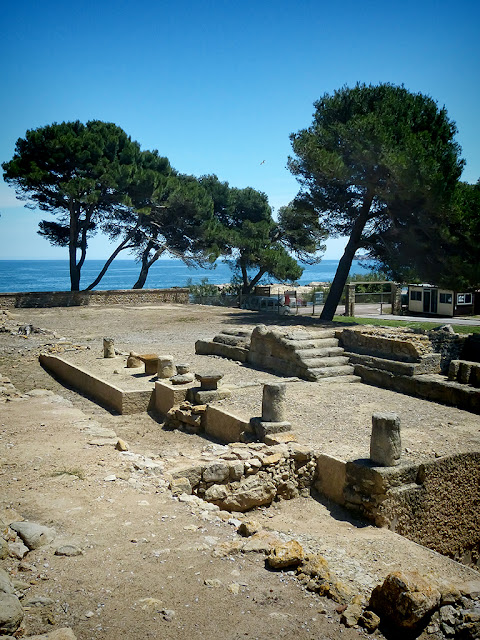
Antiquities from the excavations at Empúries onsite and in the Archaeological Museum of Catalonia in Barcelona, Spain

Image
Antiquities from the excavations at Empúries onsite and in the Archaeological Museum of Catalonia in Barcelona, Spain. Empúries was founded in 575 BCE by Greek colonists from Phocaea. After the invasion of Gaul from Iberia by Hannibal the Carthaginian general in 218 BCE, the city was occupied by the Romans (Latin: Emporiæ). After the conquest of Hispania by the Romans, Empúries remained an independent city-state. However, in t he civil war between Pompey and Julius Caesar, it opted for Pompey, and after his defeat it was stripped of its autonomy. A colonia of Roman veterans, named Emporiae, was established near Indika to control the region and a Roman mint operated there. A number of Roman mosaics have been preserved and sculptures of Asclepius, Demeter, Dionysos and possibly the Empress Livia have been recovered, too, as well as red-figured ceramics, oil lamps, articulated dolls, and coin hoards. Note: I had the wonderful opportunity to explore Empúries in 2013 taking the photogr...

Art of the Ancient Mediterranean World. Ongoing at the San Antonio Museum of Art in San Antonio, Texas.

Image
Art of the Ancient Mediterranean World. Ongoing at the San Antonio Museum of Art in San Antonio, Texas. Relief of Dionysos Roman 2nd century CE photographed at the San Antonio Museum of Art in San Antonio, Texas. Image courtesy of Yelp reviewer Michael S. The San Antonio Museum of Art houses one of the most comprehensive collections of ancient Egyptian, Greek, Roman, and Asian art in the southern United States. It also has an important collection of Latin American Art, from the Ancient Americas to the present. The Egyptian collection hold objects from the Pre-dynastic through  the late Roman and Byzantine periods. It also houses an important and rare collection of Greek and Roman sculpture that encompasses portraits, funerary sculpture, and mythological subjects.