Posts

Showing posts with the label Cleveland Museum of Art

Achaemenid Lion Strangler at the Cleveland Museum of Art in Cleveland, Ohio

Image
Achaemenid Lion Strangler at the Cleveland Museum of Art in Cleveland, Ohio. A hero strangling a lion was an enduring motif in the ancient Middle East. Possibly referring to the myth of Gilgamesh or Herakles, it was considered a symbol of Persian royal power. As a royal symbol it was already fully developed in the art of the Protoliterate period beginning approximately in 3500 BCE. In its earliest manifestations, the lion str angler was thought to depict the hero protecting the sacred flocks of the goddess of fertility. This concept was gradually replaced by the idea it reflected the eternal conflict between man and beast where man represented the defender of order and civilized life against the the chaotic forces of nature. Likewise, Gilgamesh in the early Sumerian epic, slew several monsters including Huwawa and the Bull of Heaven in such symbolic contests. Eventually, though, the iconography of the lion strangler simply became a symbol of power favored by kings who viewed themse...

Heron-Shaped Aryballos (oil vessel), 580 BCE Miletus, Greece at the Cleveland Art Museum in Cleveland, Ohio

Image
Heron-Shaped Aryballos (oil vessel), 580 BCE Miletus, Greece at the Cleveland Art Museum in Cleveland, Ohio.  In the 6th century BC, a particular type of vessel for scented oil was produced in Corinth, Rhodes, and along the western coast of Asia Minor. Primarily animal forms, they are made of unglazed fired clay with painted decoration. This example in the form of a heron was crafted by a Milesian potter. The bird rests with its delicately curving and counter-curving neck nearly touching the ground; the feathers are defined by incision and painted black slip.  Miletus was settled around 1000 BCE.  By 600 BCE, Miletus had become a wealthy center of trade exchanging goods and ideas with the cities of Egypt, Persia and Western Greece.  Greece was not yet a political entity at the time, but shared a Homeric culture with other Greek city states. Greek philosophers Thales, Anaximander and Anaximenes were all from Miletus. Image: Ceramic Heron-Shaped Aryballos 580 B...

A Roman key with two opposing humanoid faces topped with the head of a boar at the Cleveland Museum of Art in Cleveland, Ohio.

Image
A Roman key with two opposing humanoid faces topped with the head of a boar at the Cleveland Museum of Art in Cleveland, Ohio. Portunus was the ancient Roman god of keys, doors, livestock and ports. He may have originally protected the warehouses where grain was stored, but later became associated with ports, perhaps because of folk associations between porta "gate, door" and portus "harbor", the "gateway" to the sea. Portunus' fes tival, celebrated on August 17, the sixteenth day before the Kalends of September, was the Portunalia, a minor occasion in the Roman year. On this day, keys were thrown into a fire for good luck in a very solemn and lugubrious manner. A temple of Portunus still stands in the Forum Boarium in Rome. Portunus appears to be closely related to the god Janus, with whom he shares many characters, functions and the symbol of the key. He too was represented as a two headed being, with each head facing opposite directions, on coin...

Tritoness Relief Applique, Bronze with copper inlays, Greek, late 2nd century B.C.E. at the Cleveland Museum of Art in Cleveland, Ohio

Image
Tritoness Relief Applique, Bronze with copper inlays, Greek, late 2nd century B.C.E. at the Cleveland Museum of Art in Cleveland, Ohio. Greek pottery depicting a half-human, half-fish being became popular in the 6th century BCE. The original sea god, Triton, was the son of Poseidon and Amphitrite according to Hesiod's Theogony. Triton is usually represented as a merman, with the upper body of a human and the tailed lower bod y of a fish. At some time during the Greek and Roman era, Triton(s) became a generic term for a merman (mermen) in art and literature. A female version (tritoness) was eventually introduced as well. After observing the body of a creature touted as a headless Triton in Rome, Pausanias described it in detail in the 2nd century CE. "The Tritons have the following appearance. On their heads they grow hair like that of marsh frogs not only in color, but also in the impossibility of separating one hair from another. The rest of their body is rough with ...

The Vicarello Goblet late 1st century BCE to early 1st century CE at the Cleveland Museum of Art

Image
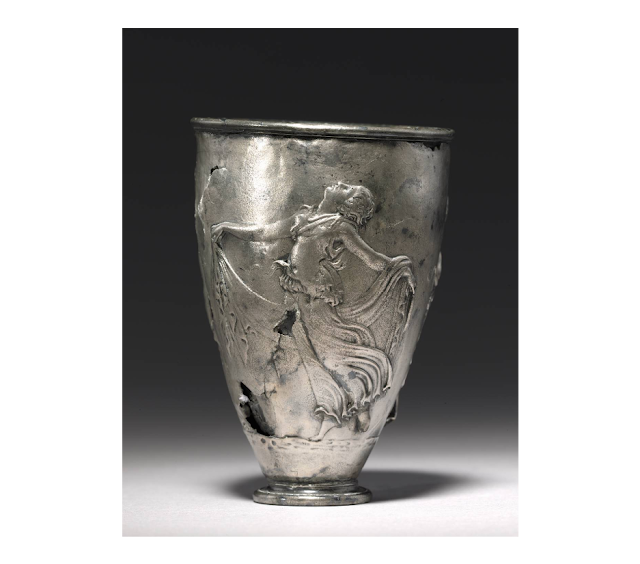
The Vicarello Goblet late 1st century BCE to early 1st century CE at the Cleveland Museum of Art. This masterpiece of the Roman silversmith’s art was found north of Rome at Vicarello, the ancient Aquae Apollinares (the Springs of Apollo). Exquisitely worked in relief is a multifigure scene centered on a rustic shrine of the god Priapus. He is in the form of a stylized boundary marker placed atop a column. A woman approaching fr om the right seems to have brought him to life by touching him. To the left are votive offerings to the god arranged on top of and around a table. A satyr at the far left and a maenad at the far right dance ecstatically. - Cleveland Art Museum Image: Three views of the Vicarello Goblet from ancient Aquae Apollinares (Vicarello, Italy) courtesy of the museum.

Ancient Near Eastern, Greek, and Roman Art at the Cleveland Museum of Art in Cleveland, Ohio

Image
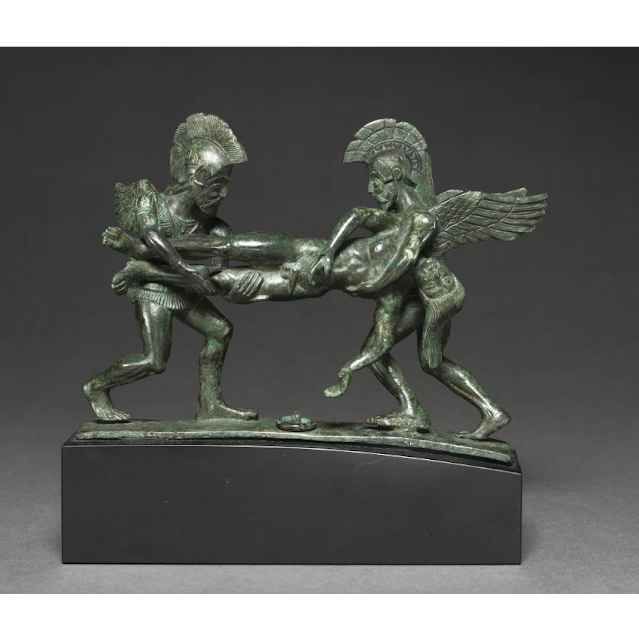
Ancient Near Eastern, Greek, and Roman Art at the Cleveland Museum of Art in Cleveland, Ohio. Spanning a period of roughly 3,800 years, the collections of Ancient Near Eastern, Greek, and Roman art at the Cleveland Museum of Art are held in very high esteem nationally and internationally. Although the collections are modest in overall numbers, they are typified by singular works of rare quality. Sasanian silver is a clear streng th in the Ancient Near Eastern collection, along with major masterpieces of large stone sculpture, and one of the very finest "stargazer" figures to have survived. In the Greek and Roman area, the collections feature exquisite small and large-scale bronzes, such as the world-famous Apollo Sauroktonos figure attributed to Praxiteles, several outstanding painted vases from the Archaic, Classical, and late Classical periods, and excellent smaller objects crafted of precious materials. Image: Sleep and Death Cista Handle 400-375 BCE Etruscan. I...